


Quick Answer
Texas barndominiums can go up almost anywhere a house is allowed, but the rules change at the city limit. Inside a city, its residential code and building permit apply; on unincorporated county land, the septic permit and the floodplain map usually matter more than a building permit. Local weather sets the engineering.
- Gulf Coast: in the 14 coastal counties and part of Harris County, a house needs a WPI-8 windstorm certificate from TDI to be eligible for TWIA wind and hail coverage.
- Hail: Texas logged 902 major hail events in 2025, more than any other state, so roof panels and covered parking belong in the plan.
- Soil: Blackland Prairie clay, from north of Dallas to San Antonio, shrinks and swells, so slab design starts with a soil report.
- Panhandle: ground snow load is a real design load there, taken by the engineer for your exact site.
- Kit or turnkey: a kit is the engineered steel package; erecting it and finishing the house are separate jobs.
Why Barndominiums are Popular in Texas
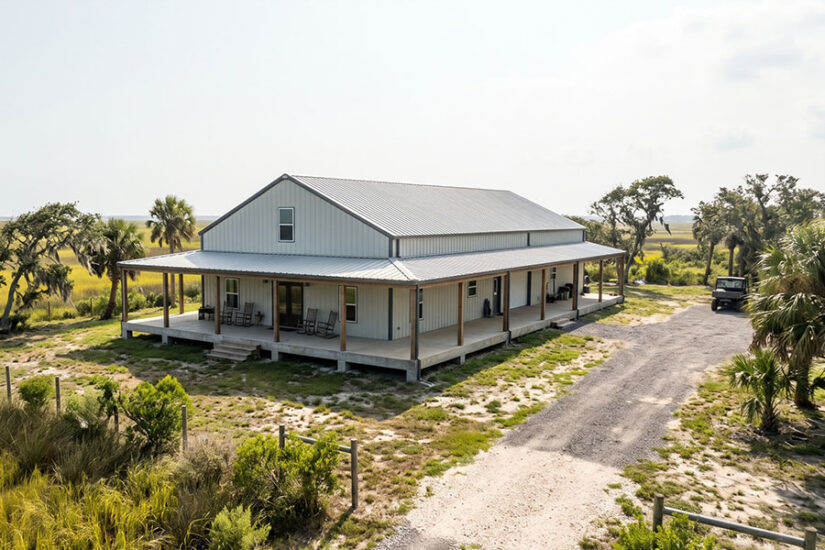
A barndominium is a steel-frame building with living quarters inside, often with a shop, garage or barn space under the same roof. The guide to what a barndominium is covers the basics; this one is about building it in Texas.
The idea fits the way a lot of Texas land gets used. A family buys acreage outside town and wants the house and the workshop in one place, close enough to walk between them in the rain. Someone keeping horses wants stalls a few steps from the kitchen door. On a working ranch, one wide building with a home at one end and equipment at the other is practical.
There’s plenty of that kind of land. Texas has more cattle and calves than any other state, according to USDA’s National Agricultural Statistics Service.
Where You Can Build a Barndominium in Texas
You can build a barndominium in Texas almost anywhere a single-family house is allowed. The question is who sets the rules for your parcel: a city, its extraterritorial jurisdiction, the county or the deed. Which code each Texas city enforces is covered under codes and permits in Texas.
Inside City Limits
Texas law makes the International Residential Code (IRC) the residential code in every municipality, with local amendments adopted by ordinance (Local Government Code §214.212), so a barndominium inside city limits is permitted and inspected like any other house. Zoning is the second filter: check that the district allows a single-family home and whether it limits exterior materials.
In a City’s Extraterritorial Jurisdiction (ETJ)
An extraterritorial jurisdiction (ETJ) is the unincorporated land next to a city’s boundary, defined in Local Government Code Chapter 42. A city can extend its subdivision and platting rules into it. Under §212.003, though, it can’t regulate the use of buildings there, or their size and number on a tract, unless another state law allows it.
Since September 1, 2023, Chapter 42, Subchapter D has let landowners petition a city for release from its ETJ. Exceptions apply, so ask the city’s planning office.
On Unincorporated County Land
On unincorporated land outside any city, Texas counties have limited say over what you build. As Dallas County’s planning department puts it, in Texas only cities, not counties, can adopt zoning ordinances. A county building permit for a house may not be part of the process either: Hays County, for example, requires county building permits for commercial, public and multifamily buildings, not for single-family homes.
The exception is Local Government Code Chapter 233, Subchapter F. In a county that has adopted it, a new house in the unincorporated area follows the International Residential Code, and the builder hires an inspector for at least three inspections: at the foundation, at framing and at completion. Dallas County, for one, has a residential building code for new homes outside city ETJs. Septic and floodplain rules apply either way, and platting rules (Chapter 232) come in if the land is divided.
Deed Restrictions and HOAs
Deed restrictions work whether or not anyone issues a permit. They can set a minimum house size, require a masonry front or ban metal buildings outright. Texas Property Code §202.003 tells courts to read restrictive covenants liberally to give effect to their purpose, so read the restrictions in the title commitment before you close on the land.
On Agricultural Land
On agricultural land, it depends on the use. The Texas Comptroller’s appraisal manual applies agricultural appraisal to land in agricultural use, not to buildings: a house is appraised separately at market value, and appraisal districts such as Tom Green CAD generally take some acreage out for the homesite. Ask your county appraisal district how a new house affects the rest of the tract before you build.
Living in a Barndominium: Permits, Septic and Utilities
Yes, a barndominium can be a full-time home in Texas when it’s built and permitted as a house, which means meeting the residential rules that apply to your parcel. Out in the county, utilities usually set the pace, and Texas barndominium homes on raw land need all of them planned before the slab.
Septic. Most rural lots need an on-site sewage facility (OSSF), the Texas term for a septic system. TCEQ writes the rules (30 TAC Chapter 285). Permits come from the local permitting authority, such as a county or a city, or from the TCEQ regional office where no local program is authorized. The process starts with a site evaluation by a TCEQ-licensed site evaluator or a professional engineer; the system design then goes to the permitting authority with the permit application. A single-family home on 10 acres or more can be exempt from the permit if it meets the other conditions, but it still needs the site evaluation and has to meet the rules.
Water. Groundwater conservation districts can regulate wells within their boundaries. The Texas Water Development Board notes that a private well doesn’t need to be registered unless the property lies inside a district, and each district sets its own rules, including permits for non-exempt wells. Check the district map before you plan a well.
Power. Texas electric cooperatives serve homes and businesses in rural and suburban areas, so a rural parcel may get power from a co-op rather than a city utility. Ask the provider how and when it can bring service to your building site before you buy the land.
Energy code. State law adopts the energy chapter of the IRC as the energy code for single-family construction (Health and Safety Code §388.003). Ask your city or county which edition it checks.
Built for Texas Weather
A Texas barndominium is engineered for the loads of its county, and those loads vary more across Texas than across most states. The building’s engineer takes the design wind speed (the wind the frame must resist at that site) and the ground snow load from ASCE 7, through the code your jurisdiction uses. The ASCE Hazard Tool shows those values for an address.
| Region | Main loads | What to plan |
| Gulf Coast | Hurricane wind, flooding, humidity | Windstorm inspections in the TDI area, a flood map check, vapor control |
| North Texas | Hail, tornadoes, expansive clay | Roof panel choice, covered parking, a soil report, a safe room |
| Central and East Texas | Heat, humidity, clay in places | Insulation and shade, vapor control, a soil report |
| West Texas and the Panhandle | Snow load, cold, distance | Snow load in the drawings, freeze-protected plumbing, truck access |
Heat, Cold Snaps and Insulation
Texas summers are long and hot, yet hard freezes still happen. NOAA’s National Centers for Environmental Information calls February 11 to 20, 2021, the Great Texas Freeze, with blackouts across the state. Steel conducts heat well, so insulation has to cover the frame, with thermal breaks between steel and panels, and supply lines belong in interior walls. The guide to insulating a metal building compares the options.
Hail
Texas had more major hail events in 2025 than any other state. Triple-I (the Insurance Information Institute), counting NOAA Storm Prediction Center reports of hail one inch or larger, puts the count at 902, against 375 in second-place Kansas. TDI explains that insurers can give credits for roofing a lab has tested and classed for impact resistance, from Class 1 to Class 4, and each insurer sets its own discount. Ask which rating, if any, the roof panels carry when you request a quote.
Coastal Wind and the Windstorm Certificate
On the coast, the windstorm certificate matters as much as the wind speed. In the 14 coastal counties and in the part of Harris County east of State Highway 146, the Texas Department of Insurance (TDI) runs a windstorm inspection program. A house there needs a Certificate of Compliance, form WPI-8, to be eligible for coverage from the Texas Windstorm Insurance Association (TWIA), which calls this territory its designated catastrophe area.
The inspections happen during construction, phase by phase, by a TDI inspector or a Texas-licensed engineer appointed by TDI. TDI asks you to apply before construction starts and issues the WPI-8 once all inspections are approved. Ask about windstorm certification when you request your quote. For how a steel frame handles hurricane wind, see whether a barndominium can withstand a hurricane.
Tornadoes
Texas records more tornadoes in an average year than any other state, about 130 a year over 1996-2025 on NOAA Storm Prediction Center maps. ASCE 7-22 added tornado loads for Risk Category III and IV buildings, such as hospitals, in tornado-prone areas, and FEMA notes they enter the 2024 International Building Code. For a home, protection comes from a safe room, inside the house or as its own small structure, built to FEMA P-320 and the ICC 500 standard it draws on. The article on how safe steel barndominiums are goes further.
Panhandle Snow and Wind
Snow is a real design load in the Panhandle. Ground snow load, the weight of snow on the ground that the roof design starts from, is set by the engineer for your exact site. The same 40×60 barndominium ordered for Potter County and for Galveston County ends up with different frames: one is sized around snow, the other around hurricane wind.
Humidity and Condensation
Along the Gulf Coast and in East Texas, humid air is the everyday problem. When warm, moist air meets steel colder than its dew point, water condenses under the roof and drips. Continuous insulation with a vapor retarder on the correct side, air sealing, ventilation and dehumidification keep it in check. Detail them for a hot, humid climate, not a northern one. See how to handle condensation in a metal building.
Insuring a Barndominium in Texas
Insuring a barndominium in Texas starts the way it does for any house built and permitted as a home: with a homeowners policy. On the coast, wind and hail coverage may come from TWIA instead.
TWIA is the wind and hail insurer of last resort for the designated catastrophe area. An applicant must have been turned down by at least one private insurer first. A building constructed or altered since January 1, 1988, needs a windstorm certificate to be eligible. TWIA policies cover wind and hail losses only.
Most homeowners policies don’t cover flood either, FEMA notes. Flood insurance through its National Flood Insurance Program (NFIP) is a separate policy, available to anyone in a participating community.
Have these ready for the insurer: the steel frame, the PE-stamped drawings, the flood zone from FEMA’s map and, on the coast, the windstorm certificate.
Land and Foundation on Texas Soil
On much of central and north-central Texas, the foundation starts with the soil report, because Blackland Prairie clays swell when wet and shrink when dry. The best known of them, Houston Black, is Texas’s unofficial state soil, chosen by the Professional Soil Scientists Association of Texas. It covers about 1.5 million acres of the Blackland Prairie, which runs from north of Dallas south to San Antonio. Its shrink-swell potential, the tendency of a clay to change volume with moisture, is very high, and it commonly limits building sites.
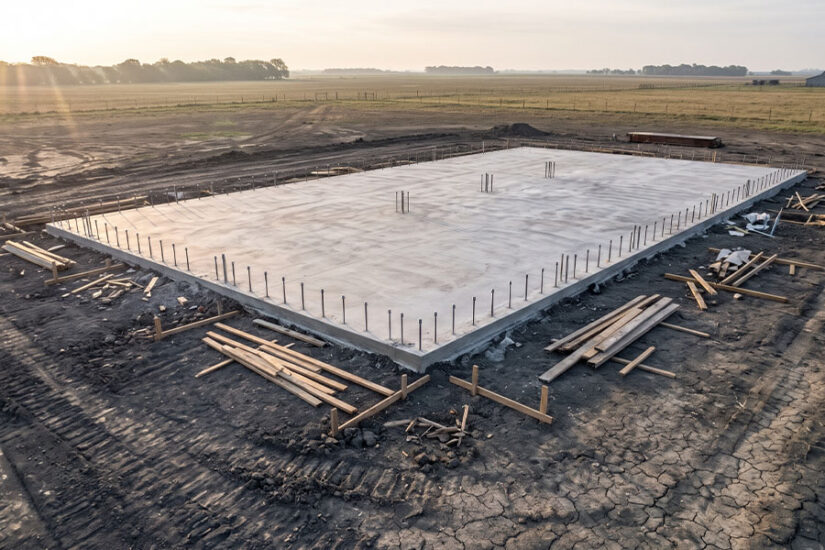
Start with the USDA NRCS Web Soil Survey: outline your parcel as an area of interest and check how suitable its soils are for building. Then order a geotechnical soil report. A local engineer designs the slab from that report, and a local contractor pours it to the anchor bolt layout in the kit drawings, the plan that shows where each bolt sits so the steel columns land on them.
Check the parcel on FEMA’s Flood Map Service Center before you buy. The flood zone affects where the house can sit and whether a floodplain permit applies. The guide to steel building foundations covers slab and footing options.
Kit, Shell or Turnkey: What You Get
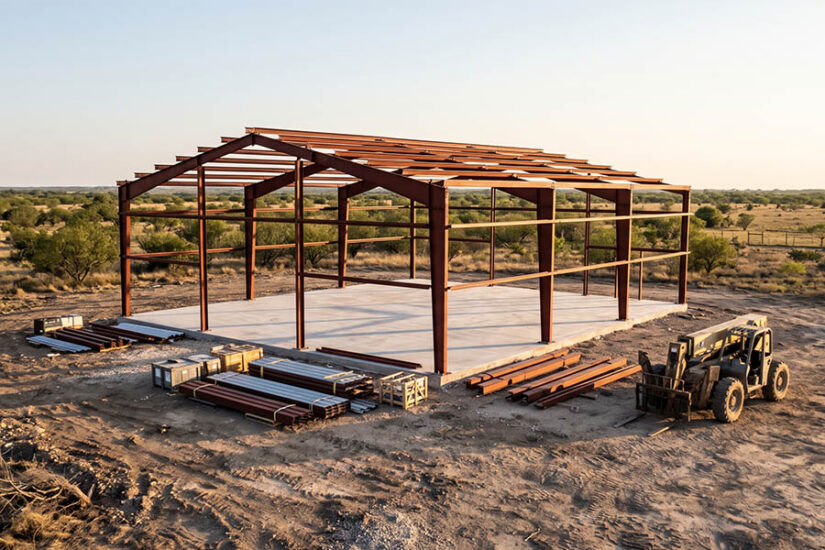
A barndominium kit is the engineered steel package: primary frames, secondary framing (purlins and girts), roof and wall panels, trim and PE-stamped drawings for your county. Erecting it and finishing the house are separate jobs. It matters when you compare barndominium kits in Texas, because sellers use the same words for different things.
“Shell kit” is the usual trap. Some sellers use it for the material package above. Others mean a dried-in shell: the frame erected, roof and walls on, doors and windows in, so the building is closed to weather but empty inside. Ask in writing what a shell includes and who puts it up. A turnkey build sits at the far end: one contract for a finished house you can move into.
| Kit | Erected shell (dried-in) | Turnkey | |
| What you get | Steel frames, panels, trim and drawings | Frame up, roof and walls on, doors and windows in | A finished house |
| Who puts it up | Your crew or an erector you hire | An erector under contract | A general contractor or builder |
| What’s left to you | Slab, erection, all interior work | Insulation, utilities, interior finish | Choosing finishes |
| Who it suits | An experienced owner-builder, or an owner with their own general contractor | Owners who will run the interior work themselves | Owners who want one party responsible for everything |
US Patriot Steel supplies the kit with drawings for your county and delivers it to your site. Your own crew or a local erector you hire puts it up (an erector is the crew that stands the frames and hangs the panels); if you want installation arranged, ask when you request a quote. Sizes and layouts are under steel barndominium kits. For steel against lumber framing, see steel vs wood frame barndominium.
“Prefab barndominium” causes the same confusion. Sellers use it for steel kits and for factory-built modular homes, which are different products with different rules, so ask which one is on offer.
Texas Barndominium Plans and Sizes
Texas barndominium plans tend to follow the land they sit on. The house and a shop or garage under one roof is the classic layout. A loft over part of the living space adds room without widening the footprint, and on a ranch an RV or equipment bay often takes one end.
Deep covered porches and wide overhangs earn their place in Texas sun, because they shade walls and windows. Orientation matters too: it decides how much afternoon heat the west wall takes, as the guide to barndominium energy efficiency explains.
Sizes are usually described by footprint, such as 30×40 or 40×60, with the living area taking part of it and the shop the rest. For room-by-room layouts, see barndominium floor plans. Roof shapes and styles are covered separately in types of barndominiums.
Barndominiums Across Texas, Region by Region
Gulf Coast
From Corpus Christi to Beaumont, the coast is windstorm country. Jefferson and Nueces counties sit inside the TDI windstorm area and Harris County partly does, so the WPI-8 inspections described above apply. Pick the house site with the flood map open. Around Houston, see metal buildings in Houston; farther east and south, the local pages are Beaumont steel buildings and steel buildings around Corpus Christi.
North Texas
Hail and tornadoes shape North Texas plans: budget for the roof panels and a safe room. Around Dallas, Blackland Prairie clay makes the soil report as important as the roof. On horse acreage west of Fort Worth, stalls or a tack room can take one end of the building. Local pages: metal buildings in Dallas, Fort Worth metal buildings and steel buildings in Weatherford.
Central and East Texas
A barndominium in East Texas often starts with a chainsaw: wooded lots need clearing for the pad and for a drive a delivery truck can use. In the Hill Country and around Austin and San Antonio, summer heat pushes the design toward deep porches and shaded walls. See metal buildings in Austin or, for the east, Longview steel buildings.
West Texas and the Panhandle
Distance is the first planning issue out west. On a remote ranch, make sure a truck can reach the pad: a steel building arrives on a flatbed, and a dirt ranch road that’s fine for a pickup can stop one after rain. For a well, check whether a groundwater conservation district covers the parcel. Local pages: metal buildings in Lubbock and Odessa steel buildings.
What Drives the Cost of a Texas Barndominium
Most of the Texas-specific cost drivers sit outside the steel:
- Land preparation: clearing and grading, plus a drive a truck can use
- Foundation: a slab designed from the soil report, which on expansive clay means more engineering
- Utilities: septic and a well, against a connection to city water and sewer
- Coastal requirements: windstorm design and inspections in the TDI area
- Loads: snow in the Panhandle and wind on the coast, both reflected in the frame
- Span and size: wider clear spans need heavier frames
- Finish level: the interior, from flooring and cabinets to fixtures
As a rough tier, the steel kit (frame, roof and wall panels) is the $ part of the project; a dried-in shell with insulation, doors and windows is $$; a finished home is $$$. For dollar figures, see what it costs to build a barndominium.
How a Texas Barndo Project Goes, Step by Step
Building a barndominium in Texas follows the same order as in any state; the Texas differences sit in the first steps.
- Check the land: city, ETJ or county rules, deed restrictions, the flood map, the soil and a septic site evaluation.
- Settle the layout and size, including the shop or barn space.
- Get drawings stamped by a professional engineer (PE) for your county’s loads, with windstorm requirements on the coast.
- Apply for the permits your parcel needs, such as a city building permit, a septic permit or a floodplain permit.
- Order the kit.
- Prepare the site and bring in the utilities.
- Pour the foundation; in the TDI area, after applying to TDI for windstorm inspections.
- Erect the frame, dry in the shell, then run the utilities and finish the interior.
The full sequence, with detail on each stage, is in how to build a barndominium.
What to do Next
Call (888) 415-1576 or request a quote. Bring your county, the size and layout you have in mind, whether the parcel is inside the TDI windstorm area, and how you plan to finish the house.
Frequently Asked Questions
Yes. A barndominium can be a full-time home in Texas when it’s built and permitted as a house under the rules for its parcel. Inside a city, that means the IRC and a city building permit. On county land, it usually means a permitted septic system and a water source, within whatever the deed restrictions allow.
It depends on the county. A county building permit for a house may not be required on unincorporated land, but the septic permit and floodplain rules still apply, and so do deed restrictions. Some counties, Dallas among them, apply residential building standards to new homes, and Local Government Code Chapter 233, Subchapter F sets those standards for counties that adopt it. Call the county before you order.
In the TDI windstorm area (the 14 coastal counties and part of Harris County east of SH 146), a barndominium needs a WPI-8 certificate to be eligible for TWIA wind and hail coverage. The inspections take place during construction, and TDI issues the certificate once all of them are approved. Outside that area, no windstorm certificate is required.
A steel roof doesn’t burn or rot, but large hail can dent panels, so the panel gauge and profile are chosen for your site. Some insurers give credits for roofing that is tested and classed for impact resistance; when you request a quote, ask whether the panels carry such a rating.
Yes, we deliver across Texas, from Beaumont to El Paso and Amarillo. On a remote ranch, make sure a truck can reach the pad. We confirm your production schedule and delivery window when your order is finalized. Your crew or a local erector assembles the building; if you want installation arranged, ask when you request your quote.
More in this Guide
- What is a barndominium? Definition, features, and types
- Texas metal buildings, built for Texas weather
- How to build a barndominium: steps from land to move-in
- How much does it cost to build a barndominium in 2026?
- Are barndominiums safe in severe weather?
- Metal barndominium kits
References
- Texas Legislature. Local Government Code, Chapter 214, §214.212 (International Residential Code in municipalities, local amendments). statutes.capitol.texas.gov
- Texas Legislature. Local Government Code, Chapter 42 (extraterritorial jurisdiction; Subchapter D, release by petition). statutes.capitol.texas.gov
- Texas Senate Research Center. Bill analysis of S.B. 2038, 88th Legislature (ETJ release by petition or election, effective September 1, 2023). capitol.texas.gov
- Texas Legislature. Local Government Code, Chapter 212, §212.003 (extension of subdivision rules to the ETJ and its limits). statutes.capitol.texas.gov
- Texas Legislature. Local Government Code, Chapter 232 (county regulation of subdivisions). statutes.capitol.texas.gov
- Texas Legislature. Local Government Code, Chapter 233, Subchapter F (residential building code standards in unincorporated areas of certain counties). statutes.capitol.texas.gov
- Dallas County Planning and Development. Zoning and other related regulations (only cities can adopt zoning; county residential building code outside city ETJs). dallascounty.org
- Hays County Fire Marshal’s Office. Plan review and permitting (county building permits for commercial, public and multifamily buildings). hayscountytx.gov
- Texas Legislature. Property Code, Chapter 202, §202.003 (construction of restrictive covenants). statutes.capitol.texas.gov
- Texas Comptroller of Public Accounts. Manual for the Appraisal of Agricultural Land (October 2024; agricultural appraisal applies to land, not improvements). comptroller.texas.gov
- Tom Green County Appraisal District. Agriculture FAQ (improvements appraised at market value; acreage taken out for a homesite). iswdataclient.azurewebsites.net
- Texas Commission on Environmental Quality (TCEQ). Getting a permit for an OSSF (local permitting authority or TCEQ regional office, site evaluation, 10-acre rule). tceq.texas.gov
- Texas Water Development Board. General groundwater and private water well FAQ (registration inside groundwater conservation districts). twdb.texas.gov
- Texas Legislature. Health and Safety Code, Chapter 388, §388.003 (energy code for single-family residential construction). statutes.capitol.texas.gov
- Texas Electric Cooperatives. Member directory (co-ops serving homes and businesses in rural and suburban Texas). texas-ec.org
- USDA National Agricultural Statistics Service. Texas Annual Cattle Review 2025 (Texas ranks highest in all cattle and calves). nass.usda.gov
- ASCE. ASCE Hazard Tool (design wind speed and ground snow load by location). ascehazardtool.org
- NOAA National Centers for Environmental Information. The Great Texas Freeze: February 11-20, 2021. ncei.noaa.gov
- Insurance Information Institute (Triple-I). Facts + Statistics: Hail (2025 major hail events by state, NOAA Storm Prediction Center data). iii.org
- Texas Department of Insurance. Roofing discounts (impact-resistance classes 1 to 4, insurer credits). tdi.texas.gov
- Texas Department of Insurance. Do you need a windstorm inspection? (14 coastal counties and Harris County east of SH 146). tdi.texas.gov
- Texas Department of Insurance. Windstorm inspection process: FAQ (apply before construction, an inspection for each phase, WPI-8 after all inspections are approved). tdi.texas.gov
- Texas Windstorm Insurance Association. Windstorm certification (certificate of compliance required for TWIA eligibility). twia.org
- Texas Windstorm Insurance Association. About us: overview (insurer of last resort, designated catastrophe area, wind and hail only, certificate for structures built or altered since January 1, 1988). twia.org
- NOAA National Weather Service, Storm Prediction Center. Annual averages: tornadoes by state, 1996-2025. spc.noaa.gov
- FEMA. Design Guide for New Tornado Load Requirements in ASCE 7-22 (Risk Category III and IV; 2024 International Building Code). fema.gov
- FEMA. P-320, Taking Shelter from the Storm: Building or Installing a Safe Room for Your Home (sixth edition, December 2024; in-home and separate safe rooms; based on ICC 500). fema.gov
- FEMA, National Flood Insurance Program. Most homeowners insurance does not cover flood damage (2025). agents.floodsmart.gov
- USDA Natural Resources Conservation Service, published by the Texas Water Development Board. Houston Black: Texas state soil (about 1.5 million acres of Blackland Prairie, north of Dallas to San Antonio; very high shrink-swell potential). twdb.texas.gov
- Soil Science Society of America, Soils 4 Teachers. Houston Black: Texas state soil (chosen by the Professional Soil Scientists Association of Texas; unofficial state soil). soils4teachers.org
- USDA Natural Resources Conservation Service. Web Soil Survey. websoilsurvey.nrcs.usda.gov
- FEMA. Flood Map Service Center. msc.fema.gov