
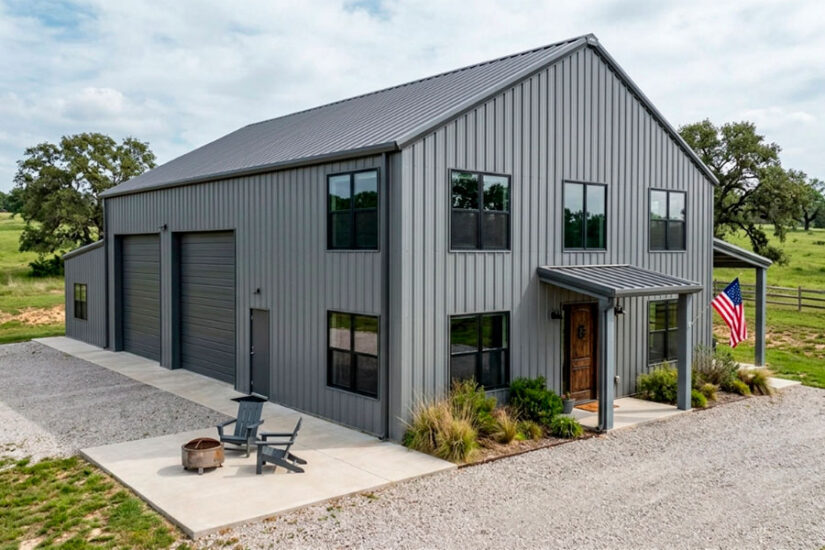
In 2024, 7% of single-family builders in the U.S. reported building at least one barndominium in the previous 12 months[1] – a number that would have been near zero a decade ago. A barndominium starts at roughly $65 per sq ft to build, versus $100+ for a conventional home. For a 2,000 sq ft structure, that gap is $70,000–$140,000. This guide covers what a barndominium actually is, who it works for, and what it costs to build one in 2026.
Definition: A barndominium is a steel-framed residential building that combines living space with a garage, workshop, or storage area under one roof. The steel frame creates clear-span interiors with no load-bearing walls – layouts a conventional home can’t match at the same price point.
- Barndominiums cost 20–40% less to build than traditional homes in most markets
- Build time is 3–6 months vs. 6–12 months for a custom stick-built home
- Best for rural buyers who need square footage, flexibility, and lower build costs
What a Barndominium Actually Is
The name comes from “barn” + “condominium” – but the connection to actual barns is mostly aesthetic. Modern barndominiums are purpose-built steel structures designed as homes, not converted agricultural buildings. The defining characteristic is the steel frame, which creates a column-free interior that can be configured any way the owner chooses.
That open structure is why barndominiums appeal to people who want to combine living space with a workshop, garage, studio, or storage area under one roof – without the cost and complexity of building two separate structures.
Most barndominiums sold today come as pre-engineered steel kits: the frame, panels, and roofing are manufactured off-site, delivered, and assembled on a concrete slab. Interior finishing – insulation, drywall, plumbing, electrical, flooring – is done on-site, same as any home.
Three Types of Barndominiums
1. Residential Barndominium
A full-time primary residence built entirely as living space. Open floor plan, bedrooms, kitchen, bathrooms – the full home program inside a steel shell. Popular with families who want more square footage for less money, particularly in rural and suburban areas where land is cheaper.
2. Shop/Garage + Living Quarters (Shopdominium)
The most common configuration. One portion of the building is finished living space; the other is an open-bay shop, garage, or storage area. The ratio varies – a 40×80 building might split 40×40 as living and 40×40 as shop. This layout works for mechanics, contractors, farmers, and anyone who needs a working space adjacent to where they live.
3. Agricultural/Commercial Hybrid
A working agricultural building with a smaller living quarters section – typically a bunkhouse or caretaker apartment inside a larger barn structure. Used on working farms and ranches where staff or owners need on-site housing without building a separate home.
Where Barndominiums Are Most Common
Texas, Oklahoma, Colorado, and the broader Midwest and South account for the highest concentration of barndominiums in the U.S.[2] The pattern follows land affordability: where rural acreage is accessible, the combination of a home and working space on one property makes strong financial sense.
Demand is expanding beyond those traditional markets. Florida Realtors reported in late 2025 that interest in metal buildings as primary residences was growing across markets that previously showed little activity.[3] The main driver isn’t rural lifestyle – it’s cost per square foot.
Barndominium vs. Traditional Home: Side-by-Side
| Category | Traditional Home | Steel Barndominium |
| Build cost (per sq ft) | $100–$200+ | $65–$160 |
| 2,000 sq ft total | $200,000–$400,000+ | $130,000–$320,000 |
| Construction time | 6–12 months | 3–6 months |
| Frame material | Wood, concrete, brick | Steel (galvanized) |
| Interior walls | Load-bearing; fixed layout | Clear-span; open plan |
| Termites / rot / mold | Vulnerable | Highly resistant |
| Fire resistance | Moderate | High |
| Maintenance (20 yrs) | High | Low |
| Energy efficiency | Good with upgrades | Excellent with insulation |
| Design flexibility | Limited post-build | High; expandable |
| Financing | Conventional mortgage | May require portfolio lender |
| Resale market | Broad buyer pool | Growing; rural/niche markets |
Reading the table: barndominiums win on cost, speed, and design flexibility. Traditional homes win on financing availability and resale consistency in mainstream markets. The financing gap is the most underestimated factor – see the financing section below before making a decision.
Cost note: barndominium build costs vary significantly by region, finish level, and site conditions. The $65–$160/sq ft range covers kit + basic finish. High-end finishes (stone counters, custom cabinetry, hardwood floors) push costs toward the top of the range or above it.
What a Barndominium Costs to Build in 2026
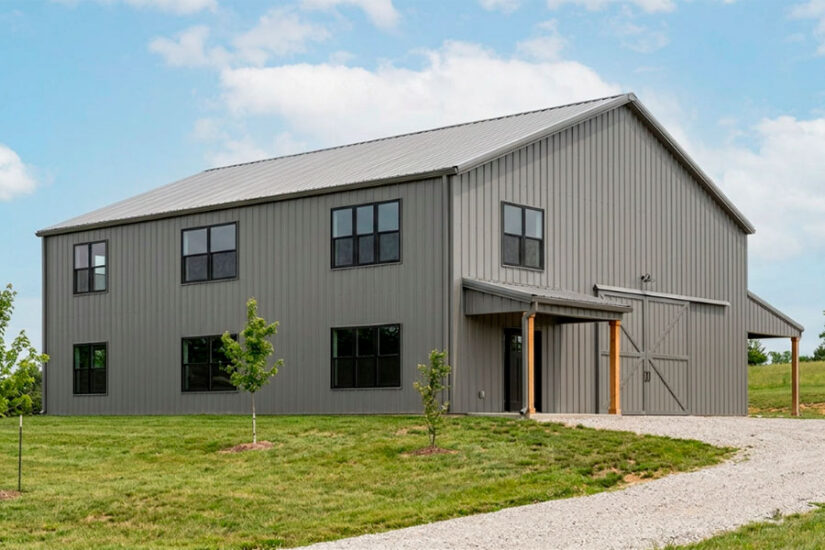
The typical range is $65–$160 per sq ft, all-in for kit, foundation, and finished interior.[4] For a 2,000 sq ft barndominium, that puts total cost at $130,000–$320,000. A conventional custom home of the same size typically runs $200,000–$400,000+.
Where the money goes:
- Steel kit (frame, panels, roofing): $20,000–$60,000 depending on size
- Concrete slab foundation: $8,000–$20,000
- Interior finish (insulation, drywall, plumbing, electrical): $40,000–$120,000+
- Site prep, permits, utilities connection: $10,000–$30,000
The steel kit itself is the smaller part of the total. Interior finish quality is what drives most of the cost variation – a basic barndominium with standard finishes costs dramatically less than one with custom cabinetry and high-end flooring.
Regional variation matters: building a barndominium in Texas costs less than the same structure in California or New York – labor, permit fees, and site prep costs differ significantly by state and county.
10–20 Year Cost Perspective
The upfront gap is real – but the long-term gap is larger. Wood-framed homes accumulate costs that steel avoids: termite treatment ($500–$2,000+ per treatment, often recurring), rot repair, painting and resealing exterior siding, and replacing damaged structural members. Steel requires none of these.
Construction speed also has a dollar value. A buyer renting while building saves 3–6 months of rent payments when a barndominium builds faster than a stick-built home – at $1,500–$3,000/month in rent, that’s $4,500–$18,000 in real savings before factoring in any material cost difference.
Total cost of ownership over 20 years typically favors a barndominium by $20,000–$50,000 versus a comparably-sized wood-framed home – driven mostly by maintenance avoidance, not just the build cost gap.
Why Steel – Specific Advantages Over Wood
The material difference between a barndominium and a conventional home isn’t just aesthetic. Steel changes the structural math in ways that affect cost, longevity, and what’s possible inside.
Clear-Span Interiors
Steel’s strength-to-weight ratio allows clear-span construction – interiors with no load-bearing walls. In a wood-framed home, walls carry structural load, which constrains layout. In a barndominium, the perimeter frame carries everything, leaving the interior fully configurable. Want to move a wall five years after building? In a barndominium, that’s a non-structural partition. In a wood-framed home, it may be load-bearing.
Durability and Maintenance
Galvanized steel doesn’t rot, warp, or feed termites. Properly coated panels carry 40+ year corrosion resistance ratings. Steel is also non-combustible, which gives barndominiums higher fire resistance than wood-framed construction – a meaningful factor for structures that include workshop or garage space. The main maintenance tasks over 20 years are repairing coating damage and checking fasteners – not replacing rotted sill plates or treating termite damage. Most barndominium builders report maintenance costs well below what they’d expect from a wood-framed home of the same size.
Construction Speed
A steel kit goes up in weeks. Interior finishing takes longer, but the overall timeline from slab to move-in is typically 3–6 months – versus 6–12 months for a custom stick-built home. For buyers who are renting while building, that timeline difference is real money.
Energy Efficiency When Insulated Properly
Steel has high thermal conductivity – uninsulated, it transfers heat and cold readily. Properly insulated with R-13 to R-30 systems, a barndominium performs comparably to or better than a wood-framed home. The key is planning insulation as part of the build, not as an afterthought. See: How to Insulate a Metal Building.
Who Barndominiums Work For
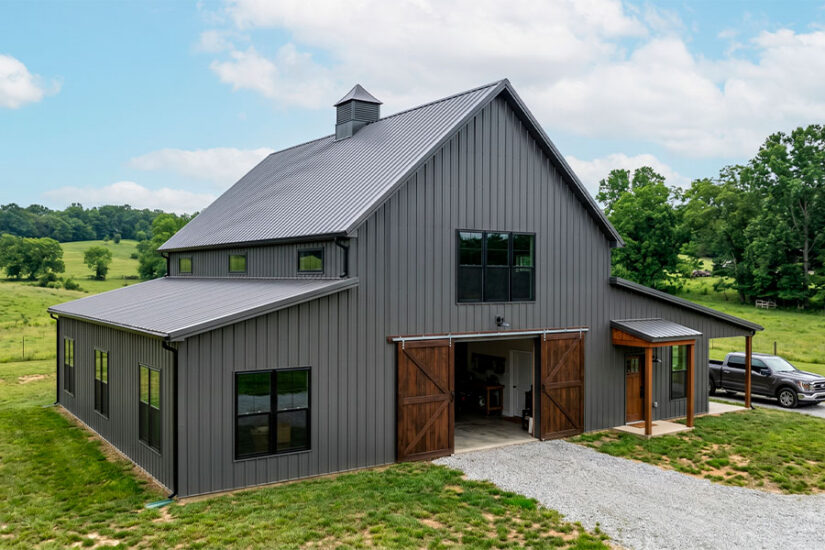
Strong fit:
- Rural and semi-rural buyers who need living space + working space on the same property
- Buyers prioritizing square footage and cost efficiency over conventional aesthetics
- People who want a workshop, garage, or studio integrated into their home
- Buyers in Texas, Oklahoma, the Midwest and South where barndominium resale markets are established
- Second homes, retreat properties, or caretaker housing on working land
Weaker fit:
- Urban or suburban neighborhoods with HOA rules prohibiting metal structures or non-residential aesthetics
- Buyers who need conventional mortgage financing – barndominiums sometimes require portfolio lenders or construction loans, which have stricter terms
- Markets where barndominium resale is thin – a barn-style steel home is harder to sell in a dense suburban neighborhood than in rural Texas
- Buyers who want traditional architectural details: brick facades, complex rooflines, ornate trim work that steel construction doesn’t naturally produce
Financing: The Part Most Guides Skip
This is where barndominium buyers often get surprised. Conventional mortgages (Fannie Mae, Freddie Mac) require the property to meet standard appraisal criteria – and barndominiums sometimes don’t. Specifically:
- If the structure includes significant non-residential space (a large shop bay), it may not qualify as a single-family residence for conventional lending
- Appraisers may lack comparable sales data in markets where few barndominiums exist
- Some lenders classify them as agricultural or commercial property, changing loan terms
Solutions used by barndominium buyers: USDA Rural Development loans (if the location qualifies), construction-to-permanent loans, portfolio lenders who hold loans in-house rather than selling to secondary markets, and cash purchases.
Before committing to a barndominium build: talk to at least two lenders familiar with rural or non-conventional residential construction in your specific county. Financing availability varies significantly by state and lender.
Permits, Zoning, and HOA Rules
Most jurisdictions treat barndominiums as residential structures and permit them under standard residential codes – but this isn’t universal. Rural counties tend to be more permissive; suburban and urban areas more restrictive. Key issues to check with your local authority:
- Zoning classification: residential, agricultural, or mixed-use
- Setback requirements for metal structures
- HOA rules – many explicitly prohibit metal exterior siding in residential subdivisions
- Fire codes for structures that include shop or garage space
- Engineering stamps: pre-engineered steel buildings come with engineering stamps for wind and snow loads, which speeds up permit approval in most counties
What the Build Process Looks Like
The sequence for a typical barndominium build:
- Site selection and soil testing – determines foundation type and cost
- Design and engineering – floor plan, bay widths, eave height, door/window placement
- Permit applications – submitted with engineering drawings
- Site prep and concrete slab – 2–4 weeks
- Steel kit delivery and erection – 1–3 weeks for the shell
- Rough-in trades: electrical, plumbing, HVAC – 4–8 weeks
- Insulation, drywall, interior finishes – 6–12 weeks depending on scope
- Final inspections and certificate of occupancy
Total timeline from permit application to move-in: typically 4–8 months for a straightforward build. Complex projects or sites with utility hookup delays run longer.
Three Things People Get Wrong About Barndominiums
“It’s basically a converted barn”
Modern barndominiums are designed as homes from the ground up – not retrofitted agricultural buildings. The steel frame is engineered specifically for residential loads, insulation, and interior finishing. The connection to traditional barns is stylistic, not structural.
“They’re always cheaper than a regular home”
The kit is cheaper. The foundation and shell go up faster. But interior finishing costs roughly the same per sq ft as any home build – and high-end finishes push the total toward conventional home prices. The cost advantage is real but not unlimited. A barndominium with luxury finishes costs about as much as a conventionally built home with standard finishes.
“Any builder can do this”
Erecting a steel frame requires experience with pre-engineered building systems – it’s not the same as stick framing. Most barndominium buyers use the manufacturer’s recommended erector or a contractor with specific metal building experience. A general residential contractor who’s never assembled a steel kit will encounter problems that slow the build and increase cost.
Frequently Asked Questions
$65–$160 per sq ft all-in, depending on location, finish level, and whether a shop bay is included. The steel kit itself runs $20–$40 per sq ft. Interior finishing accounts for the rest. High-end finishes push costs toward and above the top of the range.
Sometimes. Conventional loans (Fannie Mae/Freddie Mac) are available when the structure is classified as a standard single-family residence and comparable sales exist. Many barndominium buyers use USDA loans, construction-to-permanent loans, or portfolio lenders. Talk to lenders familiar with rural or non-conventional residential construction in your county before committing.
A properly built steel barndominium lasts 40–60+ years with minimal maintenance. The steel frame is rated for decades. The limiting factors are typically interior finishes and roofing, which follow normal maintenance cycles.
Yes, when properly insulated. Steel conducts heat readily without insulation – uninsulated metal buildings are uncomfortable year-round. With R-13 to R-30 insulation systems and proper vapor barriers, a barndominium performs comparably to a well-insulated wood-framed home.
In established barndominium markets (Texas, Oklahoma, rural Midwest), resale values are strong. In markets with few barndominium sales, appraisers have limited comparable data, which can compress appraised value. Resale is more predictable in rural and semi-rural markets than in dense suburban areas.
Texas has the largest established market. Oklahoma, Colorado, Tennessee, and states across the Midwest and South follow. These markets have permissive zoning, established contractor networks, and buyers familiar with the product – all of which make building and eventually selling easier.
More in This Guide
This pillar page covers the fundamentals. The articles below go deeper on specific topics:
- Barndominium Cost Breakdown: Real Numbers by State
- Barndominium vs. Traditional Home: Full Comparison
- Modular Home vs. Barndominium
- Are Barndominiums Safe in Extreme Weather?
- Can a Barndominium Withstand a Hurricane?
- Types of Barndominiums: Which Is Right for You?
- Floor Plans Explained
- What is a Black Barndominium?
- Steel Frame vs. Wood Frame Barndominium: Which is Best?
- Can a Barndominium Have a Crawl Space?
If you’re exploring barndominium options: US Patriot Steel offers fully configurable barndominium kits with engineering stamps included, manufactured from American steel. You can view size options, configurations, and pricing examples on the barndominium page.
→ View barndominium kit configurations and pricing
References
- NAHB / Eye on Housing. Seven Percent of Builders Now Build Barndominiums (2024). 7% of single-family builders reported building at least one barndominium in the prior 12 months
- BuildMax. The Most Popular States to Build a Barndominium. Regional concentration data: Texas, Oklahoma, Colorado, Midwest, South
- Florida Realtors. Americans Turning to Metal Buildings (2025). Growing interest in metal residential buildings beyond traditional barndominium markets
- HomeGuide. Barndominium Cost Guide 2025. $65–$160 per sq ft all-in; $130,000–$320,000 for 2,000 sq ft
- U.S. Department of Agriculture (USDA). Rural Development Single Family Housing Guaranteed Loan Program. USDA loan eligibility for rural residential construction including non-conventional structures