
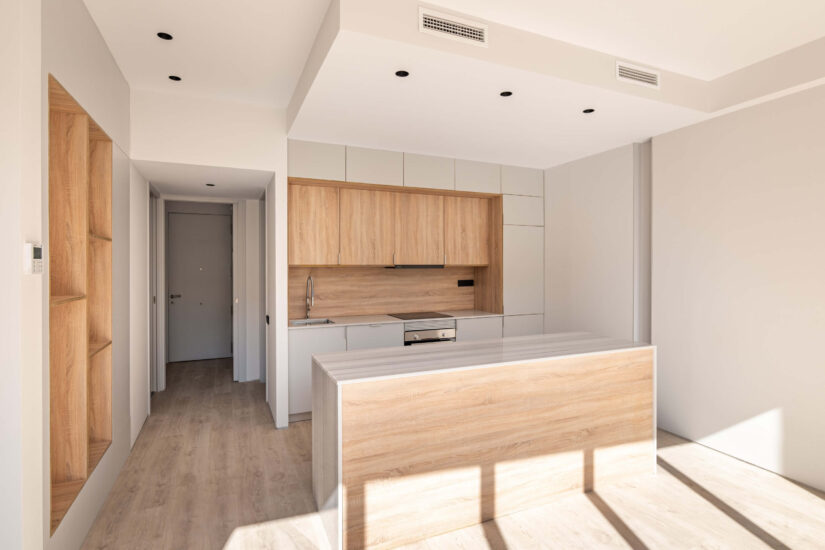

A 1,500 sq ft modular home costs $150,000–$300,000 and assembles in 2–4 months. A barndominium of the same size runs $105,000–$225,000 and takes 3–6 months. The modular home is faster and easier to finance. The barndominium is cheaper and gives you a configurable open interior that a modular home’s preset module layout can’t match.
Bottom line: choose a modular home if financing predictability and construction speed are the priority. Choose a barndominium if you need lower cost, a shop or utility space, and design flexibility –and you’re building in a market where barndominium resale is established.
Key difference: a modular home is factory-built in finished sections and assembled on-site. A barndominium is a pre-engineered steel shell erected on-site with the interior finished to spec afterward. Both are faster than stick-built – but for different reasons and with different trade-offs.
- Choose modular if financing access, construction speed, and conventional resale matter most
- Choose a barndominium if lower cost, layout freedom, and integrated shop or utility space matter more
The Core Structural Difference
A modular home is built in factory sections and assembled on-site. A barndominium is built on-site from a pre-engineered steel frame. Both are faster than conventional stick-built construction – but for different reasons and with different trade-offs.
Modular Home
Sections (modules) are built to completion in a climate-controlled factory – walls, wiring, plumbing, insulation – then transported and bolted together on a permanent foundation. Modular homes must comply with the same state and local building codes as site-built homes, which is what distinguishes them from manufactured homes (which follow federal HUD standards and can depreciate like vehicles). Once assembled, a modular home is legally and structurally equivalent to a conventional site-built home.
The constraint: modules come in standard dimensions. You’re choosing from layouts that fit how modules stack and connect, not designing from a blank slate. Reconfiguring after assembly is more difficult than in a barndominium – some interior walls carry structural load and can’t be moved without engineering work.
Steel Barndominium
A steel barndominium starts as a pre-engineered steel frame delivered to site and erected on a concrete slab. For the full picture of what a barndominium actually is, start here. The shell goes up in weeks. Interior finishing – insulation, drywall, plumbing, electrical – happens on-site. Because the steel frame carries all structural load at the perimeter, the interior has no load-bearing walls. You decide the layout after the frame is up.
According to NAHB’s 2024 survey, 70% of barndominium builds in the U.S. combine residential space with a large shop or garage area[1] – a use case modular homes don’t serve.
Market Size and Adoption
Modular construction is a larger, more mature market. The U.S. modular construction market was valued at $12.94 billion in 2025, projected to reach $24.86 billion by 2033 at an 8.6% CAGR.[2] Modular homes are built by established regional manufacturers and financed through standard residential lending – the infrastructure exists and works.
Barndominiums are a faster-growing but smaller niche. In 2024, 7% of U.S. single-family builders reported building at least one barndominium in the prior year[1] – a number that would have been near zero a decade ago. Demand is concentrated in Texas, Oklahoma, Colorado, and the Midwest, where rural land is accessible and the buyer pool for barn-style structures is established.
In practice: modular homes benefit from a more established financing and contractor ecosystem. Barndominiums benefit from growing demand in lower-density markets where land is affordable and integrated shop space has real value.
Side-by-Side Comparison
| Category | Modular Home | Steel Barndominium |
| Build cost (per sq ft) | $80–$175 | $65–$160 |
| 1,500 sq ft all-in | $150,000–$300,000 | $105,000–$225,000 |
| Construction method | Factory modules → site assembly | On-site steel frame erection |
| Construction timeline | 2–4 months | 3–6 months |
| Building code | HUD + local residential | Residential, ag, or commercial |
| Interior walls | Some structural constraints; harder to reconfigure | Clear-span; fully configurable |
| Design flexibility | Moderate (preset modules) | High (custom from ground up) |
| Shop / utility space | Not typical | Core use case (70% of builds) |
| Conventional financing | Generally available | Sometimes requires portfolio lender |
| Resale market | Broad; standard appraisal | Strong in rural TX/OK/Midwest |
| Maintenance (20 yrs) | Moderate | Low (steel vs wood) |
| Expandability | Difficult post-assembly | Lean-tos, bays added easily |
| Environmental impact | Lower on-site waste (factory build) | Recyclable steel; low long-term maintenance waste |
Reading the table: modular wins on speed and financing. Barndominium wins on cost, flexibility, and utility space. If integrated shop or utility space under one roof is essential, a barndominium is usually the stronger fit – modular homes aren’t designed for that use case.
1. Cost: What You Actually Pay

Modular Home
Factory-built modules run $80–$175 per sq ft.[3] For a 1,500 sq ft home, that puts total cost at $150,000–$300,000, including foundation, transport, and site assembly. The cost floor is higher than a barndominium – factory construction, transport logistics, and crane assembly add fixed costs that a site-built steel frame doesn’t carry.
Where modular saves money: less weather delay, fewer change orders, and predictable material pricing. The factory controls quality and schedule in ways that on-site construction can’t.
Steel Barndominium
Steel barndominiums run $65–$160 per sq ft all-in. For 1,500 sq ft, that’s $105,000–$225,000. The kit itself – frame, panels, roofing – is $20–$50 per sq ft. Interior finishing accounts for the rest, and this is where cost variation is largest: standard finishes stay well under $150/sq ft; luxury finishes push toward it.
- Steel kit: $20–$50/sq ft
- Foundation (concrete slab): $8,000–$20,000
- Interior finish: $40,000–$120,000+ depending on scope
- Site prep, permits, utilities: $10,000–$30,000
The barndominium cost advantage is real but not unlimited. A barndominium with high-end finishes costs about the same as a modular home with standard finishes. The gap is largest at the entry level: basic barndominium vs. basic modular home. The barndominium cost advantage is real but not unlimited. A barndominium with high-end finishes costs about the same as a modular home with standard finishes. The gap is largest at the entry level: basic barndominium vs. basic modular home. For a full breakdown by size and finish level, see our guide to the full cost of building a barndominium.
2. Construction Timeline
Modular homes are faster on-site: once the foundation is ready, modules are craned into place and connected in days. Total project timeline from order to move-in runs 2–4 months, with the factory build happening in parallel with site prep.
Barndominiums take longer to finish: the steel shell erects in 1–3 weeks, but interior trades – framing non-structural partitions, rough-in electrical and plumbing, insulation, drywall, finish work – add 2–5 months. Total: 3–6 months for a straightforward build, longer for complex sites or high-end finishes.
For buyers renting while building, timeline has a direct dollar value. At $1,500–$2,500/month in rent, a 2-month difference is $3,000–$5,000 in real cost. Modular’s speed advantage is worth factoring into total cost comparisons. See also: how long does it take to put up a steel building.
3. Design and Layout Flexibility
Modular homes offer meaningful but constrained customization. You’re choosing from floor plans that work within module dimensions and connection points. Moving a bathroom or adding a room after the factory build is complete is expensive. What you order is largely what you get.
Barndominiums start with a clear-span steel frame – no interior load-bearing walls. The interior is a blank rectangular space. Partition walls, loft floors, mezzanines, shop bays, and room layouts are designed independently of the structure. Changing your mind about a wall location after the shell is up costs much less than in a modular home, because nothing structural is involved.
Future expansion is also different. Adding a bay or lean-to to a barndominium is a straightforward structural addition. Expanding a modular home requires adding a module – with the associated factory, transport, and crane costs.
4. Financing: The Deciding Factor for Many Buyers
Modular homes finance like conventional homes. They meet HUD standards and local residential codes, appraisers have comparable sales data, and standard 30-year mortgages are available through most lenders. This is the modular home’s clearest practical advantage over a barndominium.
Barndominiums are more variable. When the structure is classified as a standard single-family residence and comparable sales exist in the area, conventional financing works. When it includes significant non-residential space (a large shop bay), or when comparable sales are scarce, lenders may classify it differently – agricultural, commercial, or non-conforming. In those cases:
- USDA Rural Development loans – available if the location qualifies
- Construction-to-permanent loans – one closing, covers build and mortgage
- Portfolio lenders – hold loans in-house, more flexibility on property type
- Cash purchase – common in rural markets where lender options are thin
Before committing to either structure: check with at least two lenders familiar with your specific county and property type. In established barndominium markets (rural Texas, Oklahoma), financing is much more accessible than in suburban areas with few comparable sales.
5. Resale Value and Long-Term Ownership
Modular homes appraise and sell like conventional homes. The buyer pool is broad – most buyers looking at homes in a given area will consider a modular home without hesitation. Resale is straightforward in most markets.
Barndominium resale is strong in established markets and thinner outside them. In rural Texas, Oklahoma, and parts of the Midwest, there’s an active buyer pool for barn-style properties. In suburban areas, the pool is narrower – the aesthetic and function don’t fit what most buyers expect from residential real estate.
Long-term maintenance favors barndominiums. Steel doesn’t rot, warp, or attract termites. Over 20 years, a barndominium owner avoids recurring costs – termite treatment, rot repair, siding repainting – that a modular home owner (wood-framed, same as a conventional home) will encounter. The modular home’s lower initial maintenance burden erodes over the ownership period.
Long-Term Cost Perspective
Modular homes may cost more upfront but are easier to finance and have a broader resale market. Barndominiums typically cost less to build and maintain, especially in rural markets – but financing requires more homework and resale depends heavily on location.
- If lender access and resale liquidity are the priority: modular home has the edge
- If lower total ownership cost over 10–20 years is the priority: barndominium typically wins on maintenance savings alone
- The decision often comes down to where you’re building – rural land with shop use needs is a barndominium scenario; suburban infill is a modular scenario
Which One Is Right for Your Situation
Choose a modular home when:
- Conventional mortgage financing is required or strongly preferred
- Construction speed is the top priority – 2–4 months vs. 3–6 months
- You want a traditional residential aesthetic that fits a suburban neighborhood
- You’re in a market where barndominium comparable sales are scarce
- The floor plan you want fits within standard module configurations
- Resale to a broad buyer pool matters – modular homes appeal to anyone looking for a conventional home
Choose a barndominium when:
- You need a shop, garage, or utility space integrated with living quarters – 70% of U.S. barndominium builds include this
- Lower per-sq-ft cost is the priority and you’re comfortable with a similar build timeline
- You’re building on rural or semi-rural land where barn-style structures fit the property and neighborhood context
- You’re in Texas, Oklahoma, the Midwest, or another established barndominium market with active resale
- You want a fully configurable interior with no structural wall constraints
- You plan to expand – adding lean-tos or extra bays later is simpler on a steel frame than on a modular structure
Three Things People Get Wrong
“A barndominium is just a barn with some rooms added”
Modern barndominiums are purpose-designed residential structures. The steel frame is engineered for residential loads, insulation, and interior finishing. How well one holds temperature comes down to how to insulate a metal building and the R-values you choose. The barn aesthetic is a style choice, not a structural reality – many barndominiums have no barn-like features at all externally.
“Modular homes depreciate like manufactured homes”
Manufactured homes (mobile homes, HUD-code homes) are a different product. Modular homes are built to the same local residential codes as stick-built homes, sit on permanent foundations, and are appraised and sold the same way. The depreciation stigma belongs to the manufactured home category, not modular.
“Barndominiums always cost less than modular homes“
At the entry level, yes – a basic barndominium costs less per sq ft than a basic modular home. At the high end, the gap closes. A barndominium with spray foam insulation, high-end cabinetry, and custom finishes costs about the same as a modular home with standard finishes. The variable is interior finish level, not the structure itself.
Frequently Asked Questions
Generally yes – $65–$160/sq ft for a barndominium vs. $80–$175/sq ft for a modular home. For a 1,500 sq ft structure, that’s roughly $45,000–$75,000 less at comparable finish levels. The gap is largest at basic finish levels and narrows with upgrades.
Sometimes. In markets with comparable sales and when the structure qualifies as a single-family residence, conventional lending works. When a large shop bay makes classification ambiguous, or when comparable sales are scarce, buyers use USDA loans, construction-to-permanent loans, or portfolio lenders. Modular homes have broader conventional financing access.
Modular homes are faster: 2–4 months from order to move-in. Barndominiums run 4–7 months. The modular advantage is the parallel factory build – modules are being manufactured while site prep happens simultaneously. Barndominium interior finishing is sequential and takes longer.
In established markets – rural Texas, Oklahoma, Midwest – yes. Resale is active and comparable sales exist for appraisals. In suburban or urban areas, the buyer pool is narrower and resale is less predictable. Modular homes have broader resale markets because they look and function like conventional homes.
Yes, as a separate structure – but not integrated under the same roof in the way a barndominium does. A modular home with a detached garage is two structures. A barndominium is one structure with living and utility space under one roof, which is the key functional difference.
Both can be highly energy efficient with proper insulation. Modular homes meet HUD energy code minimums by default. Barndominiums require deliberate insulation planning – steel conducts heat readily without it. With R-13 to R-30 systems and proper vapor barriers, a barndominium performs comparably to a well-specified modular home.
If you’re comparing steel residential options: US Patriot Steel offers pre-engineered steel barndominium kits with engineering stamps included, manufactured from American steel. Reviewing example configurations and pricing ranges can help clarify whether a barndominium fits your budget and property.
→ View barndominium configurations and pricing examples
References
- NAHB / Eye on Housing. Seven Percent of Builders Now Build Barndominiums (2024). 7% of single-family builders; 70% of builds include residential + large shop area
- Grand View Research. U.S. Modular Construction Market Size & Outlook, 2025–2033. $12.94B in 2025, projected $24.86B by 2033, CAGR 8.6%
- QTO Estimating. Modular Home Construction Costs (2026 Guide). $80–$175 per sq ft for modular homes in the U.S.
- Angi. Barndominium vs. Modular Home Cost Comparison. Modular: $180,000–$360,000; barndominium: $112,800–$504,000 depending on size and finish
- U.S. Department of Housing and Urban Development (HUD). Manufactured Home Construction and Safety Standards. Federal standards distinguishing manufactured, modular, and site-built homes