
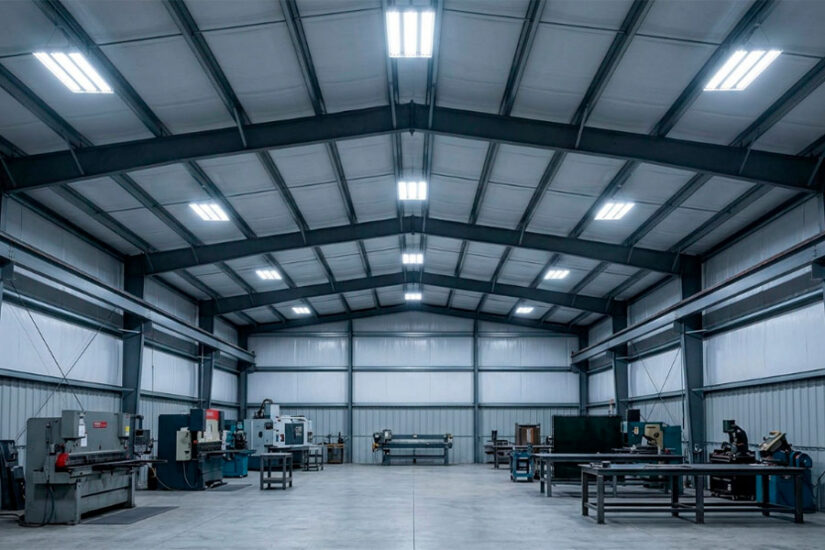

Metal workshop lighting is undeniably important for many reasons. It impacts how safely you can operate tools, how accurately you can measure and cut, and how comfortable the space feels during long hours of work.
Poor lighting, on the other hand, creates shadows, eye strain, and a higher risk of mistakes that can come at a high cost.
On top of this, metal buildings tend to come with some unique lighting considerations. For instance, light can reflect off interior surfaces. In open spaces, the lighting must also cover a large area without creating major shadows or dim spots. Ceiling height, fixture spacing, wall reflectivity, dust, moisture, and future electrical access all affect how well the lighting system performs.
So, what is the best lighting for a workshop? The truth is that multiple lighting types may be necessary. For most metal workshops, the best setup combines LED overhead lighting for full-room coverage, focused task lighting over benches and machines, and natural daylight from windows, skylights, or translucent panels where possible. In this article, we take a closer look at lighting for metal garages, garage workshop lighting ideas, and what you should consider.
Why Lighting Matters in a Metal Workshop
With lighting, you rarely notice when it’s done well, but constantly notice when it isn’t. In a metal workshop, the stakes are higher than in most spaces because the work involves sharp tools, moving parts, and precision that depends on what you can clearly see.
Beyond safety and accuracy, lighting shapes how the space feels to work in. A well-lit workshop is easier on the eyes during long sessions and reduces fatigue from constantly readjusting between bright and dim areas. In other words, even distribution of the light should be considered to ensure the entire space is usable.
Good workshop lighting should do three things: provide enough brightness, reduce shadows, and place extra light where detailed or higher-risk work happens.
Lighting Challenges in Metal Buildings
Metal workshops are different from standard metal garages or interior rooms. Their structure creates a few lighting challenges that should be planned for early:
- Reflective metal panels can increase glare if lights are aimed poorly.
- High ceilings may require stronger fixtures, such as high-bay LEDs.
- Open-span interiors need even fixture spacing to avoid dark zones.
- Dust, humidity, and condensation can affect fixture performance over time.
- Wiring is easier to plan before insulation, liner panels, or interior finishes are installed.
This is why lighting should not be treated as an afterthought. The best results come when the lighting layout is considered during the building design phase.
General Lighting vs. Task Lighting
Most well-designed workshops rely on two layers of lighting working together. General lighting, sometimes called ambient lighting, is the broad overhead illumination that fills the whole space. It’s what lets you walk through the shop, find tools, and see the room as a whole without bright spots or dark corners. In a metal workshop, this usually comes from ceiling-mounted fixtures spaced to cover the full floor area.
Task or focused lighting, on the other hand, is aimed at specific work zones, such as a welding bench, a drill press, or a workbench used for detailed assembly, where extra brightness and precision are important for safety and accuracy.
Overall, task lighting fills in the shadows that overhead fixtures can’t reach, especially when you’re leaning over a project and blocking the ceiling light with your own body. Most workshops benefit from having both.
Recommended Brightness for a Workshop
Brightness is one of the biggest factors in workshop lighting design. A common way to measure light on a work surface is in foot-candles. The more detailed or safety-sensitive the work, the more light the space usually needs.
| Area | Recommended Brightness |
| General workshop lighting | 50–75 foot-candles |
| Detailed bench work | 75–100+ foot-candles |
| Welding or fabrication zones | 50–100 foot-candles |
| Storage areas | 20–50 foot-candles |
Another practical way to estimate lighting is by lumens. For general workshop use, many owners plan around 50–70 lumens per square foot. More detailed work may require 80–100+ lumens per square foot.
Example: A 30×40 metal workshop is 1,200 sq ft. At 70 lumens per sq ft, the space needs about 84,000 total lumens, divided across multiple fixtures instead of concentrated in one or two bright spots.
LED Lighting for Metal Workshops
LED lighting for metal buildings has become the default choice. It runs efficiently, produces bright, consistent illumination, and holds up well in the demanding environment a workshop creates.
For metal buildings in particular, where ceilings are often high and floor space is open, LEDs are well-suited to throwing strong, even light across large areas.
LEDs also use noticeably less power than older fluorescent or incandescent options, which adds up over the long hours a workshop is typically in use. They also tend to last much longer than traditional bulbs, which means fewer replacements and less time spent on a ladder swapping out fixtures.
LEDs are also available in different fixture types, including high-bay lights, low-bay fixtures, linear shop lights, strip lights, wall packs, and focused task lights. The right choice depends on ceiling height, building size, and how the workshop will be used.
High Bay vs. Low Bay Lighting
Ceiling height plays a big role in how well-lit your space is. Two main options include high bay and low bay lighting.
High-bay lighting is often used in spaces with tall ceilings, typically those 20 feet and above. These fixtures are built to project light downward over a long distance without losing intensity, which is exactly what large metal workshops with open framing tend to need.
Low-bay lighting is a better fit for shorter ceilings, typically under about 20 feet. The fixtures distribute light more broadly at a shorter distance, so the space doesn’t end up with hot spots directly under each light and dim patches between them.
At the end of the day, matching the fixture type to your ceiling height is one of the easiest ways to avoid a workshop that’s either too harsh or too dim. It also affects how many fixtures you’ll need overall.
Best Color Temperature for Workshop Lighting
Brightness is only one part of the lighting plan. Color temperature also matters because it affects visibility, eye comfort, and how natural the space feels.
- 4000K: Neutral white, good for general workshop use
- 5000K: Daylight white, often better for detailed work, measuring, cutting, automotive work, and assembly
- 6500K: Very cool white, bright but can feel harsh during long work sessions
For most metal workshops, 4000K–5000K is the best range. It provides clean visibility without making the space feel overly blue or clinical.
CRI: Why Color Accuracy Matters
CRI, or Color Rendering Index, measures how accurately colors appear under a light source. This matters in workshops where color, finish quality, wiring, paint, or detail work is important.
For general workshop use, choose fixtures with a CRI of at least 80. For painting, detailing, automotive work, electrical wiring, finishing, or any color-sensitive work, CRI 90+ is a better choice.
Best Fixture Types for Metal Workshops
Different workshop zones may need different fixture types. The most common options include:
| Fixture Type | Best Use |
| LED high bay lights | Large metal workshops with tall ceilings |
| LED low bay lights | Garages and workshops with lower ceilings |
| Linear LED shop lights | Small to mid-size work areas and garage workshops |
| LED strip lights | Storage areas, tool walls, and supplemental lighting |
| Task lights | Workbenches, machines, detail stations, and inspection areas |
| Wall packs | Exterior doors, loading areas, and perimeter lighting |
| Motion sensor lights | Storage zones, entry points, and occasional-use areas |
A strong lighting plan usually combines several of these rather than relying on one fixture type for the entire building.
Natural Lighting Options
At the same time, don’t forget about natural lighting options. This is an easy factor to overlook, but one that could save on costs and installation. Features such as windows, skylights, and translucent panels can add daylight, a much less harsh alternative for the eyes.
Even a couple of well-placed windows or a single skylight can noticeably reduce how often the overhead lights need to be on during the day.
Yet, there are some limitations. For example, during certain times of the year, some areas may get much less sunshine, limiting the hours of natural light. Additionally, weather conditions, such as rain or snow, can make for a more dimly lit working environment, which may not be ideal.
Natural light should support the lighting plan, not replace it. Workshops still need reliable artificial lighting for early mornings, evenings, cloudy days, and precision work.
Reducing Glare and Shadows
Another overlooked issue that may arise after the initial build is glare or shadows. Ideally, you want to avoid these issues from the start. This may include:
- Ensuring optimal placement of your lights to minimize shadows
- Avoiding direct glare on work surfaces
- Considering even light distribution across your space
- Using diffused or shielded fixtures where glare is a concern
- Adding side or task lighting in areas where your body blocks overhead light
Aiming your light fixtures carefully, using diffused or shielded lights where needed, and avoiding fixtures placed directly in your line of sight all help keep glare under control. On top of this, spreading your light fixtures across the ceiling and adding task lighting in your main work zones helps fill these gaps, keeping the work surface evenly lit from multiple angles.
Planning Lighting Layout for a Workshop
A good lighting layout starts with how the space will actually be used. This means that mapping out work zones, benches, and movement paths first makes it easier to position general lighting for full coverage and add task lighting where close work happens.
It also helps to plan lighting before the building is finished, since running wiring and mounting fixtures is far easier during construction than retrofitting later. Leaving some flexibility for future additions may also be important; many workshops evolve over time, and a good layout should be able to grow with them.
Before choosing fixtures, consider:
- Ceiling height
- Workshop dimensions
- Door and window placement
- Location of workbenches and machines
- Storage areas and tool walls
- Future electrical needs
- Whether the building will be insulated or finished inside
Permanent wiring, fixture installation, outlets, and electrical panels should follow local electrical codes and should be handled by a licensed electrician when required.
Choosing Lighting by Workshop Type
The best lighting setup depends on how the workshop will be used.
| Workshop Type | Recommended Lighting |
| Small garage workshop | Linear LED shop lights plus task lighting over benches |
| Large metal workshop | LED high bays with supplemental wall or task lighting |
| Welding or fabrication shop | High-output overhead LEDs plus focused task lights |
| Automotive workshop | 5000K LEDs, high CRI fixtures, and side lighting for detail work |
| Storage-focused workshop | Efficient overhead LEDs with motion sensors |
| Multi-use workshop | Layered lighting: ambient, task, and exterior/security lighting |
Energy Efficiency and Long-Term Use
Overall, efficient fixtures, especially modern LEDs, use less power while still giving you the brightness you need, so energy costs stay reasonable even when the lights are on for long stretches of time.
It also helps to find the right balance between brightness and efficiency. Lights that are brighter than necessary waste energy and can cause glare, but lights that are too dim lead to eye strain and slower work. Matching the fixtures to the size and use of your workshop is usually the best way to keep both performance and running costs in check over the long run.
Working with a company such as US Patriot Steel that knows the ins and outs of metal building design can ensure you make the right choices. If you are planning a new metal workshop, US Patriot Steel can help design the building shell with the right ceiling height, wall openings, insulation layout, and electrical planning space for an efficient lighting system.
Frequently Asked Questions
LEDs are the most efficient. But ideally, you’ll want a mix of overhead and task lighting to ensure your workshop is well-lit. For most metal workshops, LED overhead fixtures combined with focused task lights provide the best balance of brightness, efficiency, and safety.
The required brightness depends on a few factors, such as the size of the space and how it’s being used. For example, more precision-driven tasks and activities with higher safety risks may require better lighting. As a general guideline, many workshops need around 50–75 foot-candles for general work and 75–100+ foot-candles for detailed bench work.
Yes, LED lights work great in large open spaces. They provide even, bright lighting without excessive power consumption. For large garages or workshops with tall ceilings, LED high-bay fixtures are often the best fit.
Yes, taller ceilings usually call for high-bay fixtures designed to project light over longer distances, while shorter ceilings are better suited to low-bay options. As a simple rule, high-bay lights are usually used for ceilings around 20 feet or higher, while low-bay fixtures are better for lower ceilings.
In most cases, yes. Adding fixtures, swapping bulbs, or expanding circuits is generally possible, though it’s easier done with the original build or if the original layout leaves room for future lighting. Planning extra electrical capacity and fixture locations during construction can make upgrades easier later.
Most workshops perform best with 4000K–5000K lighting. A 4000K fixture feels neutral and comfortable, while 5000K provides a brighter daylight-style appearance for precision work.
A practical starting point is 50–70 lumens per square foot for general workshop use. For detailed work, you may need 80–100+ lumens per square foot, divided across multiple fixtures for even coverage.