
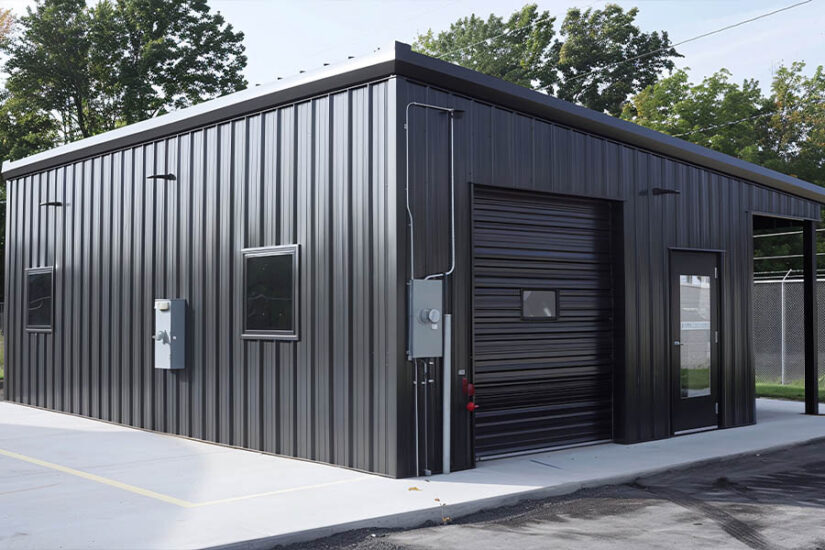

A 30×40 prefab steel workshop costs $35,000–$50,000 and goes up in 2–6 weeks. The same building in stick-built wood framing runs $65,000–$85,000 and takes 3–6 months. That gap doesn’t close over time – it widens, because steel costs $2,000–$5,000 to maintain over 20 years versus $15,000–$25,000 for wood.
That said, prefab steel isn’t the right answer for everyone. Here’s when it is – and when it isn’t.
Bottom line: Prefab steel costs 35–45% less upfront, builds in 2–6 weeks instead of 3–6 months, and carries structural warranties of 40+ years. Choose stick-built when you need to match existing residential architecture or have a non-standard footprint.
What’s the Actual Difference?
Prefab steel buildings are pre-engineered structures manufactured in a factory and assembled on-site from ready-to-bolt components. Stick-built buildings are constructed entirely on-site using raw materials –primarily wood framing cut and assembled by multiple subcontractor crews.
Prefab Steel (Pre-Engineered Metal Building / PEMB)
Components are precision-cut and pre-drilled at a factory, then shipped to your site. No on-site fabrication – assembly follows engineering drawings. Used for metal workshops, garages, barns, warehouses, hangars, and barndominiums.
Stick-Built
Raw lumber arrives on-site and gets cut, framed, and finished by multiple crews in sequence. About 97% of new single-family homes in the U.S. are still built this way[2] – it’s the default for residential construction, not commercial or agricultural.
Why Prefab Is Taking Share
The U.S. prefabricated construction market hit $146.7 billion in 2024, up 8.8% year-over-year, with a projected CAGR of 8.4% through 2028.[1] Two factors are driving this: a chronic skilled-labor shortage in construction, and lumber price swings that make stick-built budgets hard to lock in.[5] Commercial and agricultural buyers – who care more about cost and speed than curb appeal – are leading the shift.
Head-to-Head Comparison: Prefab Steel vs. Stick-Built Cost, Time, and Durability
| Category | Stick-Built | Prefab Steel |
| Upfront Cost | $65K–$85K (30×40) | $35K–$50K (30×40) |
| Cost per sq ft | $40–$70 | $20–$40 |
| Construction Time | 3–6 months | 2–6 weeks |
| Labor Intensity | High (multi-trade) | Low (pre-cut kit) |
| Design Flexibility | Full custom | High within PEMB framework |
| Durability | Good (with maintenance) | Excellent (40–60+ yrs) |
| Maintenance (20 yrs) | $15,000–$25,000+ | $2,000–$5,000 |
| Termites / Rot | Vulnerable (wood) | Not applicable (steel) |
| Rust / Corrosion | N/A | Highly resistant (Galvalume coating) |
| Fire Resistance | Moderate | High |
| Insurance Premiums | Standard | Often lower |
| Expandability | Complex/costly | Easy lean-to or bay add |
| Eco Impact | Higher waste, single-use | Low waste, 100% recyclable |
1. Upfront Cost
Prefab steel costs less because factory production eliminates most on-site labor and material waste. Lumber prices fluctuate – a project priced in January can cost 15–20% more by spring if markets move. Steel building pricing locks in when you order.
Average cost per square foot:
- Stick-built: $40–$70 per sq ft
- Prefab steel: $20–$40 per sq ft
Common examples:
- 30×40 metal workshop: $35,000–$50,000 prefab steel vs. $65,000–$85,000 stick-built
- Two-car metal garage kit: $18,000–$28,000 prefab steel vs. $35,000–$50,000 stick-built
Foundation, permits, and site prep cost the same regardless of build method. That $15,000–$35,000 gap is real savings, not an accounting trick.
2. Construction Timeline
Prefab steel: 2–6 weeks on-site once the foundation is ready. Stick-built: 3–6 months, often longer. The difference isn’t just convenience – each extra month of construction is a month you’re not using the building.
NIST research on prefab and modularization shows 66% of construction professionals report a positive schedule impact, with 35% seeing project timelines shrink by four weeks or more.[3] McKinsey’s 2019 modular construction analysis found that up to 80% of traditional labor activity can be moved offsite, directly compressing on-site duration.[5]
For a farmer needing equipment storage before harvest, or a business owner fitting out a new shop, 3 months earlier is money – not just a preference.
3. Durability and Long-Term Maintenance
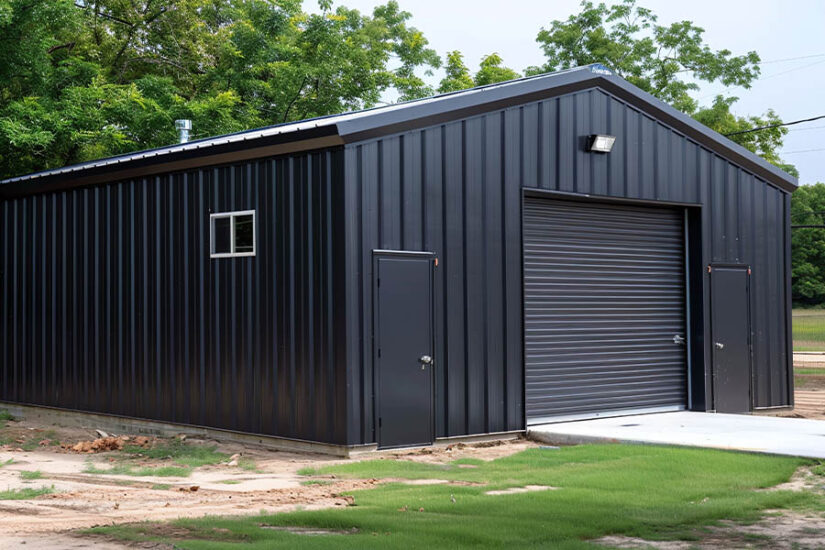
Steel doesn’t rot, warp, or feed termites. Galvanized and Galvalume-coated panels carry 40+ year corrosion resistance ratings – the coating does the work, not the steel itself. Scratch through it without repairing and rust will follow, same as paint on wood.
Estimated maintenance costs over 20 years:
- Stick-built: $15,000–$25,000+ (painting, sealing, rot treatment, termite prevention, roof replacement)
- Prefab steel: $2,000–$5,000 (touchup paint, fastener checks, occasional panel replacement)
Wood structures built with quality lumber and properly maintained last decades. The issue isn’t whether wood holds up – it’s that holding it up costs real money every few years. Most buyers underestimate this at the planning stage.
4. Design Flexibility and Customization
Stick-built has a real advantage for complex residential architecture – unusual footprints, ornate facades, matching an existing home’s style. That advantage shrinks fast when the project is a garage, barn, or commercial building.
Stick-built holds the edge for:
- Non-rectangular footprints or multi-gable rooflines
- Matching existing residential architecture exactly
- Highly decorative exterior finishes
Prefab steel covers most commercial and agricultural needs:
Sizes range from small sheds to 200+ ft clear-span warehouses with no interior columns. Roof styles, colors, trim, wainscoting, and brick or stucco facades are all configurable. Door and window placements, insulation packages, and interior mezzanines can be specified at order.
- Lean-to additions and extra bays can be added later without major reconstruction
About 80% of garage, workshop, barn, and commercial building projects don’t need what stick-built uniquely offers. The 20% that do tend to involve residential matching or municipal aesthetic requirements.
5. Insulation and Energy Efficiency
Uninsulated metal buildings get hot in summer and cold in winter. Properly insulated ones don’t – and the specs needed to get there are straightforward.
Standard prefab steel insulation options:
- R-13 to R-30 fiberglass batt systems
- Spray foam for air sealing and higher R-values in tight spaces
- Reflective roof coatings that reduce solar heat gain by 15–25%
- Thermal break panels that interrupt the conductive path between interior and exterior steel
Condensation is a design problem, not a material flaw. Without a vapor barrier and proper ventilation, moisture accumulates inside metal buildings in cold climates. Plan these in at the design stage — retrofitting vapor control after the fact is expensive and often incomplete.
6. Permits and Building Codes
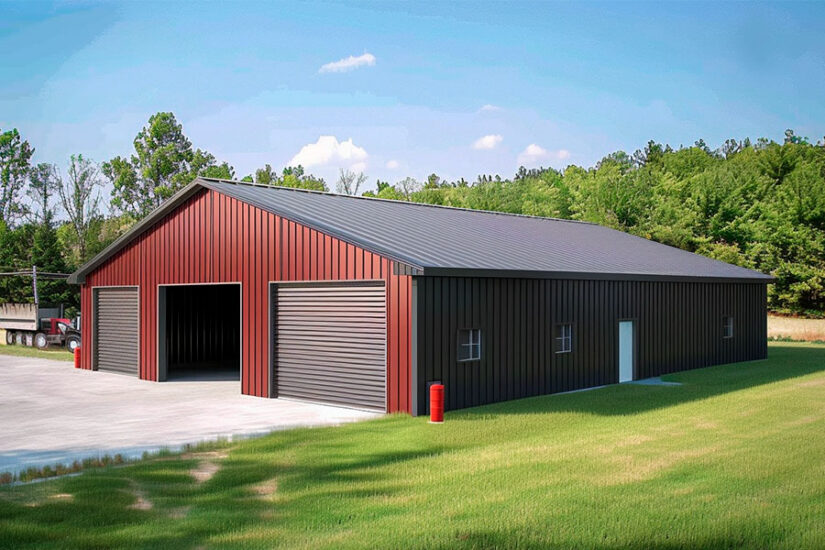
Both methods require permits. The process differs mainly in who handles the paperwork and how load calculations get submitted.
Prefab steel:
- Engineering stamps for your specific wind and snow zone come with the building package
- Manufacturer-provided load calculations speed up permit approval — building departments see these regularly
- Rural agricultural buildings under a certain sq ft may qualify for simplified permitting in many states
Stick-built:
- General contractor manages code compliance and inspection scheduling
- Multiple inspection checkpoints: framing, rough-in, insulation, final
- Building departments in residential areas are more familiar with this process
Zoning restrictions –setbacks, height limits, HOA rules –apply equally to both methods. Verify with your local authority before ordering anything.
Which One to Choose
Prefab Steel Makes Sense When:
- You need the building usable within 6–8 weeks of breaking ground
- Budget predictability matters more than design flexibility
- The use case is a garage, workshop, barn, warehouse, hangar, or commercial facility
- You expect to add lean-tos or extra bays in the future
- You’re in a high-wind or heavy-snow zone – engineered load ratings are built into the package
- Low long-term maintenance is a priority – see standard roof styles that affect longevity and drainage
Stick-Built Makes Sense When:
- The building needs to match existing residential architecture closely
- The footprint is non-rectangular or the roofline is complex
- Local zoning or HOA rules restrict metal structures
- The project is a primary residence in an area where steel homes face financing or resale complications
Four Claims About Prefab Steel Worth Correcting
“Metal buildings rust easily”
Modern panels use galvanized or Galvalume coatings rated for 40+ years of corrosion resistance. Rust appears when those coatings get scratched and aren’t repaired – the same mechanism that causes wood rot when paint fails. The steel isn’t the vulnerability; neglecting damaged coating is.
“They’re always cold in winter and hot in summer”
An uninsulated metal building will have temperature extremes. A properly specified one – R-13 to R-30 batts, vapor barrier, ventilation – performs comparably to wood framing. Buyers who skip insulation to save money upfront pay for it in heating and cooling costs. The building specification is the variable, not the material.
“Prefab steel buildings are temporary”
They’re installed on permanent concrete foundations, permitted as permanent structures, and carry structural warranties of 40+ years. Insurance companies and appraisers treat them as permanent. The confusion comes from conflating prefab steel with the temporary metal carport kits sold at farm supply stores – different product category entirely.
“Steel isn’t sustainable”
Steel is 100% recyclable without loss of quality or strength, and U.S. steelmaking furnaces consume nearly 70 million tons of domestic scrap annually.[7] Factory production also generates significantly less on-site construction waste than stick-built – McKinsey estimates up to 20% cost reduction from reduced logistics and waste alone.[5]
Frequently Asked Questions
Yes – installed on a concrete slab or pier foundation, permitted as permanent, and treated as such for insurance and appraisal. The confusion usually comes from conflating prefab steel with carport kits, which are a different product.
Yes, with limited exceptions for small agricultural structures in rural areas. Prefab steel typically comes with engineering stamps and load calculations already prepared, which can shorten the approval process.
40–60+ years with basic maintenance. Most structural warranties run 40 years. Galvalume panel coatings carry independent 40+ year corrosion resistance ratings. The main maintenance tasks are repairing coating damage before it reaches bare steel and checking fasteners after major storms.
Yes. Standard packages run R-13 to R-30. Spray foam adds air sealing on top of thermal resistance. Condensation control – vapor barrier, ventilation – needs to be specified at design time, not added later.
Upfront: $20–$40/sq ft for prefab steel vs. $40–$70/sq ft for stick-built. A 30×40 workshop is $35K–$50K vs. $65K–$85K. Over 20 years, the maintenance gap adds another $10K–$20K advantage for prefab steel.
Complex residential architecture – matching an existing home’s style, non-rectangular footprints, ornate facades. For anything commercial, agricultural, or utilitarian, prefab steel covers the use case. For a building that needs to look like a craftsman bungalow, it doesn’t.
References
- American Institute of Steel Construction (AISC). Cost: The Steel Advantage. Insurance rates for wood construction run 150% higher than for steel; U.S. structural steel averages 92% recycled content; steel fabricated offsite during foundation work reduces cycle time and financing costs
- National Association of Realtors (NAR). Modular Stacks Up to Stick-Built. 97% of new single-family homes built stick-built; factory-built share declined from ~5% to ~3%
- National Institute of Standards and Technology (NIST). Prefabrication and Modularization: Increasing Productivity in the Construction Industry. 66% of AEC professionals report positive schedule impact; 65% report cost reduction of 6%+ with prefab/modular methods
- U.S. Department of Housing and Urban Development (HUD). Factory and Site-Built Housing: A Comparison for the 21st Century. Comprehensive cost and structural comparison of factory-built vs. conventional site-built construction
- McKinsey Global Institute. Modular Construction: From Projects to Products (June 2019). Prefab could capture $130B of the U.S./European market by 2030; up to 80% of labor can shift offsite; 20% cost reduction from factory procurement and reduced waste
- National Renewable Energy Laboratory (NREL), U.S. Dept. of Energy. Challenges and Opportunities in Financing Modular Construction (2024). Modules completed in 10–15 days in factory; parallel on-site foundation work compresses total project timeline
- American Iron and Steel Institute (AISI). Steel Recycling — Sustainability. U.S. steelmaking furnaces consume nearly 70 million tons of domestic scrap annually; steel is continuously recyclable without loss of quality or strength
- U.S. Department of Energy — Building Technologies Office. Modular Construction: Energy-Efficiency Field Study in Commercial and Multifamily Buildings. Factory-controlled prefabrication may reduce total energy use by up to 50% compared to comparable site-built construction