
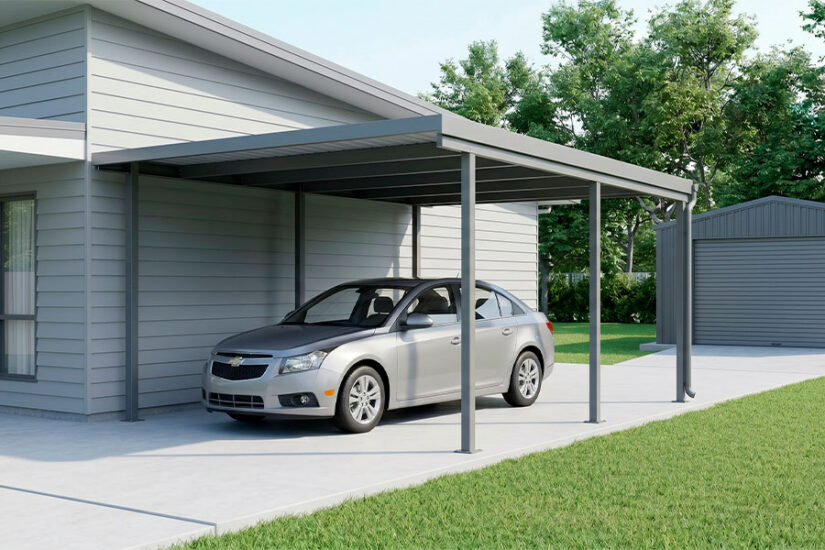

In 2024, 89% of newly completed single-family homes in the U.S. had a garage – 65% with two-car capacity, 15% with three or more. Carports accounted for just 1%. That gap isn’t just about preference – it’s about what each structure actually delivers for the money. A steel carport runs $2,640–$9,000. A steel garage starts around $8,000 and scales well past $35,000. Here’s what you get for the difference.
Bottom line: A carport costs less and installs faster. A garage protects more, stores more, and adds more to resale value. The right choice depends on what you’re protecting, where you live, and whether the space needs to do more than cover a vehicle.
- Choose a carport if you need fast, low-cost coverage in a moderate climate and security isn’t a concern
- Choose a garage if you need year-round protection, secure storage, workshop space, or plan to add to resale value
What’s the Actual Difference?
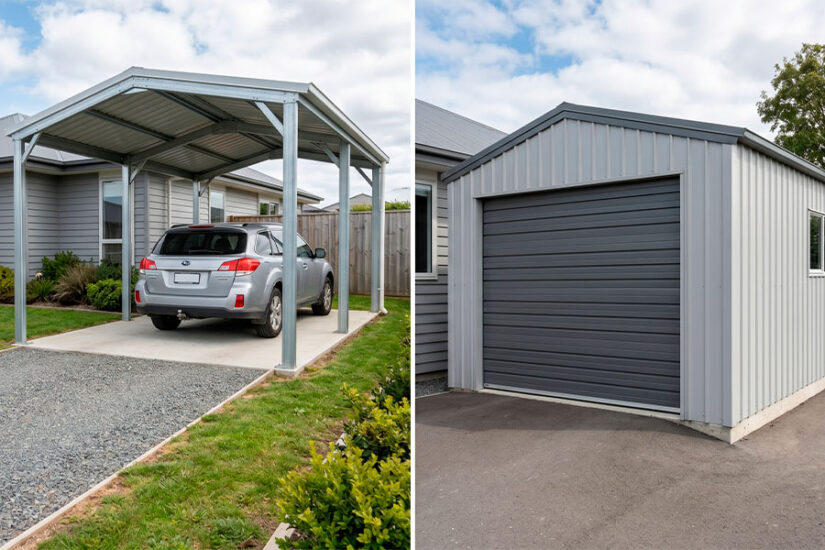
A steel carport is an open-sided or partially enclosed structure with a metal roof supported by steel posts. A steel garage is a fully enclosed building with walls, lockable doors, and the ability to support insulation, electrical systems, and interior finishes.
Steel Carport
Open-sided by default, though side panels and gable ends can be added. Anchored to piers, footings, or a light slab. Installs in 1–3 days. Metal carports work well for vehicles, RVs, boats, farm equipment, and any situation where drive-through access and airflow matter more than enclosure.
Steel Garage
Fully enclosed with exterior walls, overhead doors, and walk-in entry. Requires a full concrete slab and meets higher permitting standards. Takes 1–2 weeks to install. Supports insulation, HVAC, electrical rough-in, and interior finishes – which is why it functions as workshop, storage, or workspace, not just vehicle cover.
How Common Is Each – and Why
The DOE reports that about two-thirds of U.S. housing units have a garage or carport, with significant regional variation: 80% in the Pacific region versus 53% in the Middle Atlantic. In colder and wetter climates – the Midwest, Northeast, Pacific Northwest – fully enclosed garages dominate because open-sided coverage fails against wind-driven snow and freezing temperatures. In the Sun Belt and South, carports remain more common: lower cost, less weather pressure, and simpler permitting.
The DOE also flags a specific advantage both structures share: garages and carports provide access to electricity for parked vehicles – a growing factor as EV adoption increases and home charging becomes a decision point in property purchases.
Carport vs. Garage: Side-by-Side
| Category | Steel Carport | Steel Garage |
| Upfront Cost | $2,640–$9,000 (metal) | $8,000–$35,000+ |
| Cost per sq ft | $11–$25 | $20–$45 |
| Installation Time | 1–3 days | 1–2 weeks |
| Foundation Required | Piers, footings, light slab | Full concrete slab |
| Weather Protection | Roof only; sides open | Full enclosure |
| Security | Open access; minimal | Lockable; enclosed |
| Insulation / HVAC | Not practical | Fully supported |
| Workshop / Storage Use | Not suited | Yes |
| Permitting Complexity | Often simpler | More stringent |
| Property Value Added | Moderate | High |
| EV Charging Access | Possible with outlet | Full wiring supported |
| Expandability | Add panels, lean-tos | Add bays, mezzanines |
Reading the table: carports win on cost and installation speed. Garages win on every dimension that involves security, functionality, or long-term return. The only categories where carports are clearly better are price and time-to-install.
1. Cost: What You Actually Pay
A single-car metal carport runs $2,640–$4,800. A two-car carport runs $4,950–$9,000. At $11–$25 per sq ft, it’s the lowest entry point for covered vehicle storage.
Steel garages start around $8,000–$20,000 for a basic one-car garage and scale to $35,000+ for larger or insulated structures. Cost per sq ft runs $20–$45 depending on size, roof style, and options.
Foundation and site prep add $3,000–$8,000 for a garage slab regardless of building cost. Carports often skip this – piers or footings are cheaper and faster. That gap matters when budget is the primary constraint.
Where carports lose on cost over time: they don’t add much to property appraisals, and converting one to a garage later costs more than building a garage upfront. If there’s a reasonable chance you’ll want enclosure within 5 years, the math usually favors building the garage now.
5–10 Year Cost Perspective
Carport: $5,000–$9,000 all-in, including a basic foundation. Minimal ongoing maintenance. No meaningful contribution to property appraisal.
Garage: $15,000–$35,000+ upfront. A two-car garage typically adds $20,000–$30,000 to appraised property value in most U.S. markets – meaning a significant portion of the cost comes back on resale. A carport rarely appraises for more than $5,000–$10,000 added value.
The math for garage buyers: spend $25,000, recover $20,000–$25,000 on resale, and get a decade of secure, functional enclosed space in between. For carport buyers: spend $7,000, keep $7,000 in your pocket, and accept the trade-offs in protection and utility.
2. Weather Protection by Climate
A carport roof stops rain, hail, UV, and light snow from hitting your vehicle directly. That’s meaningful protection in moderate climates – and genuinely sufficient for much of the South and Southwest.
Where it fails: wind-driven rain comes in sideways. Snow accumulates around open sides and can drift in. In climates where temperatures regularly drop below 20°F, an open structure doesn’t slow the cold at all. In hurricane-prone regions – Florida, the Gulf Coast, parts of Texas – enclosed steel garages engineered for local wind loads provide meaningfully better structural resistance against debris and sustained high winds. Side panels help on a carport, but a fully paneled carport with a door is functionally a garage with a simpler foundation.
A steel garage provides full enclosure from all directions. With proper insulation – R-13 to R-30 depending on climate – the interior can be conditioned year-round. As EV adoption grows, enclosed garages are increasingly preferred for charger protection, cable management, and year-round usability: a Level 2 charger in an open carport requires weatherproof housing and exposed wiring; the same charger in a garage is a straightforward interior installation.
3. Security and Insurance
Carports are open structures. A vehicle under a carport is visible, accessible, and exposed to opportunistic theft in a way a garage is not. Side panels reduce visibility but don’t lock. This isn’t a minor difference – it affects whether a carport is appropriate for motorcycles, ATVs, boats with electronics, or any vehicle with detachable components worth stealing.
Garages lock. That creates a meaningful threshold for theft – most property crime is opportunistic, and a locked door is enough deterrence for the majority of incidents. Tools, equipment, and inventory stored in a garage are insurable at lower rates in many policies because enclosure reduces risk exposure.
Check with your insurer before choosing. Some carriers reduce premiums for enclosed, lockable storage. The annual savings can meaningfully offset the higher upfront cost of a garage over a 10-year horizon.
4. What Each Structure Can Actually Do
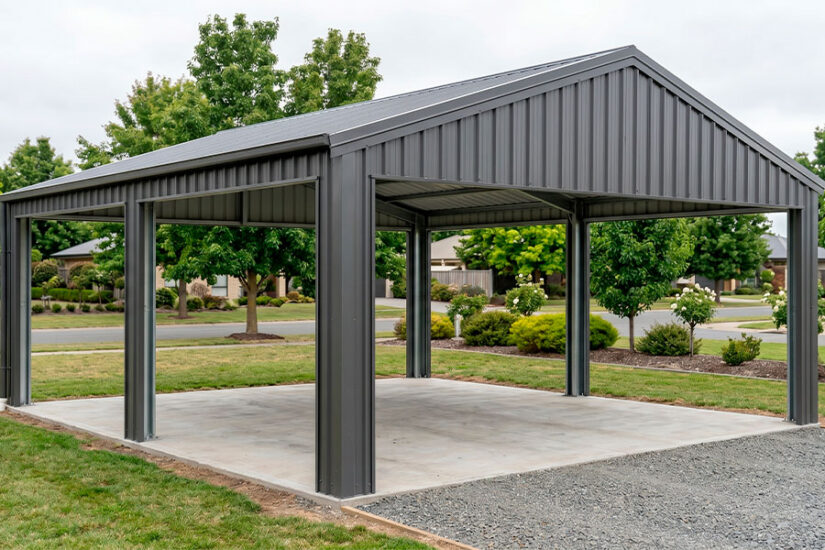
Carport: Best Fit
- Basic vehicle cover in moderate climates – cars, trucks, SUVs
- RVs, boats, and trailers – RV carports offer height flexibility that enclosed garages rarely match without a premium
- Farm equipment storage where drive-through access matters
- Fast, low-cost shelter when timeline is measured in days, not weeks
- Overflow parking for secondary vehicles or seasonal equipment
Garage: Best Fit
- Year-round vehicle storage in cold, wet, or high-wind climates
- Workshop or hobby space requiring dust control, noise isolation, or tool security
- Small business operations – mechanic bay, fabrication, light manufacturing
- Property improvements aimed at resale value – garages appraise; carports rarely do
- EV charging infrastructure – full electrical rough-in is standard in steel garage kits, making Level 2 charger installation straightforward
5. Permits and HOA Rules
Carports generally face lighter permitting requirements – particularly for smaller structures or agricultural use. Many counties don’t require a permit for carports under a certain sq ft. HOAs vary: some prohibit visible carports outright; others allow them in rear or side yards.
Garages are treated as permanent structures in most jurisdictions. They require building permits, inspections, setback compliance, and – in many cases – engineering stamps for wind and snow loads. Pre-engineered steel garages come with these calculations already prepared, which speeds up permit approval.
Always verify with your local building department before ordering either structure. Setback distances, height limits, and impervious surface rules vary significantly by county and municipality.
6. Customization and Future Expansion
Both structures are more flexible than most buyers expect at the planning stage.
Carport upgrades:
- Closed sides and gable ends for partial enclosure
- Taller leg heights for RVs and equipment (up to 16+ ft)
- Extended eaves for wider rain coverage
- Integrated storage rooms or attached lean-tos
Garage upgrades:
- Multiple bay configurations – one, two, or three cars
- Interior partitions, mezzanine floors, loft storage
- Electrical, plumbing, and HVAC rough-ins
- Future lean-to additions for expanded covered storage without new foundation work
One practical note: converting a carport to a garage later is possible but not cheap. You’re adding a foundation, walls, and doors – usually $8,000–$15,000 in additional work. If there’s a 50% chance you’ll want enclosure within 3–5 years, build the garage now.
Which One to Choose
Choose a Carport When:
- Budget is the primary constraint and basic vehicle cover is the goal
- You’re in the South, Southwest, or another moderate climate
- The structure needs to go up in days, not weeks
- Drive-through access matters – RVs, boats, farm equipment
- Local zoning or HOA restricts permanent enclosed structures
- You need temporary or seasonal shelter with option to expand later
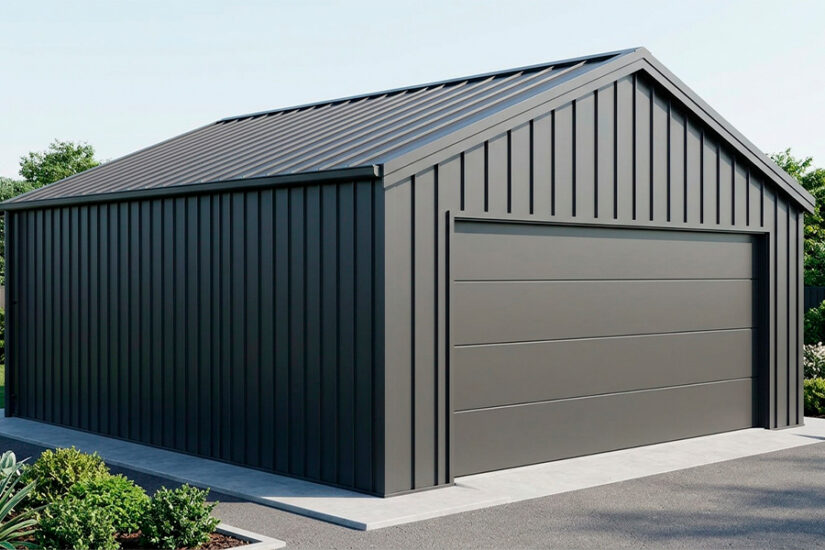
Choose a Garage When:
- You’re in a cold, wet, or high-wind climate
- Security matters – tools, motorcycles, ATVs, or equipment worth protecting
- The space needs to do more than cover a vehicle: workshop, storage, EV charging
- Property resale value is a consideration
- You want insulation, electrical, or climate control
- Long-term cost of ownership matters more than upfront price
Three Things People Get Wrong
“A carport is just a cheap garage”
They serve fundamentally different functions. A carport is outdoor covered space – closer to a patio roof than a building. A garage is indoor space. The distinction matters for permitting, insurance, resale value, and what you can actually do in each.
“Garages are always worth the extra cost”
In moderate climates with low theft risk and no workshop needs, a well-specified carport with side panels delivers adequate protection at roughly half the cost. Paying for a garage when a carport covers your actual use case is overspending, not upgrading.
“You can easily convert a carport to a garage later”
Technically yes, practically expensive. Adding walls, doors, and a proper foundation to an existing carport typically costs $8,000–$15,000 in labor and materials – often more than the carport itself. Plan for the end state, not the starting point.
Frequently Asked Questions
Modestly. Carports add some value – particularly in regions where they’re common – but significantly less than an enclosed garage. In most appraisals, a two-car garage adds $20,000–$30,000 to property value; a carport adds $5,000–$10,000 at most.
Yes, if you run electrical to it. A Level 2 charger (240V) can be installed under a carport with a weatherproof outlet. The limitation is that exposed wiring and equipment need proper weatherproofing. A garage makes this significantly simpler and cleaner.
Carports have less surface area and fewer components, so less maintenance overall. Garages with proper insulation and vapor barriers actually have lower condensation risk than uninsulated carports in humid climates. Both require periodic fastener checks and panel touch-ups.
A steel carport: 1–3 days once the foundation is ready. A steel garage: 1–2 weeks. Both timelines assume site prep and foundation work are completed before delivery.
Yes, but it costs $8,000–$15,000+ in additional work – walls, doors, and often a new or extended foundation. If there’s a realistic chance you’ll want enclosure within 5 years, build the garage upfront.
Carports, in most cases. RV carports with 14–16 ft clearance and wide spans accommodate vehicles that most standard garages can’t fit without a significant premium for taller walls and oversized doors.
If you’re comparing options for your property, getting exact pricing for both a carport and a garage side by side is often the fastest way to make the right call – the difference in total cost is usually smaller than people expect, and the difference in functionality is usually larger.
References
- National Association of Home Builders (NAHB) / Eye on Housing. Parking Trends in Newly Completed Single-Family Homes, 2024. 65% two-car garage, 15% three-or-more-car garage, 9% one-car garage, 1% carport in 2024 new homes
- U.S. Department of Energy (DOE). FOTW #1268: Two-Thirds of U.S. Housing Units Had a Garage or Carport in 2021. Regional breakdown: 80% Pacific, 53% Middle Atlantic; notes EV charging access
- U.S. Census Bureau. Characteristics of New Housing – Annual Data. Primary source for garage/parking data in new residential construction