
Completed Projects
Happy Customers
Projects in Progress
New Orders This Week
Why Steel Works in Minnesota
Steel buildings hold up in Minnesota when the roof is sized for the county’s snow and the footings go below the frost. We are a dealer of pre-engineered steel building kits from American steel, and our metal buildings in Minnesota, from barndominiums to machine sheds, arrive with PE-stamped drawings for the parcel.
Winter sets most of the loads. Arctic air sweeps in with no mountains to stop it, and the record low is −60°F, set at Tower in 1996. Most of the state averages 30 to 60 inches of snow a year, with up to 70 inches along the Canadian border and 90 inches on the Lake Superior shore. The 1991 Halloween blizzard left 36.9 inches in Duluth and 28.4 inches at the Twin Cities airport.
State rules set the ground snow load by county: 60 psf in 29 northern counties, from Kittson and Polk to St. Louis and Cook, and 50 psf in the rest of the state. Minnesota averaged 46 tornadoes a year from 1991 to 2020, and an August 2023 storm brought large hail with gusts of 40 to 70 mph. The drawings carry the snow load, design wind speed, exposure category and seismic design category under ASCE 7. Our guide to wind load vs snow load explains both.
Frost depth, the state code and permits are in the codes and permits section below.
Minnesota at a Glance
What We Engineer for:
Set by county: 60 psf of ground snow in 29 northern counties and 50 psf in the rest of the state; the figure for your site is on every drawing set
Footings go 5 feet deep in 34 northern counties and 3½ feet in the south, unless a soils engineer approves less; a local contractor pours them to our anchor bolt layout
Typical winter lows run from below 0°F in the far north to above 10°F in parts of the south; ask about insulation for a heated shop
About 46 tornadoes a year, and summer storms with large hail, like the August 2023 storm with gusts of 40 to 70 mph
One statewide code, the 2020 Minnesota State Building Code based on the 2018 IBC and IRC, enforced where your city, county or township has adopted it
Building Codes and Permits in Minnesota

Minnesota has one State Building Code for the whole state. The 2020 Minnesota Building Code and Residential Code are based on the 2018 International Building Code and International Residential Code and have been in effect since March 31, 2020. The code is the construction standard everywhere in Minnesota, but a local building official enforces it only where the city, county or township has adopted it by ordinance. Drawings are prepared to the code in force; your building department is the authoritative source.

In a city that enforces the code, start with its building department. In a township or on rural land, ask the township or county office whether the code is enforced there and who reviews plans. Ask the same office about zoning and setbacks. We don’t pull the permit; we supply PE-stamped drawings, load calculations and specifications.

State law exempts agricultural buildings from the building code. To qualify, a building must stand on land the local assessor classifies as agricultural, be designed and used to house farm implements, livestock or farm products, and be used by the owner or renter, their families and employees. Roof skylights still must carry the roof’s load, and local zoning can still apply. A barndominium does not qualify: the state treats it as a single-family home that must meet the residential code and needs a building permit.

Footings go at least 5 feet deep in 34 northern counties, including Clay, Polk, Otter Tail and St. Louis, and 3½ feet in the 53 counties to the south, including Hennepin, Stearns and Olmsted, unless a soils engineer approves less. A local contractor pours the footings to our anchor bolt layout; our foundation guide covers the options. Southern Minnesota flooded in June 2024 and Duluth in July 2012, so check your lot on the FEMA Flood Map Service Center and with your county.
Minnesota has one State Building Code for the whole state. The 2020 Minnesota Building Code and Residential Code are based on the 2018 International Building Code and International Residential Code and have been in effect since March 31, 2020. The code is the construction standard everywhere in Minnesota, but a local building official enforces it only where the city, county or township has adopted it by ordinance. Drawings are prepared to the code in force; your building department is the authoritative source.
In a city that enforces the code, start with its building department. In a township or on rural land, ask the township or county office whether the code is enforced there and who reviews plans. Ask the same office about zoning and setbacks. We don’t pull the permit; we supply PE-stamped drawings, load calculations and specifications.
State law exempts agricultural buildings from the building code. To qualify, a building must stand on land the local assessor classifies as agricultural, be designed and used to house farm implements, livestock or farm products, and be used by the owner or renter, their families and employees. Roof skylights still must carry the roof’s load, and local zoning can still apply. A barndominium does not qualify: the state treats it as a single-family home that must meet the residential code and needs a building permit.
Footings go at least 5 feet deep in 34 northern counties, including Clay, Polk, Otter Tail and St. Louis, and 3½ feet in the 53 counties to the south, including Hennepin, Stearns and Olmsted, unless a soils engineer approves less. A local contractor pours the footings to our anchor bolt layout; our foundation guide covers the options. Southern Minnesota flooded in June 2024 and Duluth in July 2012, so check your lot on the FEMA Flood Map Service Center and with your county.
Steel Buildings We Deliver Across Minnesota

What a Steel Building Costs in Minnesota
The price of a steel building in Minnesota depends on its size, the snow load and frost depth of its county and its finish.

From 20×20 to 30×40: garages, sheds and workshops.
From 30×50 to 40×80: barndominiums, equipment barns and machine sheds.
From 50×100 up: commercial buildings, warehouses and livestock barns.
A 60×100 machine shed in Polk County, with 60 psf of ground snow and footings 5 feet deep, gets a heavier frame and a deeper foundation than the same building in Hennepin County, where the state sets 50 psf and 3½ feet.
The $ tier covers the kit itself: frame, roof and wall panels. Insulation, overhead doors and liner panels move it to $$, and a finished living space or office inside to $$$. Our metal building cost guide lists dollar ranges by size, and the barndominium cost guide covers homes.
How Minnesota Owners Use Steel Buildings by Region
Twin Cities metro (Minneapolis, St. Paul, Woodbury, Blaine, Lakeville; Hennepin, Ramsey, Washington, Anoka and Dakota counties)
The metro counties take 50 psf of ground snow, with footings 3½ feet deep. Businesses here use steel for service shops and small distribution space kept heated and dry all winter. For stock and equipment, start with our metal warehouses.
See also: Metal office buildings · Metal storage unit kits
Southern Minnesota (Rochester, Mankato, Albert Lea, Fairmont, Worthington; Olmsted, Blue Earth, Freeborn, Martin and Nobles counties)
This is corn, soybean and hog country, and Minnesota ranked second in the nation in hog sales in 2022. Martin County led the state in hog sales, and Nobles County in cattle sales. Twenty tornadoes struck southeast Minnesota on December 15, 2021, the first December tornadoes in state records. Hog finishing and feed storage fit under our livestock barns.
See also: Metal red barns · Metal carports
Central Minnesota and the lakes (St. Cloud, Willmar, Alexandria, Little Falls, Brainerd; Stearns, Kandiyohi, Douglas, Morrison and Crow Wing counties)
Stearns County led Minnesota in farm sales and milk sales in 2022, and Kandiyohi County held 2.4 million turkeys. The frost line crosses the region: footings go 3½ feet deep in Stearns and Kandiyohi counties and 5 feet farther north. Dairy farms keep hay and bedding dry in our metal hay barns.
See also: RV garages · Recreational steel buildings
Red River Valley and the North (Moorhead, Crookston, Warren, Hallock, Duluth; Clay, Polk, Marshall, Kittson and St. Louis counties)
Polk County has more farmland than any other Minnesota county, 1.08 million acres, and led the state in crop sales in 2022, with wheat, soybeans and 96,745 acres of sugar beets. Footings across the region go 5 feet deep, and Polk, Marshall, Kittson and St. Louis counties take 60 psf of ground snow. Combines and beet harvesters need wide doors and a clear span; see our tractor barns.
See also: Three-car garages · Metal sheds
What can we design for you today?
Talk to a building specialist to learn more!
Design Your Building NowFrequently Asked Questions
Yes. The 2020 Minnesota State Building Code, based on the 2018 International Building Code and International Residential Code, is the standard everywhere in the state. A local official enforces it where your city, county or township has adopted it. Our drawings follow the code in force; your building department has the final word.
It depends on the township or county. Ask whether the code is enforced where you build and what zoning permit you need. A farm building that meets all the agricultural conditions in the codes section above is exempt from the building code, but a barndominium is a home and needs a building permit.
The ground snow load the state sets for your county, under ASCE 7: 60 psf in 29 northern counties and 50 psf everywhere else. Send the full address with your quote request.
Yes, we deliver across Minnesota, from Rochester and the Twin Cities to Moorhead and Duluth. Make sure a truck can reach the pad, and in winter that the access is cleared. We confirm your production schedule and delivery window when your order is finalized. Your crew or a local erector assembles the building; if you want installation arranged, ask when you request your quote.
Yes. Insulated walls and roof with a vapor barrier keep the heat in and stop condensation from dripping on equipment. See our guide to stopping condensation in a metal building.

Standard Shed Sizes: Common Shed Dimensions and What Fits in Each
Quick Answer Common Shed Sizes at a Glance There is no single standard for shed sizes. What people call standard or common shed sizes are the footprints builders and sellers make most often, and nearly all of them are even numbers of feet. For wood sheds the arithmetic is convenient: 8, 12 and 16 feet […]
Read Article
Texas Barndominiums: Where to Build and What to Plan For
Quick Answer Why Barndominiums are Popular in Texas A barndominium is a steel-frame building with living quarters inside, often with a shop, garage or barn space under the same roof. The guide to what a barndominium is covers the basics; this one is about building it in Texas. The idea fits the way a lot […]
Read Article
Post-Frame Construction vs Pre-Engineered Steel Buildings: What Actually Differs
Quick Answer What Post-Frame Construction Is Post-frame construction (sometimes written post and frame construction) is a building system in which large wood posts, embedded in the soil or fastened to concrete piers or a slab, carry the roof and the wall cladding without a continuous stud wall. The National Frame Building Association (NFBA) describes it […]
Read Article
Garage With Loft: Steel Garage Loft Sizes, Heights and Uses
Quick Answer What Counts as a Garage Loft in a Steel Building A garage loft is a second floor level built inside the garage, usually over part of the floor and open to the space below. A wood-framed garage often has an attic inside its roof trusses; a steel garage with an open frame has […]
Read Article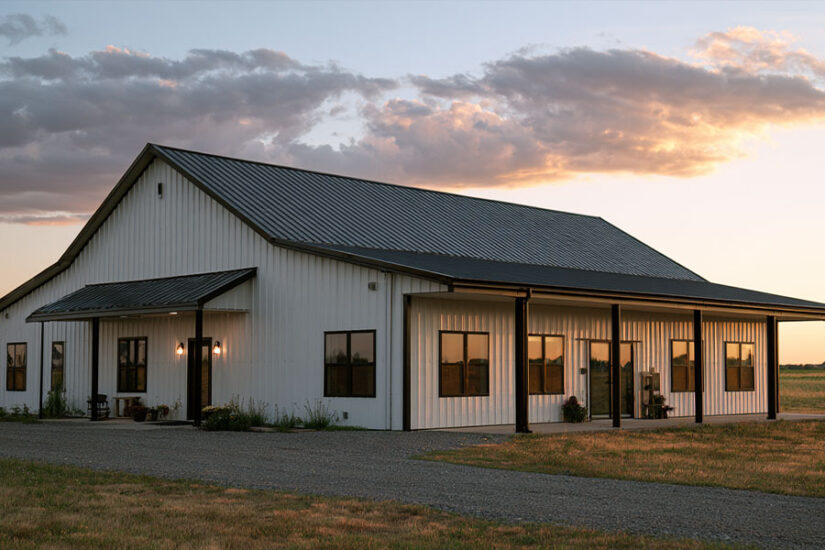
White Barndominium and Farmhouse Exterior Ideas for a Steel Home
Quick Answer A white barndominium is a steel-frame home clad in white wall panels, usually set off by a dark roof and black window and corner trim. Add a covered front porch and a steeper gable, and the same shell reads as a farmhouse barndominium, especially over a stone or wood base. Why White Works […]
Read Article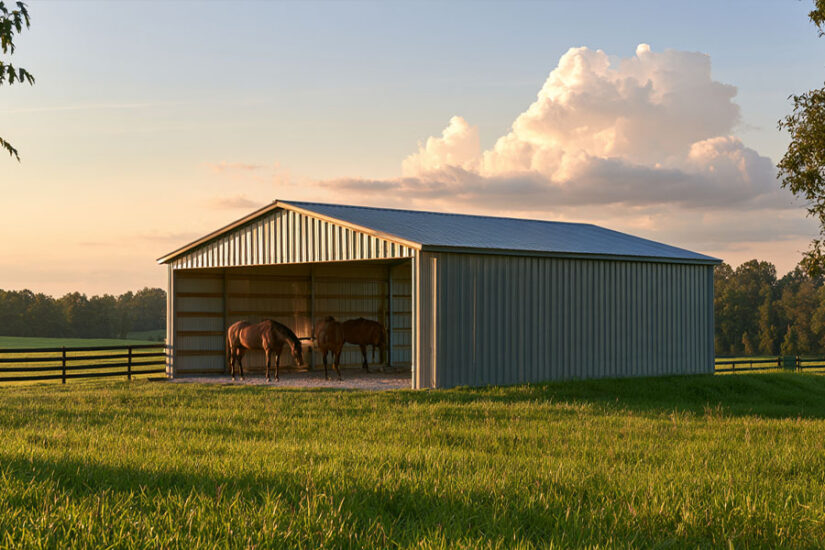
Loafing Shed vs Run-In Shed: Sizes, Layouts, Steel Option
Quick Answer What is a Loafing Shed, and How is it Different From a Run-In Shed? A loafing shed is a roofed shelter, usually closed on three sides and open on the fourth, where livestock rest out of the weather and leave whenever they like. In a barn with stalls each horse is led in […]
Read Article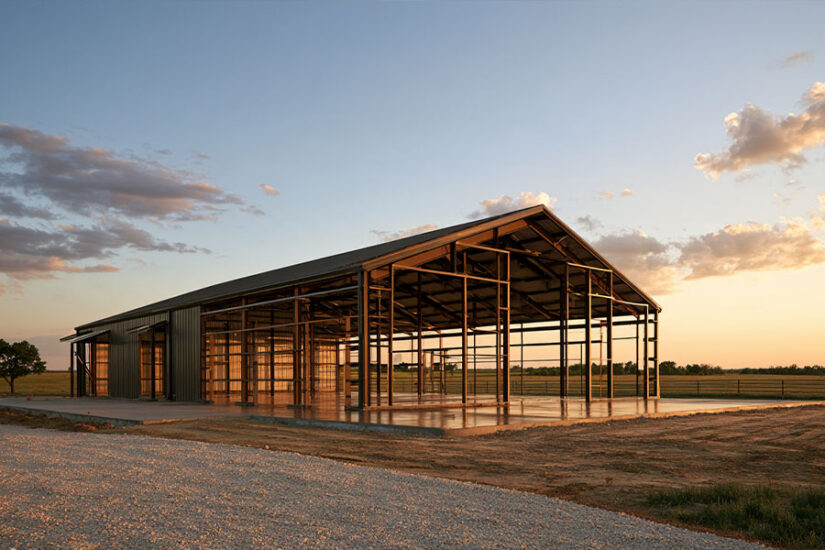
How to Build a Barndominium: Steps From Land to Move-In
Quick Answer Building a barndominium runs in a set order: check the land and local rules, choose the size and plan, get engineered drawings and a permit, order the steel kit, prepare the site and pour the slab, erect the shell, then finish rough-ins, insulation and the interior before the final inspection. A barndominium is […]
Read Article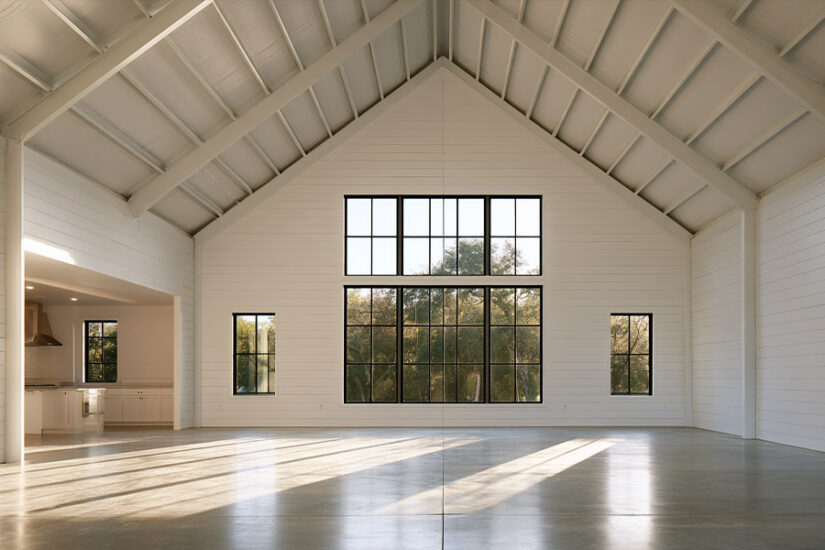
Barndominium Interior Ideas for a Steel-Frame Home
Quick Answer Barndominium interior ideas that hold up start with what the steel frame allows: an open floor with no load-bearing interior walls, and enough height for a loft or a vaulted great room. Behind the finishes, insulation and moisture control keep the rooms dry, and a separation wall divides living space from any shop. […]
Read Article
Standard Garage Sizes: 1, 2, 3 and 4-Car Garage Dimensions
Quick Answer Standard Garage Sizes at a Glance When people say “standard garage size,” they usually mean a two-car garage, and that is what most new houses get. In 2025, 64% of newly completed single-family homes had a two-car garage, according to the Census Bureau’s Characteristics of New Housing data. Garages for three or more […]
Read Article