
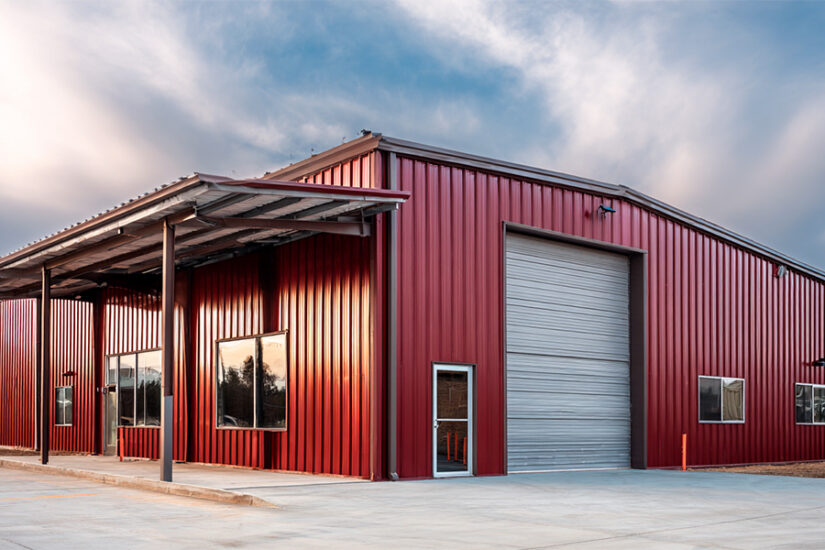

Quick Answer (2026 Data)
Per square foot range: $15 – $70 (kit only, all use cases)
Turnkey full build: add 80 – 150 percent to the kit cost
Typical 40 by 60 (2 400 sq ft) kit: $35 000 – $65 000 · turnkey $80 000 – $180 000
Typical 60 by 100 (6 000 sq ft) kit: $75 000 – $135 000 · turnkey $180 000 – $400 000
Steel kit lead time: 8 – 16 weeks
A metal building costs roughly $15 to $70 per square foot for the kit alone in 2026, with turnkey full builds running 80 to 150 percent higher than the bare kit. A standard 40 by 60 residential workshop kit lands around $35 000 to $65 000; the same build turnkey with foundation, slab, insulation, electrical, and finishing typically runs $80 000 to $180 000 depending on region and finish level. A 60 by 100 commercial building kit runs $75 000 to $135 000, with turnkey at $180 000 to $400 000.
The wide range reflects four real cost drivers. Use case (a residential workshop and an industrial warehouse use different gauge steel and different insulation specs). Size (per-square-foot cost drops as buildings get bigger because fixed costs amortize across more square footage). Region (labor and snow/wind engineering vary by state). Scope (kit-only versus turnkey full build differs by a factor of two or more).
This guide walks through 2026 metal building pricing the way a serious buyer needs to see it: by size, by use case, by component, and by state. It also covers steel versus wood versus pole-barn cost, what owners actually regret after the first year, and the long-term ownership math most buyers underestimate.
Quick Reference: Cost by Size (2026)
The most common standard sizes US buyers ask about, with realistic 2026 pricing ranges.
| Size | Sq ft | Kit cost (2026) | Turnkey range | Per sq ft turnkey |
| 20 × 20 | 400 | $5 500 – $9 500 | $14 000 – $30 000 | $35 – $75 |
| 25 × 25 | 625 | $7 500 – $13 000 | $20 000 – $45 000 | $32 – $72 |
| 25 × 30 | 750 | $9 000 – $15 500 | $24 000 – $54 000 | $32 – $72 |
| 30 × 30 | 900 | $10 000 – $19 000 | $28 000 – $64 000 | $31 – $71 |
| 25 × 40 | 1 000 | $11 000 – $21 000 | $32 000 – $72 000 | $32 – $72 |
| 30 × 40 | 1 200 | $13 500 – $25 000 | $38 000 – $86 000 | $32 – $72 |
| 40 × 60 | 2 400 | $27 000 – $52 000 | $76 000 – $172 000 | $32 – $72 |
| 50 × 80 | 4 000 | $50 000 – $98 000 | $130 000 – $290 000 | $33 – $73 |
| 60 × 100 | 6 000 | $75 000 – $135 000 | $180 000 – $400 000 | $30 – $67 |
| 80 × 120 | 9 600 | $115 000 – $210 000 | $270 000 – $605 000 | $28 – $63 |
| 100 × 200 | 20 000 | $220 000 – $440 000 | $500 000 – $1 200 000 | $25 – $60 |
Per-square-foot cost drops as the building gets larger because fixed costs (engineering, permits, mobilization, foundation crew minimums) spread across more square footage.
A Real Example: 40 by 60 Workshop in Central Texas
A buyer outside Austin in late 2025 ordered a 40 by 60 insulated residential workshop. The kit came in at $44 000 delivered. Slab was a 4-inch reinforced pour with thickened footings – $19 000. Erection by a local crew over six working days – $14 000. Spray foam insulation, electrical service with a 200-amp panel, two overhead doors, a walk door, and basic interior finishing – $48 000. Permit and engineering review – $2 200. Total turnkey: about $127 000.
The buyer up the road in the Texas Hill Country with a steeper, rockier lot paid $19 000 more – almost entirely site work and foundation. Same kit, same finish package, $146 000 final. Site is the variable that moves budgets the most after the kit decision.
Typical Mid-Range Examples (What Most Buyers Actually Pay)
Ranges are useful for shopping. Single numbers are easier to budget against. The figures below are 2026 mid-range turnkey totals for common builds in average US markets – not Florida hurricane zones or California coastal counties, but Texas, Tennessee, Missouri, Ohio.
| Build | Typical mid-range total |
| 30 × 40 backyard workshop, insulated, 2 overhead doors | ~$72 000 |
| 40 × 60 workshop, insulated, 200-amp service | ~$120 000 |
| 40 × 60 barndominium home, full residential finish | ~$240 000 |
| 60 × 100 commercial shell, finished retail or office | ~$280 000 |
| 60 × 120 hay barn, ag-exempt, no insulation | ~$165 000 |
| 100 × 200 industrial warehouse, three-phase service | ~$750 000 |
A specific quote can land 25 percent above or below these depending on site, finish level, and state. The numbers are for budget-setting before quotes come in, not as commitments.
What “Metal Building Cost” Actually Includes
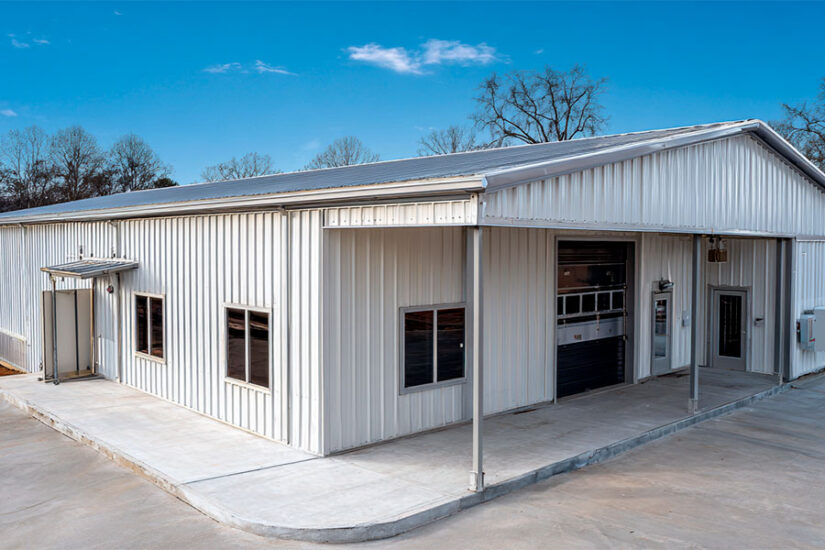
The first question to clear up before reading any number is what is being priced. Different sources quote different scopes, and the gap between them is often 2× to 3× for the same building.
Steel building kit only. Primary and secondary steel framing, roof panels, wall panels, eave trims, and the doors and windows specified on the order. No slab, no insulation, no electrical, no labor to put it together. Per-square-foot pricing in 2026: $15 to $70 depending on use case (agricultural lowest, industrial highest). This is the number steel manufacturers quote first, and it is the number that confuses most first-time buyers because the same 40 by 60 footprint as a turnkey HomeAdvisor estimate looks half the cost.
Shell erected on a prepared slab. Kit plus delivery and a crew erecting the shell on a slab the owner already has. Owner still handles slab pour, insulation, electrical, and finishing. Per-square-foot in 2026: $25 to $90.
Turnkey full build. Everything from site survey to move-in. Site clearing, foundation, shell, insulation, electrical and plumbing rough-in and finish, interior walls, doors, permits, general-contractor margin. Per-square-foot in 2026: $30 to $130 depending on use case and region.
Premium custom build. Turnkey plus architectural finishes, full HVAC, premium insulation, custom interior, exterior cladding upgrades. Per-square-foot in 2026: $130 to $250+ for high-end residential or commercial.
Every cost table in this article names the scope explicitly so the numbers line up with what the buyer is shopping for.
Cost Per Square Foot by Use Case (2026)
Use case is the second-largest cost driver after size. The same 40 by 60 footprint can land anywhere from $25 000 to $250 000 depending on whether it ends up as an agricultural hay barn or a finished commercial office.
Residential
Residential metal buildings include barndominiums, garages, workshops, and detached accessory dwellings. They need insulation, drywall, electrical, plumbing, and HVAC finishing for living or comfortable working conditions.
- Kit cost: $15 – $50 per sq ft
- Turnkey: $30 – $90 per sq ft
- Typical 40×60 residential workshop turnkey: $76 000 – $172 000
- Typical 40×60 barndominium (full residential finish) turnkey: $180 000 – $320 000
Residential is the broadest range because finish level varies hugely. A bare insulated shop costs near the low end; a fully finished barndominium home approaches custom-build pricing because the interior finish work matches a traditional house.
Commercial
Commercial metal buildings cover retail, office, auto service, dealerships, self-storage, and small-business uses. Building codes typically require more robust egress, accessibility, sprinklers (in some jurisdictions), and structural ratings than residential.
- Kit cost: $20 – $50 per sq ft
- Turnkey: $40 – $100 per sq ft
- Typical 60×100 commercial shell turnkey: $200 000 – $360 000
- Typical 60×100 finished retail/office turnkey: $360 000 – $560 000
Industrial
Industrial buildings (warehouses, manufacturing facilities, distribution centers) carry the highest per-square-foot cost because they need heavier-gauge steel, taller eaves (often 20+ feet), reinforced foundations for equipment loads, larger overhead doors, and often three-phase electrical service.
- Kit cost: $25 – $70 per sq ft
- Turnkey: $50 – $130 per sq ft
- Typical 100×200 industrial warehouse turnkey: $500 000 – $1 200 000
Agricultural
Agricultural metal buildings include hay barns, equipment storage, livestock shelters, and farm shops. These typically use lighter-gauge steel because loads are lower, skip insulation and finishing, and often qualify for streamlined ag-exempt permits.
- Kit cost: $10 – $30 per sq ft
- Turnkey: $25 – $60 per sq ft
- Typical 60×120 hay barn kit: $50 000 – $90 000
- Typical 60×120 hay barn turnkey: $130 000 – $220 000
Component Cost Breakdown
Turnkey budgets are built or blown at the component level. Numbers below are 2026 US national ranges for a 2 400 to 6 000 squamb-3re foot building.
| Component | Typical 2026 cost | Notes |
| Site survey and engineering | $1 500 – $6 000 | Required by most counties |
| Site clearing and grading | $1 000 – $40 000 | Flat cleared lot low end; wooded sloped lot high end |
| Foundation (perimeter footings + slab) | $12 000 – $80 000 | Frost depth varies by region. See the concrete slab thickness guide |
| Steel building kit | $5 500 – $440 000 | By size and use case, see tables above |
| Kit delivery | $1 200 – $5 000 | Distance to nearest steel mill |
| Erection labor (shell only) | $8 000 – $35 000 | Crew of 3 – 4 for 5 – 14 days |
| Insulation (spray foam typical) | $4 000 – $30 000 | Spray foam roughly $1.50 – $4 per sq ft on walls and roof |
| Interior framing and drywall | $8 000 – $40 000 | Studs, sheathing, interior walls |
| Plumbing, electrical, HVAC | $15 000 – $90 000 | Rough-in and finish |
| Doors and windows | $2 000 – $20 000 | Includes overhead doors $600 – $3 500 each |
| Exterior trim and finishes | $4 000 – $18 000 | Eave trim, gutters, downspouts |
| Permits | $500 – $10 000 | Wide variance by county |
| General contractor margin | 15 – 25 percent | Standard markup on managed scope |
For a 40 by 60 residential workshop turnkey at the mid-range of these components, expect roughly $110 000 – $135 000 total. For a 60 by 100 commercial finished building at mid-range: $260 000 – $300 000.
Cost by State (2026 Regional Variation)
Regional cost varies because of three factors: labor rates, snow and wind load engineering requirements, and material delivery cost from the nearest steel mill. The numbers below are turnkey full-build estimates for a 40 by 60 residential metal building (workshop spec, insulated, electrical, basic finishes) in 2026.
| State | Typical turnkey 40×60 (workshop spec) | Key local factors |
| Texas | $76 000 – $140 000 | Low labor cost, moderate snow load, abundant steel suppliers |
| Oklahoma | $80 000 – $140 000 | Similar to Texas; tornado-rated wind adds engineered cost |
| Tennessee | $85 000 – $150 000 | Moderate labor, mild climate, strong residential market |
| Florida | $95 000 – $165 000 | Hurricane wind ratings raise kit and foundation cost |
| Virginia | $90 000 – $158 000 | Moderate labor, varied terrain (mountain sites add prep) |
| Missouri | $82 000 – $144 000 | Mid-range across all factors |
| Colorado | $105 000 – $175 000 | Heavy snow load engineering, higher labor, rocky sites |
| California | $130 000 – $230 000+ | Highest labor cost, seismic engineering, strict permits |
| New York | $115 000 – $190 000 | Snow load engineering, higher labor, regional permits |
These are starting points, not quotes. A real builder will walk the specific site, check the local building department permit checklist, and price the actual labor pool.
US steel manufacturers including US Patriot Steel ship kits to all 48 continental US states (Alaska and Hawaii are typically excluded because over-water freight makes oversized steel components uneconomic). Owners outside the continental US source from regional manufacturers.
Three Cost Surprises Buyers Mention Most Often
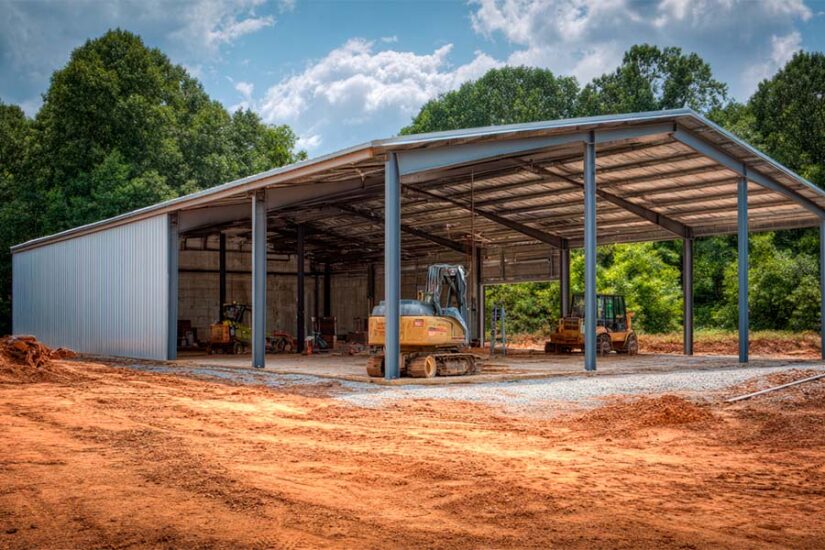
Numbers in tables anchor the budget. What blows the budget tends to be the things buyers did not have a column for. Three keep coming up in post-build conversations.
Site work. Quotes assume the site that was walked the day of the estimate. If the dozer hits ledge two feet down on day three, blasting and removal can add $4 000 to $15 000 plus a week of delay. If the topsoil is twice as deep as the contractor expected, that is another $5 000 to $15 000 in fill and compaction. A $200 to $500 soil test before signing usually saves more money than any other single line item.
Electrical service upgrade. A standard residential metal building plan often runs a single 100-amp service. By month four, the owner is running a welder, an air compressor, and a few sub-loads, and the breaker trips weekly. Upgrading the service after the slab is poured and the panel is installed lands around $2 500 to $5 000. The same upgrade specified during the original build typically costs a fraction of that.
Insulation skipped at build time. Skipping insulation on the original build saves $4 000 to $15 000 in the moment. Adding it after the building is closed in and the interior walls are framed runs $12 000 to $35 000, plus disruption. Owners who run the heater for one winter without it usually call back about retrofit pricing.
What Drives the Cost up or Down
Eight factors move final cost most in 2026.
Steel commodity price. Hot-rolled coil steel is the raw input for every kit, and its spot price moves with commodity markets. Significant moves either direction translate into a few percent of kit cost. Watch this if the project is more than 6 months out.
Snow and wind load engineering. Building code requires every steel kit to be engineered for the local site’s snow load (psf) and wind speed rating (mph). A kit rated for Colorado’s 60 psf snow load uses noticeably more steel than the same kit for Texas’s 10 psf load. Wind ratings push higher in Florida (hurricane zones) and tornado-belt Oklahoma. Cost premium for high-load engineering: 10 – 25 percent on the kit.
Eave height. A 12-foot eave costs less than a 16-foot eave costs less than a 20-foot eave for the same footprint. Each step up adds roughly 5 – 12 percent to the kit. Industrial uses needing high eaves take this premium.
Bay spacing. Standard bay spacing (the distance between primary frames) is 25 feet. Wider bays (30 or 35 feet) reduce interior column count but require heavier framing. Cost premium: 8 – 15 percent.
Doors and openings. Each overhead door, walk door, window, and louver opening cuts the steel panel coverage and adds framing and door hardware. Typical residential workshop has 2 to 3 openings; industrial buildings often have 6 to 12.
Insulation level. R-13 batt is the entry level; R-19 to R-30 spray foam is the residential standard; R-38 or higher with thermal breaks is the high-performance spec. Per square foot: $1 – $5 across this range.
Concrete slab thickness. A 4-inch residential slab differs from a 6-inch shop slab differs from an 8-inch industrial slab. Cost per square foot: $4 – $9 across this range.
Regional labor. Erection crew rates vary roughly 2× between low-cost states (Texas, Oklahoma) and high-cost states (California, New York). On a turnkey project, labor is 30 – 50 percent of total cost, so this matters.
Steel vs Wood vs Pole-Barn Cost in 2026
Three structural systems compete in the same size class up to about 60 feet wide. The cost ordering in 2026 surprised many buyers used to older assumptions.
Steel clear-span. In many markets and size ranges above roughly 40 by 60, industry pricing across Allied Steel Buildings, BuildingsGuide, and Foley Construction places steel clear-span as the lowest-cost structural system, especially as the building widens. Steel uses material efficiently across wide spans where wood starts to require expensive engineered trusses.
Pole-barn (post-frame wood). Pole-barn construction uses laminated wood columns embedded in concrete piers, with wood trusses and metal roof and wall skin. At 2026 lumber prices, this is comparable to or slightly more expensive than steel clear-span for residential workshops up to about 40 by 60. For larger buildings (60 by 120 and up), pole-barn often becomes more expensive than steel because the wood truss span limit forces interior columns.
Wood frame (full traditional framing). Standard 2×4 / 2×6 wood-frame construction tends to be the most expensive of the three options for any building over 40 by 60. At 2026 lumber prices it does not compete on cost outside of small residential builds. Termite, rot, and woodpecker maintenance costs that steel does not have widen the gap over a 20-year ownership window.
The practical takeaway: for residential workshops under 40 by 60, all three systems can be competitive on initial cost, and the choice often comes down to aesthetic preference and local builder availability. Above 40 by 60 in most markets, steel tends to lead on cost and the gap typically widens with building size.
Permits and Code
Almost every US county requires a building permit for a metal building over a small threshold (often 200 square feet but varies). Permit cost in 2026: $500 to $10 000 depending on county complexity and project scope. Plan for 4 to 12 weeks of permit review time before construction can start.
Agricultural-zoned property in many states qualifies for streamlined “ag-exempt” permits if the building is used strictly for livestock or farm equipment storage. Ag-exempt permits run $200 – $1 000 and process in 2 – 6 weeks. Worth asking about before committing to a full commercial permit path.
Snow load, wind speed rating, seismic category, and frost depth requirements come from the local code adoption of the International Residential Code (IRC) or International Building Code (IBC). Most US jurisdictions are on IRC 2018, IRC 2021, or IRC 2024.
Maintenance and Total Cost of Ownership
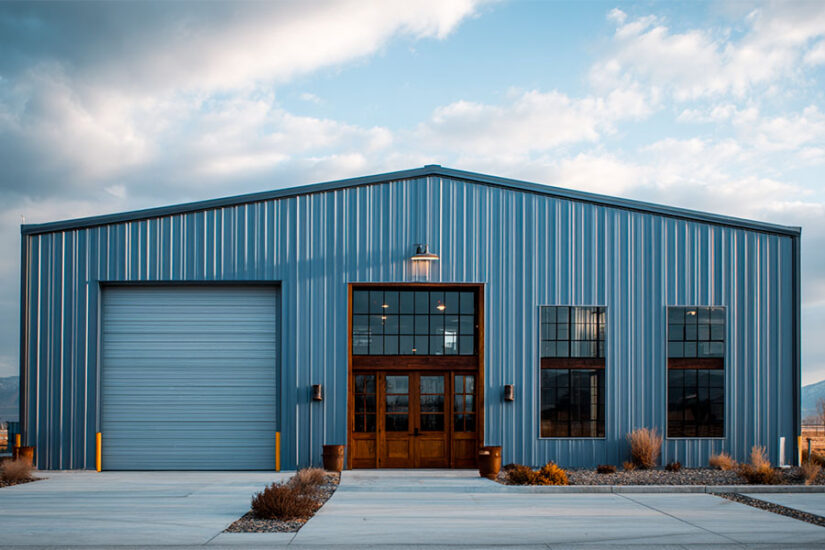
Most owners focus heavily on the purchase price and underestimate the next 25 years. A steel building does not need much maintenance compared to wood or pole-barn equivalents, but it is not zero. Roof and panel coatings need attention. Caulk and sealant joints fail before the metal does. Heating and cooling runs every year regardless. The numbers below are typical annual operating costs for a residential workshop or commercial building in 2026.
- Roof and panel inspection / minor repair: $200 – $1 500
- Exterior recoating (every 15 – 20 years): $4 000 – $20 000 amortized
- Caulk and sealant renewal: $100 – $800 every 3 – 5 years
- Insurance addition to property policy: $300 – $2 000
- Heating and cooling (climate dependent): $1 000 – $8 000
- Annual total typical: $1 500 – $10 000
Over a 25-year ownership horizon, expect to add $40 000 – $250 000 to the original build cost when budgeting total cost of ownership. Steel buildings carry roughly half the ongoing maintenance cost of pole-barn or wood-frame equivalents because the structural system does not require treatment, repair, or eventual rebuild.
What Owners Regret Most After the First Year
After a steel building has been up for a year, the questions that come back to the supplier cluster in four places. None of them is the building itself. All of them are decisions buyers made (or skipped) during planning.
The overhead doors were too small. A 10 by 10 door fits the truck the buyer owns the day the kit was ordered. Two years later the owner buys a fifth-wheel camper, or a contractor truck with a service body, or a tractor with a front-end loader, and the door does not fit. Stepping up to a 12 by 14 door at order time costs roughly $400 to $900 more per door. Replacing the door later, with frame reinforcement, runs $3 000 to $6 000.
The electrical service was undersized. A 100-amp panel handles a residential workshop with lights, outlets, and a single circuit for a welder. Add a CNC mill, a compressor, an EV charger, or a second welder, and the breaker becomes the limiting factor on every project. 200-amp service is the standard most build-experienced owners specify now. The cost difference at original build is usually a few hundred dollars; the retrofit cost is several thousand.
Insulation was deferred. A bare metal shop in a hot or cold climate becomes uncomfortable enough to abandon for half the year. Owners who deferred insulation usually add it within 24 months, at 2× the original-build cost and with significant disruption. The exception is genuinely climate-mild storage uses where the building is never occupied for long stretches.
The eave height was too low. A 12-foot eave fits a standard pickup truck and a basic workshop. A 14- or 16-foot eave fits a lift, a mezzanine office, vertical material storage, and future use cases the buyer has not thought of yet. Each foot of eave costs about 5 to 8 percent more on the kit. Adding eave height later is effectively impossible – the entire frame would need to be re-engineered and re-erected.
How to Budget and Plan
Five practical steps before signing any contract.
Define the use case clearly. A residential workshop, a barndominium home, a commercial office, and an agricultural storage building have different specs and different costs. Write down the actual planned use, including any expansion plans, before sizing.
Walk the site with a contractor. Site work is the variable that can move a budget by $30 000 in either direction. Walk it with someone who has built nearby. Look at slope, drainage, soil, access for delivery trucks, distance to electric service, and water access.
Choose the size for both today and ten years out. The cost of adding 20 percent to a metal building at design time is roughly 18 percent of the build cost. The cost of expanding an existing metal building two years later by the same 20 percent is 80 – 120 percent. Going one size up at original build is almost always cheaper than expanding later.
Get three quotes on the same scope. Quotes that compare across different scopes are useless. Write a one-page scope sheet (size, use case, insulation level, electrical spec, door and opening count, who handles permits) and send it to three suppliers or builders. Compare like-for-like.
Budget for total cost of ownership. Add 25 years of operating cost to the build cost when deciding the budget ceiling. A $150 000 build with $120 000 in operating cost over 25 years is a $270 000 commitment. Cheaper builds are often more expensive over time.
Why Buyers Still Choose Steel
The reasons steel keeps winning the size-ranges that matter come down to four practical things, not marketing.
Clear-span interior space. A steel kit gives unobstructed interior space across the full width. No interior columns to design around. For workshops with vehicles or machinery, for arenas, for storage with forklift traffic, this is the feature owners notice first.
Material efficiency at scale. Steel uses material efficiently across wide unsupported roof spans where wood needs increasingly expensive engineered trusses. This is why per-square-foot cost for steel is typically lowest in the 60 by 100, 80 by 120, and 100 by 200 size classes.
Maintenance and resale. Steel structure does not rot, does not host woodpeckers, does not need termite treatment, and does not need wood truss inspection cycles. Roof and wall panel coatings need attention around year 25 and the structure carries on. An appraiser evaluating a property with a 20-year-old steel building typically does not reserve for structural replacement; the same appraiser evaluating a 20-year-old wood-frame structure often does. This shows up in appraised value.
Expansion path. Steel buildings extend cleanly. Adding a 20-foot bay to an existing steel kit is a planned process the manufacturer designs from day one. Wood-frame and pole-barn additions are usually one-off site-built jobs with their own engineering work.
Frequently Asked Questions
Metal buildings cost $15 to $70 per square foot for the kit alone in 2026, depending on use case. Residential workshops run $15 to $50 per sq ft (kit); commercial buildings run $20 to $50; industrial runs $25 to $70; agricultural runs $10 to $30. Turnkey full build is roughly 80 to 150 percent higher than the kit. National average per-square-foot turnkey across all use cases lands around $50.
A 40 by 60 metal building (2 400 sq ft) costs roughly $27 000 to $52 000 for the kit alone in 2026 and $76 000 to $172 000 turnkey for a residential workshop spec. A fully finished 40 by 60 barndominium home runs $180 000 to $320 000 turnkey because the interior finish matches a traditional house.
A 60 by 100 metal building (6 000 sq ft) costs roughly $75 000 to $135 000 for the kit alone in 2026 and $180 000 to $400 000 turnkey. This size is the floor where steel clear-span often starts to lead on per-square-foot cost. Commercial finished spec at this size runs $200 000 to $360 000.
In most markets and at sizes above roughly 40 by 60 in 2026, steel clear-span tends to be the lowest-cost structural system because steel uses material more efficiently across wide spans while wood truss costs scale up faster. Pole-barn (post-frame wood) is comparable to steel for smaller residential workshops but typically becomes more expensive at 60 by 120 and larger. Traditional 2×4 wood frame is usually the most expensive option above 40 by 60.
Metal buildings last 40 to 60 years for the structural steel with minimal maintenance. Roof and wall panel coatings typically need recoating around year 25. Foundation and slab last as long as the structure. Owner-applied annual inspection and caulk maintenance extends life further.
Agricultural metal buildings are the cheapest type in 2026, at $10 to $30 per sq ft for the kit and $25 to $60 turnkey. They use lighter-gauge steel because load requirements are lower, skip insulation and interior finishing, and often qualify for streamlined ag-exempt permits.
The realistic DIY savings on a metal building project are limited to the shell erection and interior finish work, not the foundation or electrical. A handy owner with a small crew and rented equipment can erect a typical 40 by 60 kit in 2 to 3 weekends and save $12 000 to $25 000 in labor. Foundation, electrical service, and gas lines should be hired out for safety and code reasons.
Yes, in nearly every US county for any building over a small threshold (often 200 sq ft). Permit cost in 2026 runs $500 to $10 000. Agricultural-zoned property often qualifies for streamlined ag-exempt permits at $200 to $1 000. Plan for 4 to 12 weeks of permit review time before construction can start.
Most metal building projects take 4 to 9 months from contract signing to move-in. Permit review averages 4 to 12 weeks. Steel kit lead time is currently 8 to 16 weeks. Site prep and foundation take 2 to 6 weeks. Shell erection takes 1 to 3 weeks for a 40 by 60, 3 to 5 weeks for a 100 by 200.
The most common residential size in the US is 40 by 60 (2 400 sq ft) — it fits a comfortable workshop or shop-with-living-quarters layout on a typical 1 to 3 acre lot. For agricultural use, 60 by 120 dominates (hay barns and equipment storage). For commercial use, 60 by 100 and 80 by 120 are the workhorses. Industrial uses tend toward 100 by 200 and larger.
More in This Guide
- Cost by size: 30×30 – detailed 30×30 cost breakdown
- Barndominium floor plans and layouts – residential metal building layouts
- Pole barn house cost and design – pole-barn alternative comparison
- Indoor riding arena cost – equestrian use case deep dive
- Insulated metal panels (IMP) – premium insulation system cost
Browse by Size
Direct links to sizing pages with kit pricing and configuration tools:
- 25×25 metal building
- 25×30 metal building
- 25×40 metal building
- Residential metal buildings (category)
- Metal building kits (category)
- Metal garage kits (category)
- Commercial metal buildings (category)
References
Sources cross-referenced for pricing, sizing, and engineering guidance in this article. All URLs verified live as of May 2026.
- BuildingsGuide. Metal Building Prices: Cost per Square Foot & Estimator. Per-square-foot benchmark and component inclusion checklist; long-running US steel building cost index. buildingsguide.com/metal-building-prices
- HomeAdvisor. Metal Building Cost – National Cost Data. Methodology citing US Bureau of Labor Statistics, customer surveys, and industry expert interviews. homeadvisor.com
- Steel Structures America. Metal Building Cost: Real Pricing Guide. Builder pricing reference with component breakdown. steelstructuresamerica.com/metal-building-cost
- International Code Council. International Residential Code (IRC), 2024 edition. Model building code governing accessory and agricultural structure permits, snow and wind loads, and frost-depth requirements. codes.iccsafe.org/content/IRC2024P1
- International Code Council. International Building Code (IBC), 2024 edition. Commercial and industrial classification, fire-rated assemblies, egress. codes.iccsafe.org/content/IBC2024P1
- Metal Building Manufacturers Association (MBMA). Metal Building Systems Manual, code references, and industry research. The trade body that develops the US standard reference for steel building engineering practice. mbma.com
- National Frame Building Association (NFBA). Post-frame construction industry data and code references – used as cross-reference for pole-barn vs steel comparison. nfba.org
- American Iron and Steel Institute (AISI). Steel commodity and structural engineering reference – context for steel kit pricing. steel.org