
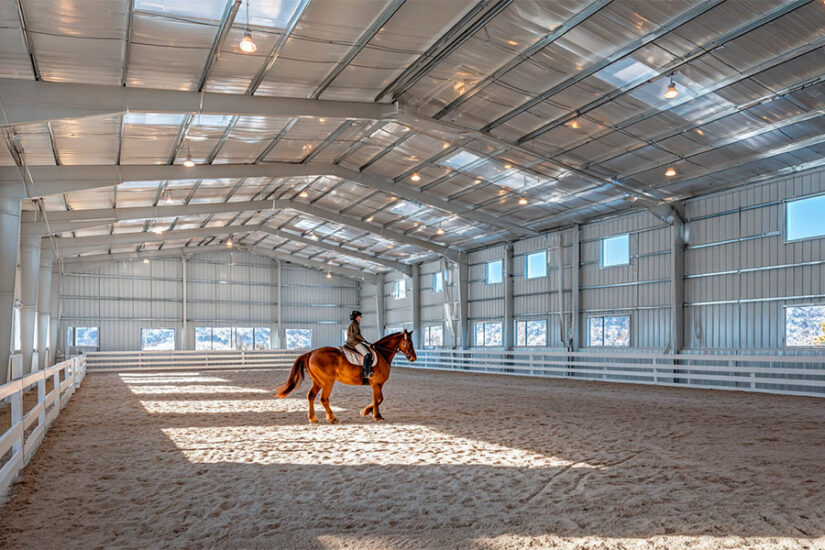

For most owners researching an indoor arena, the real answer sits in an awkward middle. More than the kit price quoted online. Less than the worst-case figure floating around forums. A bare steel riding arena kit for a 60 by 120 lands around $40,000. The same arena, finished to the point where a horse actually walks on prepared footing under proper lights, runs $150,000 to $250,000 in most US regions. A 100 by 200 commercial-grade build runs $400,000 to $500,000 turnkey, and a premium training facility can clear $700,000 without trying.
Where you land in that range comes down to four real decisions – size, structure type, footing, and how much of the work you’re willing to live without. The number you see on a manufacturer’s website is almost always for the kit alone. The number you pay is almost always two to three times that.
This is what those numbers actually cover, what most owners get wrong about them, and the line items that get sprung on you after you’ve signed.
Quick Answer (2026)
Steel kit, 60×120: $35K–$55K
Turnkey 60×120: $150K–$250K
Turnkey 80×200 (dressage size): $300K–$450K
Turnkey 100×200 (commercial): $400K–$500K+
National turnkey average: about $325,000
Per sq ft, turnkey: $40–$125
Steel kit lead time runs 8 to 16 weeks. Permits take another 4 to 12. A clean indoor build is in the saddle 5 to 8 months after the contract.
Where the Kit Price Ends and the Real Bill Starts
The biggest single source of sticker shock is what the kit doesn’t include. The steel kit is the frame, roof, walls, and the doors you specified. It doesn’t include the slab you’ll bolt it to, the footing you’ll ride on, the lighting that lets you ride at night, the electrical service that feeds the lights, or the permit your county will demand.
If someone quotes you $40K for a 60 by 120 and then walks away, you still have an empty box on raw dirt. You need:
- Site survey and grading. $5K–$25K. Flat cleared pasture is cheap. Sloped wooded clay is not.
- Foundation. $18K–$45K for a perimeter strip with anchor pads under each frame line.
- Drainage. $5K–$20K. Skip this and the arena fails in year two regardless of what’s on top.
- Footing system. $10K–$40K for the base, sub-base, and riding surface combined.
- Lighting and electrical. $10K–$30K.
- Doors, ventilation, and trim. $5K–$15K.
- Permits and engineering. $2K–$12K.
- General contractor margin. 15–25% on the managed portion.
Add it up and a $40K kit becomes a $150K building. There’s no trick to it – just a lot of separate trades that nobody mentions when they email you the kit price.
Cost by Size, in Plain English
| Size | Sq ft | Kit only | Turnkey (full build) | What it actually fits |
| 60 × 120 | 7,200 | $35K–$55K | $150K–$250K | One rider, flatwork and basic schooling. The floor of “useful.” |
| 70 × 140 | 9,800 | $40K–$70K | $200K–$340K | Two horses working, small clinic. Comfortable private size. |
| 80 × 200 | 16,000 | $60K–$110K | $300K–$450K | Full 20×60 m dressage court with a safety border. Serious training. |
| 100 × 200 | 20,000 | $100K–$200K | $400K–$500K+ | Commercial, multi-discipline, lesson program, hosting shows. |
Per-square-foot cost drops as the building gets bigger. A 60 by 120 carries the same engineering fee and permit cost as an 80 by 200, so its math runs naturally higher per square foot.
Most private owners who ride consistently year-round end up happiest somewhere between 70×140 and 80×200. Smaller arenas work, and plenty of riders ride out their careers in a 60×120, but the space starts feeling cramped faster than people expect once a few jumps, a lesson horse, or a second rider enters the picture. The conversation that comes up six months after delivery, on the kits US Patriot Steel ships, is owners wishing they had added another 20 feet of length before the slab was poured. The marginal cost at design time is $10K–$25K. The cost to add it after the build is closer to double the original kit price, because the roof line, foundation, and steel framing have to be re-engineered.
Steel, Fabric, or Wood – the Cost Ordering Changed
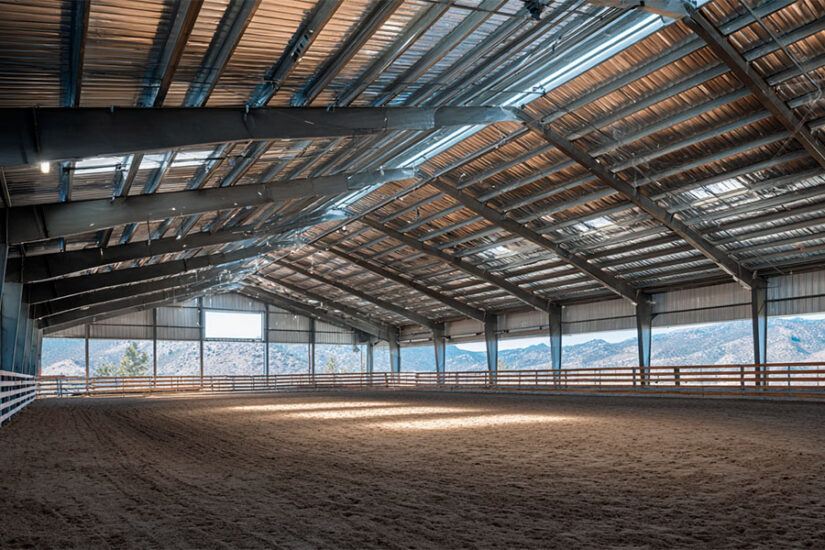
For years the default assumption was that wood is the cheap option. That stopped being true sometime around 2022, depending on the region. At 2026 lumber prices, a wood post-frame riding arena over 60 feet wide runs 10 to 20 percent more than the steel clear-span equivalent, plus 20 years of termite, rot, and woodpecker maintenance that steel doesn’t carry.
Steel clear-span is the default for anything over 70 feet wide. The math works because steel handles a wide unsupported roof span with less material than wood does, and the difference grows fast as you go up in size.
Fabric tension structures (high-tension PVC roof and walls on steel hoops) are the wildcard. The kit costs slightly less than steel clear-span. The turnkey cost is the same because the foundation, footing, lighting, and drainage cost the same regardless of what’s above them. Fabric pays you back in two places: daytime lighting savings (translucent roof) and shorter erection time. It costs you in places too: the fabric itself needs replacement around year 17, and heavy snow, ice, or a falling tree limb is a real worry that doesn’t exist with steel.
In practice, most US private builds over 70 feet wide come out as steel clear-span. The math tilts that way once the building gets bigger than a small workshop, and the long-term maintenance gap with wood widens every year after the build.
Biggest Regrets After Arena Builds
The part contractors don’t bring up at the quote.
Building too small. Already mentioned above and worth saying twice. Inside 18 months most owners wish they had built one size up. The fix later is roughly double the cost.
Skimping on drainage. A $7,500 perimeter drain and geotextile package looks like an easy line to cut. Four years later the base is rebuilt because surface water has destroyed it from below, and the bill clears $30K–$60K. In wet states – Pacific Northwest, the Carolinas, the Gulf, the Northeast – bad drainage destroys arenas faster than heavy riding does. Owners tend to spend too much on footing and not quite enough on drainage. Usually it should be the other way around.
Going too deep on the footing. More sand sounds like more cushion. It isn’t. Four inches of top sand strains tendons, especially under collected work or jumping. Two to three inches is the working range. Going deeper is the most common reason a vet flags suspensory issues at year two on a brand-new arena.
Cheap doors that won’t clear an arena drag. A 10-foot end door catches the drag arms on every pass. Plan for 12 by 14 minimum on at least one end door, even if it costs $2K more.
Lighting that looks fine the day it’s installed. A grid of 12 LED high-bays looks bright on day one. Two years in, when half the bulbs have dimmed and the rest cast shadows between fixtures, riders quietly give up on evening work and the arena sits dark from October through March. Spec at least 30 foot-candles average across the riding surface, with under 3:1 max-to-min uniformity. An electrician who doesn’t talk in those numbers should not be the electrician.
Forgetting that horses live in this building too. Five small things owners discover the hard way after the first winter. Condensation drips off the underside of an uninsulated metal roof on cold mornings and lands on whatever is below it – usually saddles. Tractors and ATVs rut soft footing within a week if anyone drives across the riding surface to get to a back door. Horses refuse the dark corner of the arena when lighting drops below about 15 foot-candles, and most uniform-looking installs do exactly that in the corners. Footing near the end doors freezes solid two weeks before the rest of the arena does, because cold air pours in every time the door opens. And indoor dust coats everything in the tack room within a month if there’s no door between the arena and the tack space – every bridle, every blanket, every helmet. None of these show up on a quote. All of them show up on day 200.
What Contractors Bon’t Tell You
Site work is where arena budgets quietly explode. The grading line item assumes the site that got walked the day of the quote. If the dozer hits ledge two feet down on day three, blasting runs $4–$8 per cubic yard plus a week of delay. If the topsoil is twice as deep as the contractor expected, that’s another $5K–$15K. A $200 soil test before signing saves more money than any other single line item in arena planning, and almost nobody does one.
Footing freight costs almost as much as the footing. A truckload of washed silica sand from the nearest quarry runs $300–$800 in delivery on top of the material price. A 60×120 arena needs roughly 20 truckloads. Always get the per-ton delivered cost, not just the per-ton material cost, when comparing footing quotes. The cheaper material with a longer haul almost always costs more total.
Slope kills you on concrete day. A perimeter strip foundation needs a concrete pump if the site has any slope or limited truck access. That’s $1,500–$3,500 per pour and it almost never shows up on a kit-only quote because the kit supplier doesn’t know what the site looks like.
Permit fees breed. The $2,000 building permit budgeted on day one often comes with separate $300–$1,500 add-ons for stormwater, electrical, and a fire-marshal review. Call the county permit office before the project starts and ask for every fee that applies to “covered agricultural structure.” Then assume there’s more. There usually is.
If You’re a Private Owner
You’re probably building 60 by 120 to 70 by 140. You ride three to five times a week. You don’t need lighting that supports show jumping at night, and you don’t need a full HVAC system.
Spend on: base, drainage, decent footing (sand with fiber, $2.50–$4.50/sq ft), one good 12×14 door.
Skip: HVAC, premium engineered footing, viewing gallery, finished tack room (rough it for now, finish later).
Realistic 2026 budget: $150K–$220K turnkey in most regions.
If You Run a Lesson or Training Barn
You need 80 by 200 minimum if you’re teaching more than one rider at a time. Lessons mean horses on the surface 6+ hours a day, so the footing has to be a step up – sand with rubber or sand with fiber at $4–$6/sq ft. Lighting is non-negotiable because half your business runs after school and after work.
Spend on: oversized doors (mounted rider clearance), heavy-duty footing, redundant LED lighting, perimeter rail and kickboards, two restrooms.
Realistic 2026 budget: $350K–$500K turnkey.
If You’re a Breeder, Trainer, or Competition Facility
You’re building 100 by 200, possibly larger, and the footing line alone is $30K–$60K. Branded engineered footing (GGT, Pinnacle, Attwood) is the default at this tier. Insulation matters because horses produce condensation and you don’t want it raining inside the building.
Spend on: engineered footing installed by a certified crew, full HVAC if you’re in a temperature-extreme region, mirrors for dressage, viewing gallery, tack and feed rooms.
Realistic 2026 budget: $500K–$1.2M turnkey.
Cost by State – What Regional Variation Actually Means
Same 80 by 200 turnkey build, varied by state:
| State | Typical 80×200 turnkey | Why |
| Texas, Oklahoma | $250K–$380K | Cheap labor, moderate snow, plenty of steel suppliers |
| Tennessee, Missouri, Kentucky | $290K–$430K | Strong equestrian market, mid-range labor |
| Florida | $310K–$480K | Hurricane wind rating adds to kit and foundation |
| Virginia, North Carolina | $310K–$470K | Mountain sites cost more for site prep |
| Colorado, Montana, Idaho | $340K–$500K+ | Heavy snow load engineering, higher labor, rocky sites |
| New York, Pennsylvania | $360K–$540K | Snow engineering plus regional permit complexity |
| California | $400K–$650K+ | Highest labor, seismic engineering, strict permits |
These are starting points. A real builder walks the site, checks the permit office, and prices the actual labor pool. The numbers above are useful for setting expectations before quotes start coming in, not as a final budget.
In real projects, an owner in Texas and an owner in California are not running the same build even on identical specs. The kit might cost the same. The labor, the engineering, the permit path won’t. Budget against the local market, not the national average.
US Patriot Steel has shipped kits to all 48 continental US states since 2005. Alaska and Hawaii get skipped because over-water freight on oversized steel doesn’t pencil out, and most island and Alaska builds end up sourcing locally regardless. For owners outside the continental US, a regional manufacturer is the practical path.
Riding Arena Footing
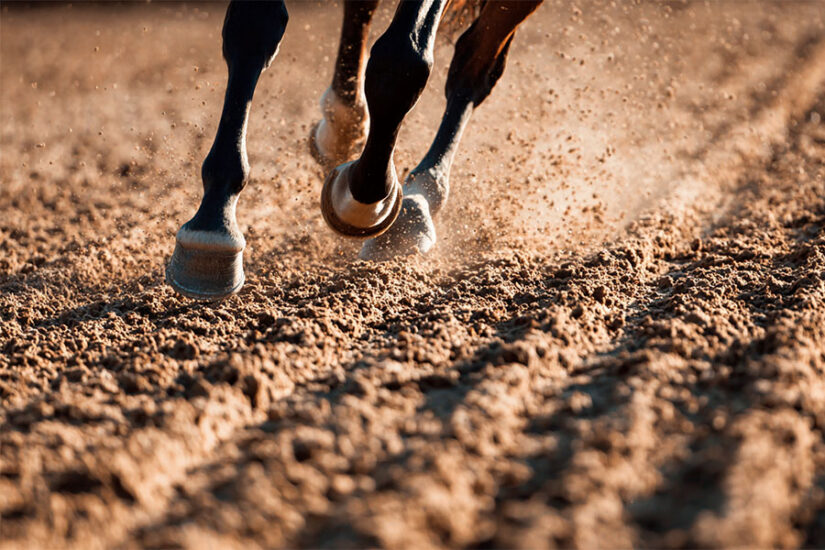
Footing is its own world, but here’s the short version for budgeting an arena build:
- Plain washed sand: $1–$2/sq ft installed. Trail riding, ranch use, low intensity.
- Sand with fiber: $2.50–$4.50/sq ft. Dressage, jumping, lessons. The default for most serious private arenas.
- Sand with rubber: $3–$5/sq ft. Jumping facilities especially.
- Engineered branded footing (GGT, Pinnacle, Attwood): $5–$12/sq ft. Competition tier.
The Penn State Extension equine program puts the criterion as plainly as it gets: a perfect riding surface is cushioned, gives traction, isn’t slick or dusty, isn’t abrasive, is inexpensive, and is easy to maintain. No single material hits all six. The right blend depends on the discipline being ridden and the climate the arena sits in.
If footing is the part that keeps you up at night, spend serious time on it before signing anything. Surface mistakes are expensive to undo later, and a wrong call can turn a $200,000 arena into a building that horses don’t want to work in. The horse arena footing guide walks through materials, layer engineering, ranked picks by discipline, and maintenance. The Penn State original is at extension.psu.edu/riding-arena-footing-material-selection-and-management – academic, free, and worth an evening.
Maintenance and the 15-Year Number
A new arena is not a one-time expense. Yearly running cost for a private 60×120 to 80×200 indoor arena lands somewhere between $5K and $20K depending on footing, lighting type, and climate. Over a 15-year ownership window, you’ll add roughly $75K to $300K to the original build cost.
Premium footing costs more upfront and less over time. Cheap sand costs less upfront and chews through replacement cycles every three to five years. The math usually favors paying once if you plan to keep the property.
Does it Add Property Value?
It depends on who’s buying. A 40-acre Kentucky horse farm with a new $400K indoor arena will appraise about $200K–$300K higher than the same farm without it – call it 50 to 75 percent recovery. The same arena on a 5-acre suburban lot may recover less than half its cost because the buyer pool is too narrow.
If you’re building primarily for resale, do it on a property in an established equestrian region. If you’re building primarily to ride year-round in any weather, don’t anchor the decision on appraisal recovery in the first place.
How to Actually Decide
Walking through a budget with five questions, in order:
What discipline drives the design? Dressage needs the 80×200 court. Jumping needs the height (18 ft to peak). Western and trail can live with 60×120.
How many days a week will the arena get used? Three to five for a private rider, six to seven for a lesson barn. Wear-and-tear scales with that, and your footing choice should too.
What’s the site really like? Slope, drainage, soil, distance to electric service, access for delivery trucks. A two-hour site walk with the builder before you sign saves $20K in surprises.
What’s the total budget ceiling, build plus 15 years of running cost? The cheaper build is often more expensive over time. Run the 15-year number before you commit.
Who’s going to manage the project? An owner who hires a single design-build firm pays a bundled price with one point of contact. An owner who acts as their own GC saves 15–25% and spends every weekend on the phone with subs.
For the actual step-by-step build sequence – what happens in what order and what you can DIY – the step-by-step horse arena construction guide walks through it.
Frequently Asked Questions
Around $400,000 to $500,000 turnkey in 2026 for a steel clear-span shell with mid-range footing, full lighting, two doors, and permits. The kit by itself runs $100K–$200K. A premium build with engineered footing, full HVAC, and a finished viewing gallery can clear $700K.
For a private owner, 60×120 is the floor and 70×140 is more comfortable. For dressage at any serious level, 80×200 to contain a full 20×60 m court with a safety border. For commercial work or hosting shows, 100×200. Interior height should be 16 ft minimum, 18 ft if anyone’s jumping.
A 60×120 steel kit on an owner-prepared slab with plain washed-sand footing, owner-managed instead of a general contractor, can land at $90K–$130K in 2026 in a low-cost state like Texas or Oklahoma. Going smaller than 60×120 is usually false economy because the fixed costs (permits, mobilization, foundation crew minimums) don’t shrink.
Four to nine months from contract to first ride. Permit review is 4–12 weeks. Steel kit lead time is 8–16 weeks. Site prep and foundation take 2–6 weeks. Shell erection is 1–3 weeks for a 60×120. Footing install adds another 1–2 weeks. Cold-climate builds usually pause through hard winter.
Yes in almost every US county. Cost runs $1,000–$10,000 depending on the jurisdiction. Some agricultural-zoned counties have streamlined ag-exempt permits that move faster and cost less – worth asking about before applying for a full commercial permit.
Sand with synthetic fiber for most private arenas ($2.50–$4.50 per sq ft installed). Sand with rubber crumb for jumping facilities specifically. A branded engineered blend (GGT, Pinnacle, Attwood) if the arena will host shows or run lessons all day.
$5K–$20K a year for a private 60×120 to 80×200. Footing maintenance is the biggest line – dragging, watering, top-up sand. Dust control is the second. Lighting electricity and lamp replacement is the third. Over 15 years of ownership, plan on adding $75K–$300K to the original build cost.
The Three Things Worth Getting Right
Most indoor arena builds in 2026 succeed or fail on three decisions made before the slab is poured. Almost everything after that is execution problems, which are mostly solvable as they come up.
Size. Build one footprint larger than feels comfortable. That’s it. The marginal cost is the cheapest expansion money will ever buy.
Drainage. A perimeter drain, geotextile fabric, and a 1 to 1.5 percent surface crown are the difference between an arena that rides well in year ten and one that turns to soup after the third wet spring. Drainage costs less than footing and matters more, especially in wet states. This is the line owners cut to save $7,500 and end up paying $40,000 to redo four years later.
Scope honesty. The kit price is not the build price. The build price is roughly two to three times the kit price for a typical turnkey project. Plan against the build price from day one. Owners who plan against the kit number are the ones who run out of money halfway through and live with an unfinished arena for two years before they can finish it.
Get those three right and the rest of the project, while not exactly easy, is workable.
More in This Guide
A few related reads if you want to go deeper on a specific piece of the build:
- The horse arena footing guide – materials, depths, what fails and why.
- Horse arena construction – the contractor-grade engineering side: code, structural specs, build sequence as engineering protocol.
- How to build a horse arena – the owner’s view, what you do at each step and what you hand to a pro.
- How big should a horse riding arena be? – sizing by discipline and use.
- Concrete slab thickness for steel buildings – slab spec for arena foundations.
References
A handful of sources worth cross-checking against when arena cost numbers are in question.
- Penn State Extension (Eileen E. Fabian Wheeler, Ph.D., with Jennifer Zajaczkowski, Restless Winds Farm). Riding Arena Footing Material Selection and Management. The serious academic reference on arena surface decisions. extension.psu.edu
- Eileen Fabian Wheeler, Ph.D. Horse Stable and Riding Arena Design. Wiley-Blackwell, 2006. ISBN 9780813828596 – the textbook on equestrian facility planning if you want the full deep dive.
- HomeAdvisor. How Much Does a Riding Indoor Arena Cost in 2025? – national cost benchmark with methodology citing BLS and customer surveys. homeadvisor.com
- Angi. How Much Does an Indoor Riding Arena Cost? [2026 Data]. – second cost benchmark, used as cross-check. angi.com
- International Code Council. International Residential Code (IRC), 2024 edition. – the model building code most US states adopt for permit and structural requirements. codes.iccsafe.org