
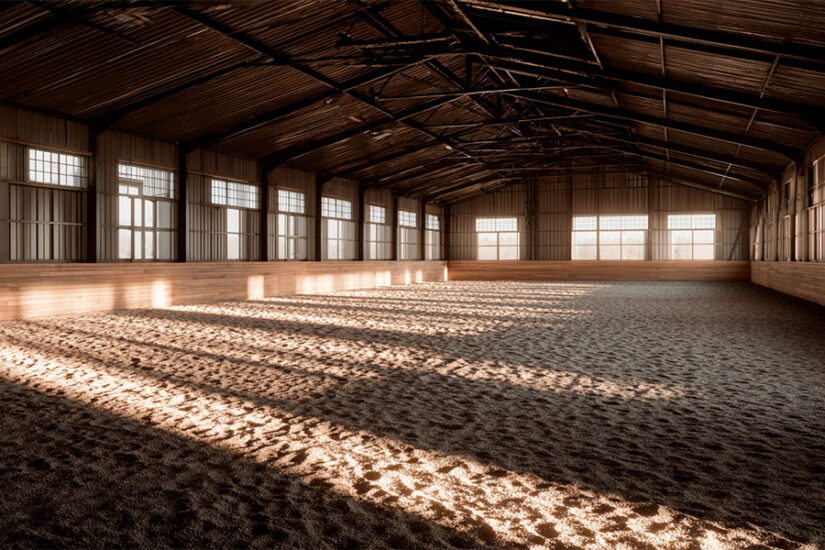

Most owners think of arena footing as the sand the horse walks on. That’s the top inch of a three-layer system, and the layer everyone shops for. The other two layers, the ones nobody talks about, are why one arena rides well for ten years and another goes soft by year two on what looks like identical sand. The footing decision is really three decisions: the base, the sub-base, and the top layer. The top is the one that gets the brochure. The base is the one that decides whether the arena lasts.
A workable default for most US private arenas in 2026: two to two and a half inches of washed silica sand with five to ten percent synthetic fiber, on four to six inches of compacted ¾-inch crushed stone base, with two to four inches of stone-dust sub-base in between, all laid on a geotextile fabric separation layer over compacted subgrade. Budget $1.50 to $5 per square foot installed for the footing layers, which works out to $11,000 to $36,000 for a standard 60×120 arena.
That’s the short answer. The longer version covers materials, layer depths, climate adaptations, what changes by discipline, maintenance reality, and the mistakes that show up most often on private arena builds.
Quick Reference (2026)
Base: 4–6 in compacted ¾” minus crushed stone, two-lift placement, 95% Proctor
Sub-base: 2–4 in stone dust or quarry screenings, lightly compacted
Top (riding surface): 2–3 in of chosen footing material
Geotextile separator: non-woven, 4–6 oz/sq yd
Perimeter drain: 4-in perforated pipe in washed gravel, geotextile sock
Surface crown: 1–1.5% indoor, 1.5–2% outdoor
Indoor sweet spot: silica sand + 5–10% synthetic fiber, 2–2.5 in
Show-grade default: branded engineered blend (GGT, Pinnacle, Attwood)
Cost (footing layers only, 60×120): $11K–$36K materials and labor
The three-layer system
A correctly built arena footing has three structural layers, each doing different work.
The base is the structural foundation. Four to six inches of three-quarter-inch minus crushed stone or limestone, placed in two lifts of two to three inches each, compacted between lifts to roughly 95% Standard Proctor density. The base carries every load the arena will ever see – a 1,200-pound horse moving at speed, the drag tractor, the watering equipment, the occasional truck delivering footing top-up. It also drains. Water passes through the void space between stones and exits through the perimeter drain at the subgrade level.
The sub-base sits on top of the base, two to four inches of stone dust or quarry screenings, lightly compacted. Lightly is the key word. Fully compacting the sub-base creates a hard pan that the top footing can’t bond to and water can’t drain through. The sub-base levels the base, takes the laser-leveled crown profile, and gives the top layer something stable to ride on.
The top layer is the riding surface, two to three inches of sand, sand with fiber, sand with rubber, or a branded engineered blend. This is the layer everyone shops for and the one that gets all the attention. It’s also the layer that fails most visibly, fastest, and most spectacularly when the base under it isn’t right.
Skip any of the three and the surface fails. No base means water sits and the arena turns to mud after every storm. No sub-base means the top sand migrates down into the rock and disappears. The wrong top means horses get hurt, or just won’t work on it.
The Six Materials Worth Considering in 2026
Most arena surfaces in the US are built around one of these six options. Each has a place; none is universally best.
Washed concrete sand (mason sand). The cheapest option and the default for ranch and trail arenas across Texas, Oklahoma, and the Plains states. Angular grains give some grip. Most quarries carry it. The downsides show up by week three: it compacts hard when dry, gets deep and heavy when wet, throws dust without daily watering, and breaks down to a finer particle size within three to five years of regular riding. Use it over a stone-dust sub-base at two to three inches. Cost: $0.50–$1.00 per square foot installed.
Silica sand (quartz sand). A meaningful step up. Grains are rounder and more uniform in size, which gives the surface less compaction and longer life. The cost climbs because silica ships from fewer quarries, especially east of the Mississippi. Use at three inches over stone dust. Cost: $1.00–$1.75 per square foot installed.
Sand with synthetic fiber blend. Sand mixed with chopped polyester, polypropylene, or nylon fibers, typically at five to ten percent by volume. The fibers act like a hidden mesh that holds sand grains in place, so the surface rides more like turf on soil than loose sand. This is what most show-quality private arenas in the US ride on in 2026. The Penn State Extension equine program (Eileen E. Fabian Wheeler, Ph.D., with Jennifer Zajaczkowski) describes the criterion plainly: a perfect riding surface is cushioned, gives traction, isn’t slick or dusty, isn’t abrasive to hooves, is inexpensive, and is easy to maintain. No material hits all six. Fiber blends come closest. Best for dressage, jumping, eventing, reining, and cutting. Two to three inches over stone dust. Cost: $2.50–$4.50 per square foot installed.
Sand with rubber crumb blend. Sand mixed with shredded or granulated rubber, often recycled tire rubber in 1/4 to 3/8 inch granules. The rubber adds cushion. Concussion drops noticeably for horses jumping repeated rounds. Best for jumping arenas, gaited horses, and any horse with a soundness history. Two to three inches over stone dust. Cost: $2.00–$3.50 per square foot installed. Two caveats. Rubber drifts to low spots if the arena isn’t properly crowned, leaving rubber-rich corners that ride sponge-soft and rubber-poor zones that ride harder than expected. And in heavy-rain outdoor regions the rubber granules slowly migrate over the rail in storm events.
Premium engineered footing. Branded, lab-tested blends of silica sand, proprietary fibers, sometimes textile chips or wax coatings. GGT, TruStride, Pinnacle, and Attwood are the names visible at Wellington, Devon, Tryon, and the World Equestrian Center in Ocala. Best for serious competition training facilities, breeding and sales barns, and high-end private arenas. Depth is manufacturer-specified, usually two to three inches over a custom geotextile sub-base. Cost: $4.00–$8.00 or more per square foot installed. Most manufacturers won’t warranty the product unless installed by a certified crew, which adds to the bill but transfers install risk away from the owner.
Wood products (shavings, bark, hog fuel). Mostly seen in covered arenas across western Oregon, western Washington, the Idaho panhandle, and small New England barns. Cheap locally where lumber is abundant, problematic everywhere else. Wood decomposes into mud, breeds bacteria, holds moisture, and needs full replacement every one to three years. Acceptable for a low-use private arena in a wet, forested region. Not for show work, not for commercial training. Cost: $0.50–$1.50 per square foot, paid frequently.
Best Picks by Discipline
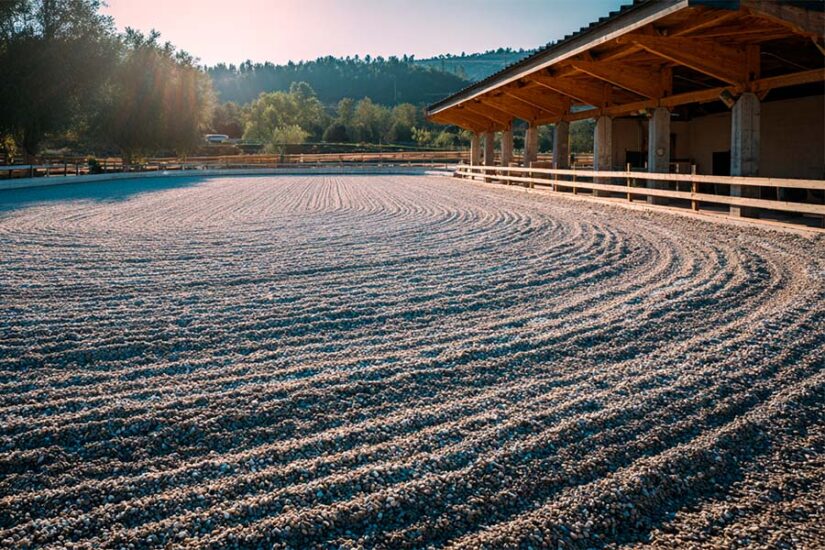
Different disciplines load the horse in different directions and at different speeds, so the right footing changes with what the arena will actually be ridden in. The tables below rank the practical options for each.
Dressage
The dressage horse moves in collected, medium, and extended gaits, with lateral work that loads the inside hind in every direction. The footing has to grip evenly without grabbing, and rebound predictably. Inconsistency shows up in the horse’s tempo before it shows up to the rider.
| Rank | Footing | Depth | Price per sq ft | Notes |
| 1 | Branded engineered (GGT-class) | 2–2.5 in | $4–$8+ | Show-grade rebound, minimal maintenance variation |
| 2 | Silica sand + 7–10% fiber | 2–2.5 in | $2.50–$4.50 | The default for most serious private dressage arenas |
| 3 | Silica sand, no fiber | 3 in | $1–$1.75 | Workable for schooling, dusty without daily water |
| 4 | Concrete sand | 2.5 in | $0.50–$1 | Budget option, short lifespan and dust |
The gap between rank 1 and rank 2 is smaller than the price difference suggests for private use. Most private dressage owners are happy on the fiber blend. The engineered tier mainly pays off when the surface is in daily use by multiple horses or when the rider is competing at a level where small differences in surface consistency matter.
Jumping (Show Jumping, Hunter, Eventing)
A jumping horse takes a one-stride compression on every landing – three to five times the horse’s body weight, concentrated on the leading front leg. The footing has to absorb that impact without going so deep it strains the tendons coming out. The fastest way to chronic suspensory issues is too much sand.
| Rank | Footing | Depth | Price per sq ft | Notes |
| 1 | Branded engineered (GGT, Attwood) | 2.5–3 in | $5–$8+ | What’s used at WEC, Wellington, Tryon, Devon |
| 2 | Sand + rubber crumb | 2.5–3 in | $2–$3.50 | Strong cushion at a fair price; mind the drift |
| 3 | Sand + synthetic fiber | 2.5–3 in | $2.50–$4.50 | Excellent for daily training |
| 4 | Sand + fiber + rubber mix | 3 in | $3–$5 | Custom blends, regional installers |
The catch with rubber crumb in jumping arenas: it migrates. In a sloped or improperly crowned arena, rubber slowly drifts to the low end and accumulates by the rail. After two years the arena has a rubber-rich zone and a rubber-poor zone, and one corner rides like landing in a sponge while the other rides like landing on a sidewalk.
Reining, Cutting, and Ranch Sorting
The reining horse slides 20 feet on his hocks. The cutting horse pivots at a hand gallop. Both need a footing that grips on demand but releases on cue.
| Rank | Footing | Depth | Price per sq ft | Notes |
| 1 | Silica sand + 8–12% fiber | 2.5–3 in | $3–$5 | The standard at top reining barns in Oklahoma and Texas |
| 2 | Concrete sand + high fiber percent | 2.5–3 in | $2–$3 | Lower-cost alternative for working barns |
| 3 | Branded reining-specific blend (Pinnacle) | 2.5–3 in | $4–$7 | If NRHA scores matter |
| 4 | Sand alone | 3 in | $0.50–$1.75 | Recreational reining and ranch sorting only |
A note specific to reining: the slide is a function of the top inch of footing, but the spin is a function of the next two inches down. A perfect slide layer on a soft sub-base produces a horse that slides 30 feet on the first run of the day and 12 feet on the eighth, because the lower layer has shifted under repeated load. The fix is base depth, not surface choice.
Barrel Racing and Speed Events
Barrel horses run at speed and turn 360 degrees three times in 17 seconds. The footing has to give a quick lateral bite without the front end losing traction at the second-barrel turn.
| Rank | Footing | Depth | Price per sq ft | Notes |
| 1 | Coarse silica sand + fiber | 2.5–3 in | $3–$5 | Quick grip, drains well |
| 2 | Sand + rubber + fiber | 3 in | $3–$5 | Cushion plus grip for high-mileage horses |
| 3 | Concrete sand + light fiber | 2.5–3 in | $2–$3 | Workable budget option |
| 4 | Sand alone | 3 in | $0.50–$1.75 | Budget barns; expect grooming every ride |
By Budget Tier (60×120 Arena)
A different way to look at the same picture, sized for a standard 60 by 120 foot arena (7,200 square feet) and not counting base or sub-base.
Under $7,500. Plain concrete sand, 2.5 inches, over a stone-dust sub-base. Acceptable for ranch, trail, lessons on a budget, and any private arena that will see light use. Plan to top-dress at year two and replace at year four or five. Expect dust without daily watering.
$8,000 to $15,000. Silica sand, 3 inches, possibly with a low fiber percentage. Works for general dressage schooling and lower-level jumping. The cleanest step up from the budget tier without committing to a full fiber blend.
$18,000 to $32,000. Silica sand with 7 to 10 percent fiber, 2 to 2.5 inches deep. The sweet spot for most private US arenas in 2026. Rides like show footing at a price most owners can absorb in the larger arena build budget. Lifespan of seven to ten years with annual top-up makes the per-year cost lower than the cheaper options.
$30,000 to $60,000+. Branded engineered blend installed by a certified crew, with manufacturer warranty. The cost is justified for breeding and sales barns where the surface affects buyer evaluation rides, for competition training facilities, and for owners who specifically want the surface used at WEC Ocala or Wellington at home.
Layer Depths: the Engineering Numbers
The proven cross-section, top to bottom, for most US riding disciplines runs as follows.
| Layer | Material | Depth | Purpose |
| Top (riding surface) | Sand blend, with fiber or rubber | 2–3 in | Cushion, grip, dust control |
| Sub-base | Stone dust or screenings | 2–4 in | Locks the base, supports top |
| Base | Crushed rock (¾” minus) | 4–6 in | Drainage, structural support |
| Sub-grade | Compacted native soil | n/a | Foundation for the whole stack |
Two inches is the magic number for the top layer. Less than that and the horse risks concussion on hard ground. More than three inches and tendons strain pulling out of deep surface. That extra depth is the single most common cause of suspensory injuries in private arenas. Top dressage competitors ride on roughly 2 to 2.5 inches at major US shows.
Base depth scales up with climate, not with arena size. In northern states with frost penetration (the Dakotas, Minnesota, northern New England, northern Mountain West), the base goes to 8 to 10 inches because thin bases heave in frost cycles. In wet states, the base gets a 6-ounce geotextile fabric instead of a 4-ounce. In dry desert states the base can sometimes drop to 4 inches without consequence. The arena’s footprint does not change the base depth.
The geotextile separator is the line owners cut most often to save money and regret most often within four years. A non-woven, 4 to 6 ounce per square yard separation-grade fabric sits between the compacted subgrade and the base. The fabric stops fines from native soil from migrating upward into the void space of the base under repeated load. Without it, the base contaminates from below in roughly two to five years depending on subgrade quality. Cost is $0.30 to $0.50 per square foot for material plus $0.20 to $0.40 for install. Skipping it saves about $5,000 on a 60×120 arena and creates a $25,000 to $40,000 problem four years later when the base has to be torn out and redone.
Climate Changes the Spec More than Discipline does
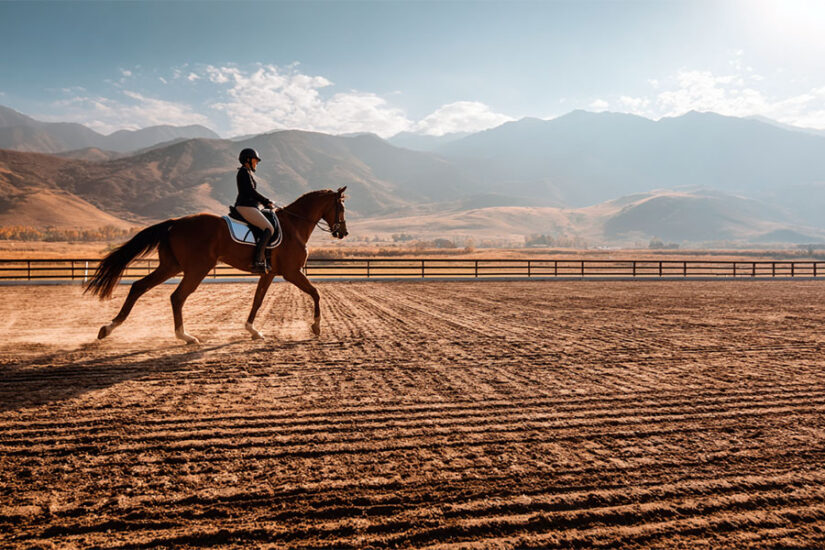
Footing decisions shift more by climate than by what the arena is ridden in. The same fiber blend behaves very differently in West Texas than it does in the Pacific Northwest.
Dry climates (Texas, Arizona, Nevada, New Mexico, eastern Colorado). Dust is the dominant problem. Fiber and rubber blends suppress dust well. Plain sand needs daily watering. Wax-coated premium footings work only if the arena sees daily use, because the wax oxidizes if the surface sits idle in sun. Crown the surface 1 to 1.5 percent indoors, 1.5 percent outdoors. Watering infrastructure (a hydrant near the arena, or a tow-behind water truck) is more important than premium footing material.
Wet climates (Pacific Northwest, Gulf states, Southeast, Northeast). Drainage is the dominant problem. Crown the arena steeper, 1.5 to 2 percent. Use angular sand (concrete or silica), not rounded river sand, because angular sand drains faster. Skip rubber crumb in heavy-rain regions; the granules drift downhill and end up against the rail during storm events. Use a 6-ounce geotextile fabric, not 4-ounce. Run the perimeter drain to a positive outflow rather than a dry well.
Cold climates (Northern Plains, Mountain West, northern New England). Freeze is the dominant problem. Two operational approaches: either add 5 to 8 percent salt by volume to the top layer to depress the freeze point (extends the riding season by several weeks at the shoulders), or commit to indoor riding from December through March and budget for a covered, possibly heated arena. Sand with rubber stays softer than plain sand in freezing temperatures, which buys a couple weeks at each end of the season. Footing near end doors freezes solid two weeks before the rest of the arena every winter because every door opening pulls in floor-level cold air. The first hour of the day in January is unrideable in the doorway lanes.
Indoor (any region). Dust is always the issue indoors because there’s no rain to wash the surface. Sand with fiber or a branded engineered blend almost always wins. Plain sand works only if someone is willing to water it daily. Lighting affects how the footing looks but not how it rides – a dead corner at 12 foot-candles rides the same as the center at 30 foot-candles, even if it looks different. Horses know.
Maintenance: What it Actually Takes
A footing system is not install once and forget. The real work breaks down as follows.
Daily to weekly. Drag the surface with an arena drag (chain harrow, leveler, or rotary groomer) to break up packed areas and pull material back to a flat profile. Fifteen to thirty minutes per ride day is normal for active arenas. Owners who skip dragging end up with packed lanes along the rail and a center that scoops out by month four.
Weekly to monthly. Water. Indoor arenas with fiber footing need water every 7 to 14 days. Outdoor plain-sand arenas in dry climates need water every day in summer. Fibers grip best at roughly 8 to 10 percent moisture content. Under-watered fiber dries out and lets the sand slip during turns. Over-watered fiber gets heavy and slow.
Annually. Walk the arena edges with a six-foot level and check for material migration. Pull material back from the rail toward the center if a low pile has formed on the long sides. Inspect the base profile and crown using the same straightedge. Address any subsidence early.
Every 3–7 years. Refresh the top layer. Top up sand to replace what’s broken down, add fresh fiber to replace what’s degraded. Plain sand needs full replacement at this interval. Fiber blends usually need a fiber top-up and a partial sand top-up but rarely a full replacement.
Every 10–15 years. Plan a major rebuild. Strip the top layer, recompact the base if needed, install fresh top. A well-maintained sand-with-fiber footing can ride beautifully for ten years. A neglected one is unsafe inside eighteen months.
Some maintenance details that show up in year one and surprise new owners. Fiber blends shed loose fibers for the first month – visible on tack, on saddle pads, on the inside of helmets. It’s normal and stops after about thirty days of riding. Dust coats everything in the tack room within a month if there’s no door between the arena and the tack space, even with fiber. Tractors and ATVs rut soft footing within a week if anyone drives across the riding surface to get to a back door – and the rut is impossible to fully drag out because it’s compacted into the sub-base. A horse that starts holding back in turns and transitions is usually telling the owner the footing has shifted, even if the rider sees training resistance instead.
What Goes Wrong With Footing Systems
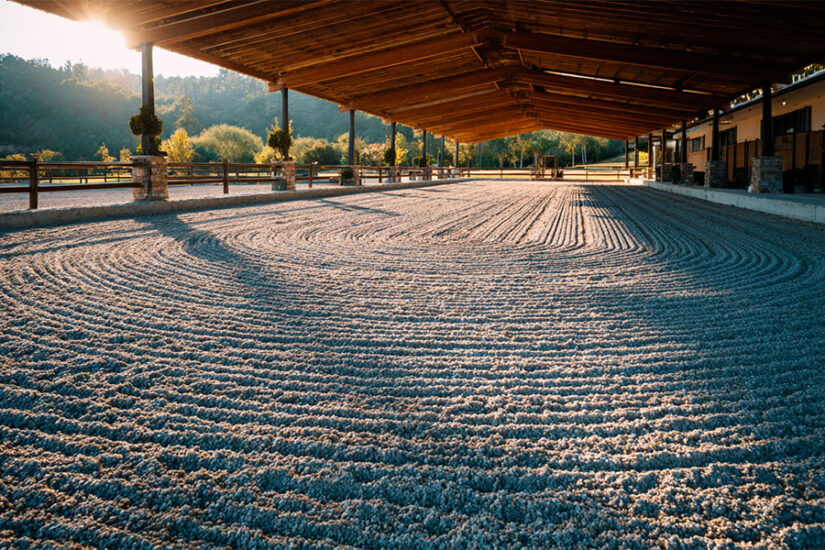
The same five mistakes show up year after year on private arena builds.
Skipping the base. Either no crushed-rock layer at all, or laying sand directly on graded dirt. The footing migrates into the dirt within a season, and the arena turns to mud after the first wet month. The fix is to rebuild from below.
Going too deep on the top. More cushion sounds better than less. It isn’t. Four inches of top sand strains tendons, particularly in disciplines where the horse pulls out of the surface at speed. Two to three inches is the working range. Going deeper is the most common cause of soundness issues showing up on a brand-new arena.
The wrong sand spec. Buying sand from a local pit without checking particle shape, fines content, or gradation. Rounded river sand fails on grip. High-fines mason sand turns to mud. The right arena sand is angular, washed, less than 5 percent fines, and particle size between roughly 0.25 mm and 0.85 mm.
Most quarries that supply construction-grade sand can produce a sieve analysis on request. Some need a day or two to pull it together. A few will say they don’t have one. That last group is usually selling the wrong sand for arena use.
No crown or slope. Flat arenas pool water at the low spots. A 1 to 1.5 percent crown from center to long sides handles 90 percent of drainage problems. Outdoor arenas need the steeper 2 percent.
Skipping the geotextile. Covered above. The base contaminates from below in two to five years without it. The fabric is cheap insurance and replacing the base later is not.
A sixth mistake worth calling out separately: trying to fix a bad base by adding more top material. That never works. Bad base means rebuild from the ground.
Footing Cost for a Standard Arena
A 60 by 120 foot arena covers 7,200 square feet. Realistic 2026 cost for the footing layers alone (not the steel building or site work) looks like this.
| Setup | Top layer | Total cost (60×120) | Notes |
| Budget tier: concrete sand | Plain sand, 2.5 in | $4,500–$7,000 | Ranch and trail use |
| Standard tier: silica sand | Silica, 3 in | $8,000–$12,500 | Better for general riding |
| Premium tier: sand with fiber | Fiber blend, 2.5 in | $18,000–$32,000 | Dressage and jumping quality |
| Elite tier: engineered GGT-class | Proprietary, 2.5 in | $30,000–$60,000+ | Show-grade |
Add another $3,500 to $8,500 for the base and sub-base layers (gravel and stone dust) regardless of which top is chosen. For context against the full arena build, the indoor riding arena cost guide puts the footing line in the larger budget picture. For the base and drainage engineering side, the horse arena construction guide covers code references and compaction specs.
Where to Spend, Where to Save
Spend on the base. Always. Properly compacted crushed rock with geotextile fabric under a stone-dust sub-base outlasts every other layer in the arena. The base is the line where corner-cutting is most expensive long-term.
Spend on drainage. A perimeter drain and geotextile add $2,500 to $7,500 to the project and prevent the failure mode that destroys arenas in clay-soil regions. In wet states, this is non-negotiable.
Save on the top layer if the arena will see trail, pleasure, or light schooling use. Concrete sand at $0.50 to $1 per square foot does the job for everything short of serious training.
Don’t save on the top layer if the arena will host competition or daily training work. The $14,000 price gap between concrete sand and a fiber blend (on a 60×120 arena) buys seven to ten years of show-quality riding and skips the cost of redoing the surface after the first three.
When to Hire a Specialist (and When DIY is OK)
A handy owner with a tractor and a few hundred dollars in gravel can install a basic concrete-sand arena adequately. The parts to hire out are different.
Site grading and base installation should go to a contractor with arena-specific experience, not a generic driveway grader. The laser-graded, properly compacted base is the single largest determinant of whether the arena rides well in year five.
Fiber and rubber blends should be hired out because correct mixing ratio and even spread are difficult to achieve with general-purpose equipment. Engineered branded footings have to be installed by a certified crew or the manufacturer warranty does not apply.
Indoor arenas attached to a steel building kit are usually graded by the same crew that erects the building, which saves a mobilization fee. For US Patriot Steel customers building a covered riding arena (in business since 2005, shipping to all 48 continental US states), footing installation typically happens five to ten days after the building is closed in, the slab is sealed, and the doors are hung.
Frequently Asked Questions
For most US private arenas in 2026: washed silica sand mixed with 5 to 10 percent synthetic fiber, 2 to 2.5 inches deep, on a stone-dust sub-base over a crushed-rock base. Costs $2.50 to $4.50 per square foot installed, lasts seven to ten years, rides well for dressage, jumping, and reining. The branded engineered tier (GGT, Pinnacle, Attwood) is better but mainly for competition use.
The riding top layer should be 2 to 3 inches. Use 2 to 2.5 inches for dressage and general riding, 2.5 to 3 inches for jumping, reining, and cutting. Deeper than 3 inches and the risk of tendon and suspensory ligament strain climbs sharply. Below the riding layer, plan on a 2 to 4 inch compacted stone-dust sub-base and a 4 to 6 inch crushed-rock base.
For a 60 by 120 arena (7,200 sq ft), expect $4,500 to $7,000 for plain concrete sand, $8,000 to $12,500 for silica sand, $18,000 to $32,000 for a sand-with-fiber blend, and $30,000 to $60,000+ for a branded engineered footing. Add $3,500 to $8,500 for the base and sub-base.
Different strengths. Rubber adds the most cushion, which suits jumping and gaited horses. Fiber gives the most consistent grip and rebound, which suits dressage, reining, and cutting. Some premium blends use both at lower percentages.
Branded engineered blends from GGT, Pinnacle, Attwood, and TruStride dominate top-tier US venues like Wellington and the World Equestrian Center in Ocala. These are silica sand with proprietary fiber, sometimes with textile chips or wax coating, installed by manufacturer-certified crews. Cost runs $4 to $8 or more per square foot.
Only if it tests well. Arena-grade sand needs angular grains, particle size between roughly 0.25 mm and 0.85 mm, less than 5 percent fines, and consistent washed gradation. River sand and high-fines mason sand both fail. Ask the quarry for a sieve analysis before signing.
Yes, almost always. Pure sand outdoors in a dry climate needs daily watering. Sand with fiber needs water every 7 to 14 days indoors and more often outdoors. Fibers grip best at 8 to 10 percent moisture. Plan on a water truck, in-arena sprinklers, or a hose-and-sprinkler routine.
Plain concrete or mason sand lasts 3 to 5 years before it breaks down and needs replacement. Silica sand lasts 5 to 7 years. Sand with fiber lasts 7 to 10 years before a major refresh, with annual top-ups. Branded engineered footings last 10 to 15 years with a fiber refresh every 5 to 7 years.
A Practical Way to Think About the Decision
The footing choice narrows down to three questions long before brand comparisons start.
What’s the arena going to be ridden in? Dressage, jumping, reining, or general schooling each push the answer in different directions. A blanket “premium footing” recommendation that ignores discipline is marketing.
Is the base built right? Most footing failures trace back to the base, not the surface choice. The fancy material doesn’t compensate for a cheap base.
And the question owners almost never ask themselves honestly: who’s doing the maintenance? Fiber footing needs water every one to two weeks indoors. Plain sand needs it nearly every day in dry climates. Engineered blends come with a maintenance protocol, and the warranty walks if it isn’t followed. If nobody on the property will reliably do the work, the cheaper footing usually outperforms the fancier one over a five-year window – because the fancier one is being neglected.
Between the top two or three options at any given price tier, the differences are usually small enough not to lose sleep over. Get the three questions above right first.
More in This Guide
A few related reads for the parts of the arena build worth deeper attention:
- Indoor riding arena cost – full pillar with size, type, and US state pricing
- Horse arena construction – base engineering, drainage hydraulics, IBC/IRC/ASCE code references
- How to build a horse arena – owner’s view of the build sequence
- How big should a horse riding arena be? – sizing by discipline
References
Sources worth cross-checking against on footing materials, layer engineering, and discipline standards. All URLs verified live as of May 2026.
- Penn State Extension (Eileen E. Fabian Wheeler, Ph.D., with Jennifer Zajaczkowski, Restless Winds Farm). Riding Arena Footing Material Selection and Management. The academic reference on arena surface decisions. extension.psu.edu
- Eileen Fabian Wheeler, Ph.D. Horse Stable and Riding Arena Design. Wiley-Blackwell, 2006. ISBN 9780813828596 – the textbook for the full deep dive.
- United States Dressage Federation (USDF). Arena dimensions and surface standards for licensed dressage competition. usdf.org
- United States Equestrian Federation (USEF). Rulebook references on arena surfaces in licensed competition. usef.org/forms-pubs/rulebook
- Penn State Extension. Horse Stables, Facilities, and Technology – equine facility design reference library. extension.psu.edu/animals-and-livestock/equine/facilities-and-technology