

Quick Answer
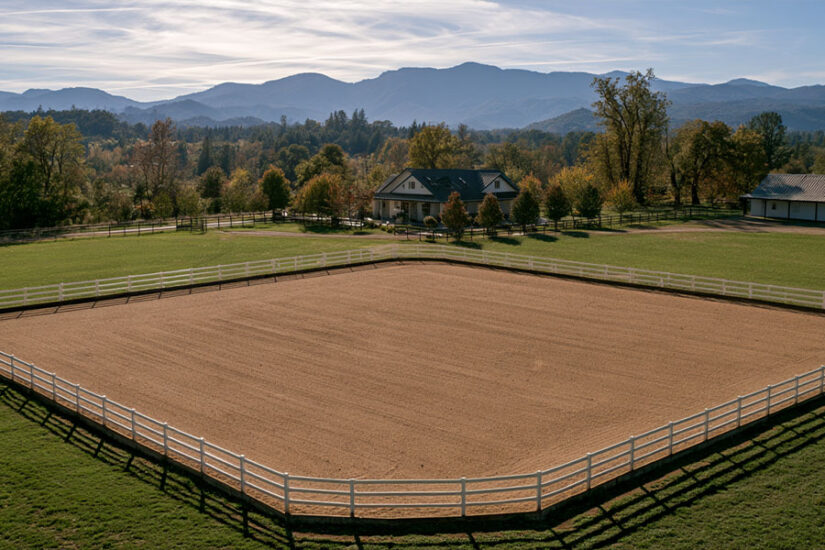
Horse arena size depends mostly on what the arena is for. A general-purpose riding arena works well at 60 by 120 feet, enough room for most recreational riding, lessons, and training that isn’t tied to a specific competition discipline. Competition disciplines follow their own standard dimensions: dressage arenas measure 20 by 40 meters (about 66 by 131 feet) for a small court or 20 by 60 meters (about 66 by 198 feet) for a standard court, under USEF, USDF, and FEI rules. Barrel racing needs roughly 120 feet of width and close to 200 feet of length to fit the National Barrel Horse Association’s official pattern with safe clearance, and cutting typically needs a larger working area plus a separate herd holding pen.
- General/recreational riding: 60×120 ft (practical range 60×100 to 100×200 ft)
- Dressage, small court: ~66×131 ft (20×40 m), USEF / USDF / FEI standard
- Dressage, standard court: ~66×198 ft (20×60 m), USEF / USDF / FEI standard
- Barrel racing: about 120×200 ft minimum to fit NBHA’s official pattern, more preferred
- Cutting: a working area plus a separate herd holding pen; no single association publishes a minimum
How Big Should a Horse Riding Arena Be, in General?
There’s a difference between the smallest horse arena dimensions that technically work and the size most owners actually want to ride in day to day. A horse arena size chart is a useful starting point for comparing options, but the right number always comes down to what the arena is actually for. A horse can walk, trot, and canter a circle in an arena as small as 60 by 100 feet, but that leaves little margin for a green horse, a nervous rider, or more than one pair working at once. Sixty by 120 feet is the practical starting point most builders recommend for a single rider doing flatwork, light jumping, or general training without a specific competition in mind.
Rider count pushes that number up first, and it’s covered in more detail below: more horses and riders working at once means more width. Discipline matters just as much. A horse and rider preparing for dressage tests, barrel racing, or cutting need to practice at or near the actual competition dimensions, not just enough room to move, and some site plans label these same numbers equestrian arena dimensions rather than horse arena measurements, even though they describe the identical footprint. Indoor versus outdoor changes the math again. Indoor arenas usually run smaller than outdoor arenas built for the same purpose, since every extra foot adds to the building’s footprint and cost, while an outdoor arena’s only real constraint is the property line. That tradeoff, and which one makes more sense for a given operation, is covered in US Patriot Steel’s guide to indoor vs. outdoor arenas.
For most owners without a specific competition goal, 60 by 120 feet remains a sound default, close to the average horse arena size builders quote for that exact use case. It’s the number to start from before adjusting up for discipline or rider count.
Standard Horse Arena Sizes by Discipline
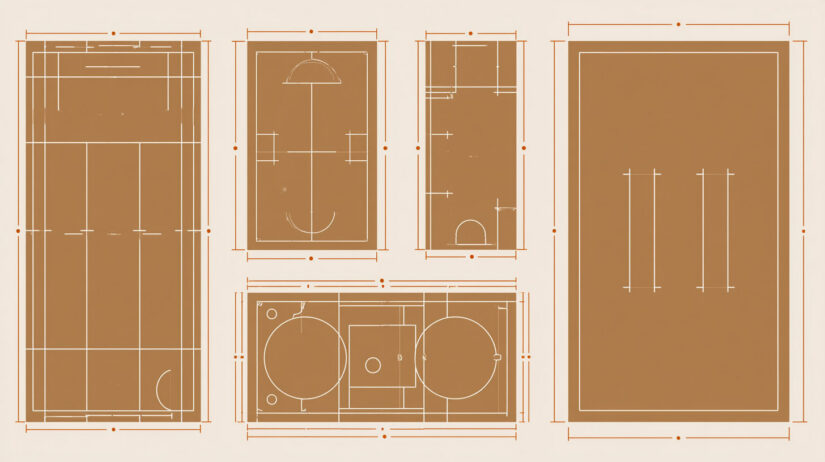
Competition disciplines don’t leave arena size up to guesswork. Dressage, barrel racing, and cutting each come with their own expectations, set either directly by a governing body’s rulebook or by what the pattern itself requires to run safely.
| Discipline | Size in feet | Source |
| Dressage, small court | ~66 × 131 ft (20 × 40 m) | USEF / USDF / FEI |
| Dressage, standard court | ~66 × 198 ft (20 × 60 m) | USEF / USDF / FEI |
| Barrel racing | ~120 × 200 ft minimum, more preferred | Calculated from NBHA pattern measurements |
| Cutting | Working area plus separate herd holding pen, no fixed minimum | Industry practice |
| General/recreational | 60 × 120 ft up to 100 × 200 ft | Industry practice |
Dressage Arena Size in Feet
A dressage arena measures 20 by 40 meters (about 66 by 131 feet) for a small court or 20 by 60 meters (about 66 by 198 feet) for a standard court. The small court is used for training-level tests and the early phases of eventing, while the standard court is what most pure dressage tests above the introductory levels are ridden in. USEF and USDF both build their competition standards around these two dimensions, and they line up with the international arena sizes set by the FEI, so a horse trained to either size is training to the same numbers it will see at a show.
The width stays fixed at 20 meters, about 66 feet, for both courts. Only the length changes, which is why builders sizing a dressage arena from scratch generally plan for the full 66-by-198-foot standard court if the property allows it: a standard-size arena can still host small-court patterns, but a small-court arena can’t host standard-court tests.
Barrel Racing Arena Size
A barrel racing arena needs roughly 120 by 200 feet at minimum to fit the National Barrel Horse Association’s official pattern with safe clearance. NBHA’s rulebook doesn’t publish that number directly, but its pattern measurements do the math for it: the standard pattern sets barrels 1 and 2 about 90 feet apart, with the scoreline 60 feet in front of them, and barrel 3 roughly 105 feet from both. The rulebook also sets minimum clearances: at least 15 feet between each of the first two barrels and the side fence, and at least 30 feet between the third barrel and the back fence.
That 120-by-200 minimum comes straight from those clearances, before adding room for a horse to build speed on the approach or slow down after the last barrel. Many arena builders plan for at least 100 by 200 feet as a working minimum and closer to 150 by 300 feet where the property allows it, since extra length at both ends gives horses more room to run and stop safely.
Cutting Horse Arena Size
A cutting run needs two distinct spaces: a working area where the horse and rider separate a cow from the herd, and a separate holding pen where the rest of the herd stays calm and contained during the run. Cutting doesn’t have one clean number the way dressage and barrel racing do, and no single national association publishes a standard minimum footprint the way USDF and NBHA do; the sizes used across cutting facilities vary more than in either of those disciplines.
What’s consistent is the shape of the problem: a cutting arena needs to be wide enough for a horse to change direction hard without running out of room, and it needs the herd holding area kept genuinely separate from the working space, not just marked off with a rail. Anyone planning a cutting-specific facility should work from an actual competition or clinic host’s layout rather than a single published spec, since local training and show practices vary by region.
General Recreational and Training Arena Sizes
For riders without a specific competition discipline, 60 by 100 to 100 by 200 feet covers most needs. The lower end works for a single horse and rider doing flatwork and light jumping. The upper end starts to accommodate small group lessons, more than one horse working at a time, or a rider who wants room to canter full circles without constantly adjusting the pattern to the fence line.
Choosing Arena Size for How Many Riders You’ll Have
Arena size calculations built around a single horse and rider don’t hold up once more than one pair works at the same time. Width matters more than length here: two horses passing on the rail, or a small group lesson circling at different gaits, need enough side-to-side room that a horse cutting across the arena doesn’t put another horse and rider in a tight spot.
There’s no fixed formula for exactly how many feet to add per additional rider, since it depends on the gaits being worked and how the group is organized. As a practical guide, going from the 60-by-120-foot single-rider minimum toward something closer to 80 by 160 feet gives a second or third rider real working room instead of a shared circle. Boarding facilities and lesson barns that regularly run group sessions tend to plan even larger, since the arena also needs to handle a horse standing, warming up, or being led through at the same time others are actively working.
If riders will mostly work solo with occasional overlap, the general-use range covered above is enough. If group lessons, boarding, or multiple family members riding at once is the normal pattern, sizing up from the start costs less than trying to add width later.
Ceiling Height and Clearance for Indoor Arenas
🖼 Image (Midjourney): interior photo of an indoor steel-frame horse riding arena, tall clear-span ceiling, natural light through translucent panels, sand footing, wide angle showing full height, photorealistic, editorial style –ar 16:9 · alt: “Interior view of an indoor horse riding arena showing ceiling clearance and clear-span structure”
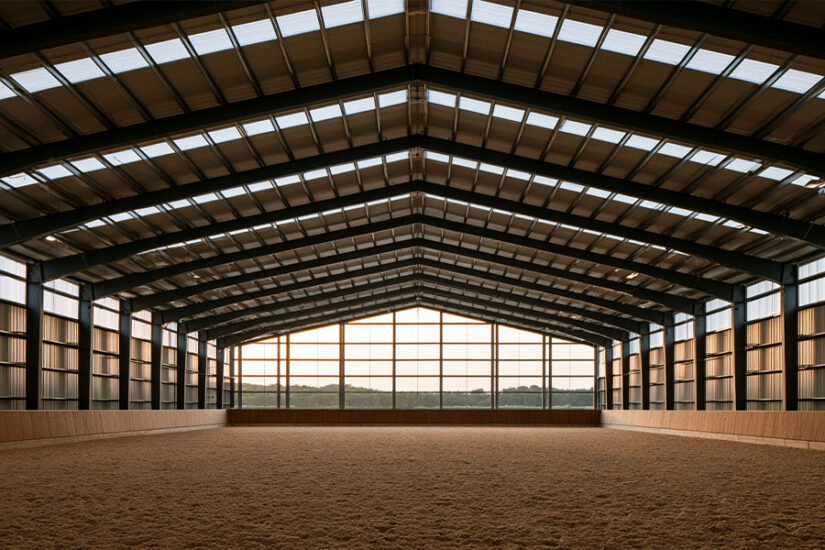
Once the footprint is settled, height is the next question for an indoor arena, and it’s easy to underestimate. A mounted rider and horse need real clearance overhead, not just enough to walk through a doorway. Most indoor arenas work well with at least 16 feet of clearance at the sidewalls, measured to the lowest point of the ceiling, trusses, or any equipment hanging from them, not just to the roof peak.
Sixteen feet covers flatwork, light training, and general riding comfortably. Jumping changes the math: a horse clearing a fence needs enough vertical room that neither horse nor rider comes close to the ceiling structure or any lighting and fans mounted there. Arenas built with jumping in mind typically plan for 18 to 20 feet of clearance rather than the 16-foot general minimum.
Height interacts with the building’s structural design, since a wider clear span generally needs a taller structure to keep the roofline from feeling low over the working area. That’s a construction question rather than a sizing one, and it’s covered in more depth in US Patriot Steel’s guide to building a horse arena. For sizing purposes, the rule of thumb holds: 16 feet minimum for general use, 18 to 20 feet if jumping is part of the plan.
What to do Next
A few questions narrow down the right size fast. What’s the primary use: general riding, a specific competition discipline, or a mix? Will one horse and rider use the arena at a time, or does it need to handle group lessons and boarding? Indoor or outdoor, and if indoor, does jumping need to be part of the plan?
Answering those settles the footprint before construction planning starts. For the full cost breakdown of building an indoor arena at any of these sizes, see US Patriot Steel’s indoor riding arena cost guide.
Once a size is set, US Patriot Steel’s steel riding arena kits cover the structural side: clear-span buildings sized to match dressage courts, barrel patterns, general-use arenas, or custom dimensions. Call (888) 415-1576 or use the quote form to talk through arena size, clear span, and site conditions for a specific property.
Frequently Asked Questions
For general riding without a specific competition discipline, 60 by 120 feet is a practical default, with a working range from 60 by 100 up to 100 by 200 feet depending on how many riders use it. Competition disciplines follow their own standard sizes rather than this general range.
USEF, USDF, and FEI rules recognize two standard sizes: a small court at 20 by 40 meters, about 66 by 131 feet, and a standard court at 20 by 60 meters, about 66 by 198 feet. Width stays fixed at 66 feet on both.
Working through NBHA’s official pattern measurements and minimum clearances, a barrel pattern needs roughly 120 feet of width and close to 200 feet of length at minimum. Many builders plan for 100 by 200 feet as a working minimum and up to 150 by 300 feet where the property allows more room to run and stop.
Cutting arenas need a working area plus a separate herd holding pen, but no single national association publishes one standard minimum size the way dressage and barrel racing do. Sizes vary by facility and region, so it’s worth checking with a local competition or clinic host before finalizing dimensions.
Not necessarily. A bigger arena costs more to build and, for an indoor structure, costs more to heat, light, and maintain. The right size matches actual use: a single rider doing general training doesn’t need barrel-racing dimensions, while a facility running group lessons or boarding several horses benefits from sizing up.
Most indoor arenas need at least 16 feet of clearance at the sidewalls for a horse and rider to work comfortably. Arenas built for jumping typically need 18 to 20 feet to keep clearance over fences.
More in this Guide
- Indoor riding arena cost guide: full cost breakdown by size and building type *(pillar)*
- Indoor vs. outdoor horse arenas: how to decide between the two
- How to build a horse arena: construction steps from site prep to finished structure
- Horse arena footing options: choosing the right riding surface
- Horse arena construction guide: what goes into building the structure itself
- Steel riding arenas: US Patriot Steel’s arena building kits *(down-funnel)*
References
- United States Dressage Federation (USDF). *How to Set Up a Dressage Arena.* Official dimensions and diagrams for the 20×40m small court and 20×60m standard court, the arena sizes USEF competitions are built around. usdf.org/EduDocs/Facility-Management/How_to_Set-Up_a_Dressage_Arena.pdf
- Fédération Equestre Internationale (FEI). *Dressage Rules.* International governing rules setting the 20×60m and 20×40m dressage arena standard that USEF and USDF align with. inside.fei.org/fei/disc/dressage/rules
- National Barrel Horse Association (NBHA). *Official Rulebook.* Pattern measurements and minimum arena clearances for sanctioned barrel racing. nbha.com/wp-content/uploads/2024/01/NBHA-Rulebook-2024.pdf