
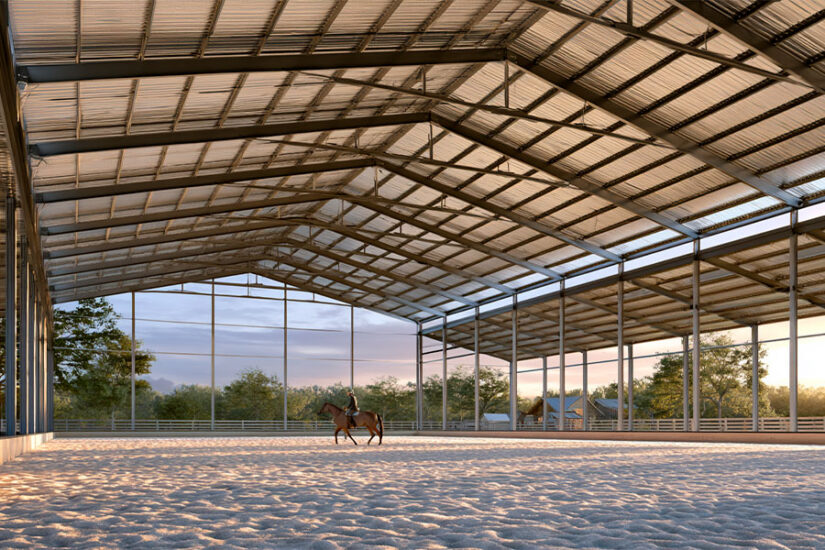
For most owners the question isn’t which type is better. It’s which type fits the climate they ride in, the budget they actually have, and the number of days a year they want to be on horseback. An outdoor arena costs $15,000–$50,000 for a finished, fenced, drained surface. A full indoor runs $150,000–$500,000 depending on size and finish level. A covered arena (a roof with open or partially open sides) sits somewhere between the two, and it solves more problems than most buyers realize before they start pricing it out.
This guide covers how the three types differ in real use, what each one actually costs, and the five questions that settle the choice for most buyers.
Quick Answer
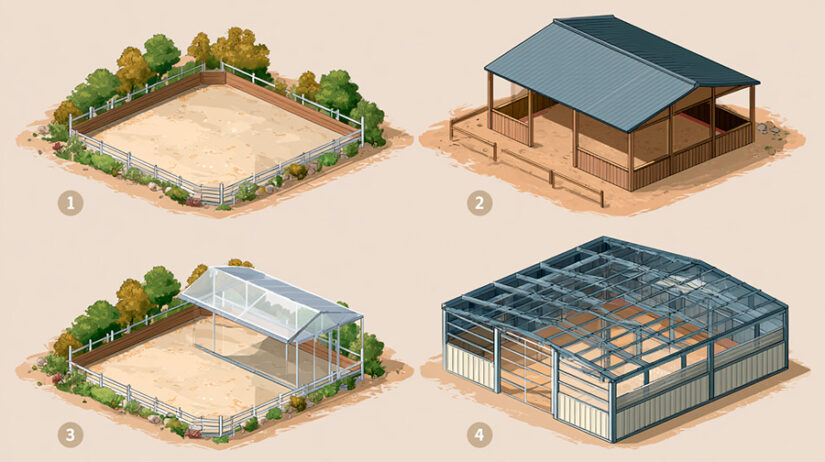
- Outdoor arena: $15,000–$50,000 finished (footing, base, drainage, fence). Usable in good weather only.
- Covered arena (roof-only or partial walls): $35,000–$130,000 depending on size and how many sides are enclosed. Extends the season significantly in mild climates; temperature and wind limits remain.
- Full indoor arena: $150,000–$500,000 turnkey. Rides in any weather. Higher permitting and structural costs.
- Size affects cost more than any other single variable. A 60×120 and an 80×200 aren’t even close in price.
- The most common mistake: buying an outdoor to save money, then spending $80,000–$150,000 to add a roof two years later when lost riding days become unbearable.
The Real Difference: Use Case, Climate, and Vear-Round Access
The structural difference between an outdoor and an indoor arena is obvious. What matters more is what that difference means for daily use.
An outdoor arena works well in dry, mild climates where usable weather spans ten or eleven months. Texas, Oklahoma, New Mexico, and much of California can support a serious riding program on an outdoor surface. Rain is occasional, freezes are short, and the footing dries fast between sessions.
The same arena in Kentucky, Pennsylvania, or Oregon becomes a problem in October. The footing stays wet, freezes, or turns to mud. Riders lose two to four months of training time, sometimes more in a wet year. Some barns in the mid-Atlantic lose half their lesson revenue between November and March because the outdoor is unusable and they have no covered alternative.
An indoor arena eliminates that variable entirely. The footing stays consistent, the temperature is manageable, and scheduling doesn’t depend on a weather app. For a lesson barn or a trainer who charges by the hour, that consistency has a direct dollar value. For a private owner who rides four mornings a week through winter, it means the difference between training and not training.
The tradeoff is cost. A full indoor arena with a steel clear-span shell adds $100,000–$300,000 over the surface and fence alone. That’s before the lighting, ventilation, and electrical service the building needs to be functional.
The choice most owners end up making: outdoor arena first, covered structure later, once the riding program is established and the usage patterns are clear.
Cost Comparison: Outdoor vs Indoor vs Covered
The biggest mistake in arena budgeting is comparing kit or shell prices to finished-build prices. Here is what each type actually costs when you can ride on it.
| Arena type | Finished cost (60×120) | Finished cost (80×200) | What’s included |
| Outdoor (open) | $15,000–$35,000 | $25,000–$55,000 | Grading, base, footing, fence. No structure. |
| Covered (roof-only, open sides) | $35,000–$75,000 | $65,000–$130,000 | Above + steel roof structure, columns |
| Partially covered (1–3 sides enclosed) | $55,000–$110,000 | $90,000–$180,000 | Roof + partial walls for wind/weather blocking |
| Full indoor | $150,000–$250,000 | $300,000–$450,000 | Full enclosed steel building, lighting, doors |
Sources: HomeAdvisor national cost data (2026); metal-buildings.org covered arena pricing (2026); US Patriot Steel kit and build estimates.
The outdoor cost is mostly footing, base, and drainage. Those same line items exist in every other arena type. A covered arena doesn’t get cheaper footing just because there’s a roof over it. The roof adds cost on top of the surface work, not instead of it.
For detailed indoor cost breakdowns by size, region, and finish level, the indoor riding arena cost guide covers it fully, including the line items that don’t appear until after you’ve signed a contract.
Outdoor Arenas: When They Make Sense
An outdoor arena is the right answer in four situations.
You’re in a dry, mild climate. A well-drained outdoor in Texas or Arizona rides nine to eleven months with minimal interruption. The surfaces dry fast, freezes are short, and the footing doesn’t develop the deep saturation problems that haunt wetter regions.
Budget is the binding constraint. If $150,000 for a full indoor isn’t available and the choice is between a $30,000 outdoor or nothing, the outdoor wins. A year-round program on limited access beats no arena at all. Many serious trainers and breeders have run successful programs for years on outdoor surfaces, especially in favorable climates.
The use case is low-intensity. Trail riders, horse owners who lunge and do ground work, breeders who use the space for turnout and occasional flatwork: these programs don’t need a year-round enclosed facility. An outdoor surface with good footing and drainage covers the actual demand.
It’s a first step, not a final answer. Many owners build an outdoor arena knowing they’ll add a roof structure in three to five years. The base, drainage, and footing work doesn’t get wasted, because a roof structure goes over an existing surface. Planning for this from the start means grading and drainage work done once, not twice.
What outdoor arenas can’t do: they can’t protect riders from lightning, ice, or hard freezing temperatures that make footing dangerous. Scheduling becomes weather-dependent. In competition facilities, outdoor arenas limit what shows can be run and when they can be booked.
Drainage is the single biggest factor in whether an outdoor arena works long-term. A perimeter drain, proper base layer, and 1–1.5% surface crown are non-negotiable for any outdoor arena that sees serious use. Owners who cut the drainage line to save $6,000–$10,000 upfront tend to rebuild the base at $30,000–$60,000 within four years. In wet states, bad drainage destroys arenas faster than heavy riding does.
Indoor Arenas: When They Make Sense
An indoor arena earns its cost in specific situations. It’s not the obvious choice for every owner, but for the right program, the math gets clear quickly.
Year-round training programs. A lesson barn in Ohio or Virginia that runs six to eight hours of lessons daily doesn’t have the option of closing from November through March. Indoor access protects that revenue. At $75–$125 per lesson hour, a barn booking four lessons daily loses $25,000–$45,000 in revenue per lost winter month. An indoor arena amortized over twenty years costs less than that.
High-value horses. Performance horses in training for competition can’t afford three months off due to weather. A horse at $5,000–$15,000 per month in training costs needs a surface to work on. One training season can justify a significant capital investment in the facility.
Northern and mountain climates. Colorado, Montana, New York, and the upper Midwest get enough frozen ground, ice, and snow to make outdoor arenas genuinely dangerous for extended periods. In those regions, an indoor isn’t a luxury. It’s what separates a functional facility from a seasonal one.
Discipline-specific requirements. Dressage at higher levels needs a consistent surface with predictable footing behavior. Jumping needs consistent clearance height (18 feet to peak, minimum). These requirements are hard to maintain on an outdoor surface through changing weather. The controlled environment of an indoor makes a measurable difference in training quality.
What indoor arenas require that outdoor arenas don’t: permits (almost always more complex and expensive), lighting ($10,000–$30,000), ventilation to prevent condensation and respiratory issues for horses, and a structural shell that adds $80,000–$200,000 over the surface work. The step up in cost is real. So is the step up in utility.
Covered and Partially-Covered Arenas
This is the option most buyers price last and end up wishing they’d priced first.
A covered arena is a roof structure on columns with some or all sides open. It provides overhead protection from rain, snow, and sun. It doesn’t provide the temperature control, full weather exclusion, or lighting optimization of a fully enclosed building. But for a large portion of the US, it’s enough.
Roof-only, fully open sides. Steel roof on columns, no walls. Protects from rain and direct sun. Natural ventilation keeps air moving. In climates with mild winters and occasional rain, this is often all that’s needed. A 60×120 roof structure runs $20,000–$45,000 on top of the surface preparation. Footing dries faster than under a full enclosure because wind gets to it. Temperature is ambient: in January in Georgia or Texas, that’s fine; in January in Michigan, it isn’t.
Partial walls (one to three sides enclosed). A back wall and one or two side walls block prevailing wind and rain blown horizontal by storms. This configuration extends usability into shoulder-season months without the full cost of a closed building. Common in transitional climates (Tennessee, the Carolinas, Missouri) where winters are cold but not severe. Cost runs $15,000–$40,000 more than the roof-only structure for the same footprint.
Clear-span covered with end walls only (open long sides). The roof and both short end walls are enclosed; the long sides remain open. This protects against rain and wind from the ends while maintaining airflow along the sides. It reads as “almost indoor” during light rain or moderate cold, and it avoids the ventilation and condensation problems that come with full enclosure. Many competition facilities use this for warm-up or schooling arenas adjacent to fully enclosed show arenas.
For the “covered outdoor arena” buyer who shows up in search data, this is usually what they mean. They want protection without the full indoor price. In most mild-climate states, a well-built covered structure with partial walls is a genuinely good answer. The limitations are temperature (below about 25°F the open sides become a problem) and humidity (condensation under the roof with no walls can be significant in humid regions).
Example scenario: A horse property in Tennessee with three private horses and a lesson student two afternoons a week. The owner rides five to six months of the year outdoors and loses two or three months in winter to rain and mud. A 60×120 roof-only covered structure over an existing outdoor arena surface costs $55,000–$75,000 complete, extends the riding season by two to three months, and doesn’t require the $150,000–$200,000 full indoor budget.
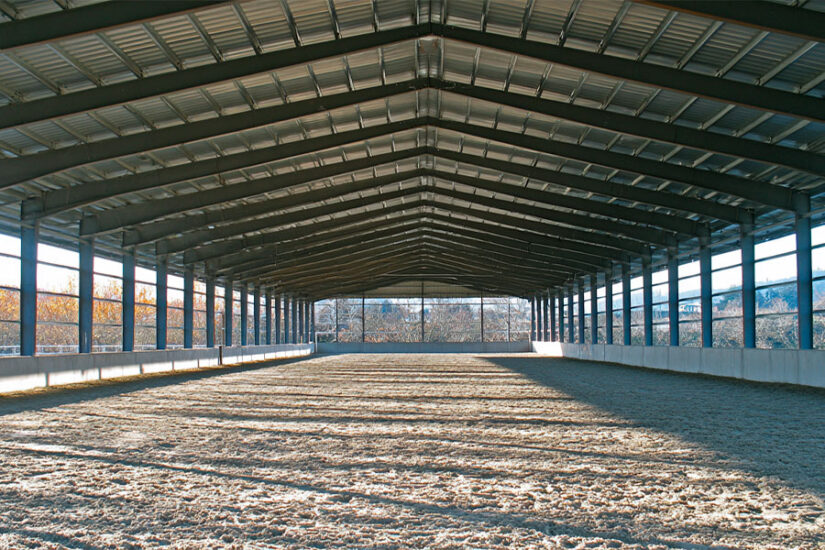
The covered arena is also the most common starting point for owners who plan to enclose fully later. A roof structure built to the right spec can have walls added later without rebuilding the frame. This needs to be specified at design time. Not every kit is designed for later enclosure.
Footing Differences
The surface under a horse’s feet performs the same basic job regardless of what’s above it: cushion, traction, drainage. But the arena type affects which footing materials work and how they need to be managed.
Outdoor arenas deal with direct weather. Rain, sun, freeze-thaw cycles, and wind all affect the surface. Plain washed sand works in dry climates but turns to soup in wet ones. Most serious outdoor installations in variable climates use a stabilized base (crushed stone, geotextile, compacted granite) under the riding surface. Sand with fiber or rubber works better than plain sand in wet climates because the fiber binds the particles through moisture changes.
Indoor arenas have consistent temperature and no rain, but they develop different problems. Without natural moisture from precipitation, indoor surfaces dry out. Dust becomes the primary maintenance issue, especially in arid climates. Watering systems are common in commercial indoor facilities. The footing choice also affects air quality: a dusty surface in an enclosed building affects both horses’ respiratory health and riders’.
Covered arenas with open sides split the difference. Rain blows in from the open sides in a storm, so the surface still needs outdoor-grade drainage and base preparation. Between storms, natural wind helps control dust. Most covered arenas use the same footing as a comparable outdoor. The roof reduces direct rain but doesn’t create indoor conditions.
For a complete breakdown of materials, layer depths, and what fails by discipline, the horse arena footing guide covers the topic in detail.
Sizing: What the Common Dimensions Actually Mean
Arena size should be driven by what discipline gets ridden, not by what the budget wants to build.
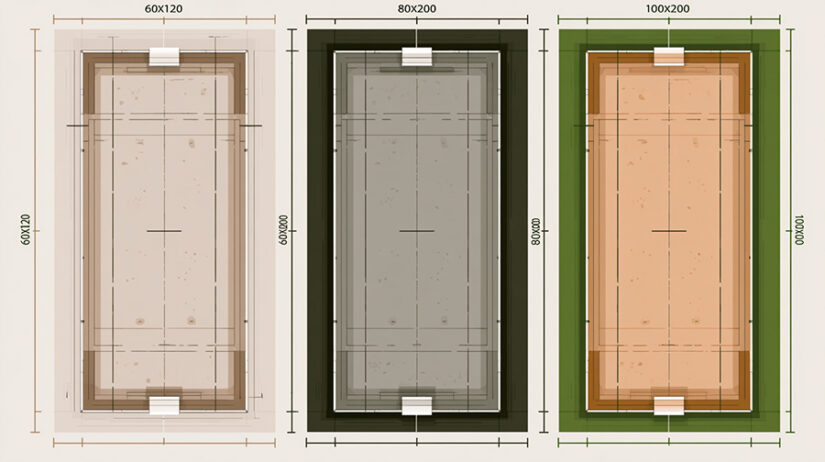
| Size | Common use | Minimum for discipline |
| 60 x 120 | Private flatwork, basic schooling, western | One rider; no room for gymnastics or regular jumping courses |
| 66 x 132 (20x40m) | Dressage (training through second level) | Minimum dressage court size |
| 70 x 140 | Comfortable private arena, small clinics | Two horses working, room for small jump course |
| 80 x 200 | Dressage through grand prix, jumping | Full 20x60m court with safety border; serious training |
| 100 x 200 | Commercial, shows, multiple disciplines | Multi-rider lessons, hosting competitions |
Interior clearance height matters for jumping: 16 feet minimum, 18 feet preferred. A horse approaching a 4-foot fence needs at least 16 feet of peak clearance; anything less creates a problem that riders notice within the first month.
Size decisions have permanent cost consequences. Adding 20 feet of length after the slab is poured costs as much as or more than the original kit in most cases, because the foundation, frame, and roof all have to be re-engineered. The time to add square footage is before the slab. The marginal cost at design time is $10,000–$25,000 for a 20-foot length extension. That same change after build-out runs $60,000–$100,000.
More on arena sizing by discipline: how big should a horse riding arena be?
Climate and Region: What Actually Drives the Choice
Climate more than budget usually settles the indoor vs outdoor question for serious buyers. Budget sets the ceiling; climate sets the floor.
High-use wet climates (Pacific Northwest, Gulf Coast, Northeast, Appalachians): Outdoor arenas lose four to five months of usable time in bad years. A covered structure is nearly essential for any serious riding program, and a full indoor is the right answer for a barn running lessons or training.
Dry climates with mild winters (Texas, Oklahoma, New Mexico, Southern California): Outdoor arenas can sustain year-round programs with minimal interruption. A covered roof is a convenience, not a necessity. Most private owners in these regions do fine with a well-built outdoor arena and selective scheduling.
Cold, dry climates (Colorado mountains, Montana, Wyoming): Outdoor arenas freeze solid for three to four months. A full indoor is the right answer for winter training. But the climate is also dry, so ventilation and dust management in the indoor become the main maintenance concerns.
Transitional climates (Tennessee, Missouri, Kentucky, Virginia, Carolinas): These are the regions where the covered arena argument is strongest. Winters are cold enough to limit outdoor use significantly but not severe enough to demand a full indoor. A roof structure with partial walls extends the season meaningfully without the full indoor cost.
Hurricane zones (Florida, Gulf Coast, Carolinas): Any covered structure needs engineering to the local wind code. In South Florida’s high-velocity hurricane zone (Miami-Dade and Broward counties), design wind speeds reach 170–175 mph for standard structures. That’s a fundamentally different engineering problem than Kansas at 90 mph. Expect $5,000–$20,000 added to kit cost for wind-rated structures in high-exposure coastal areas; that cost is non-negotiable for structural safety.
Decision Guide: Five Questions
These five questions, answered honestly, settle the choice for most buyers.
Zero to two months: outdoor or covered. Three or more months: covered or indoor. Five or more months: indoor.
Private horse owner, occasional riding: outdoor or covered. Lesson program or professional training: indoor. Breeding and turnout with occasional flatwork: outdoor.
Slope, soil type, and drainage characteristics affect every option equally at the surface level. A wet, clay-heavy site needs serious drainage work regardless of what structure goes over it. Get a soil test before pricing out the project.
As a rough illustration: an outdoor arena at $30,000 plus $5,000/year in maintenance runs about $80,000 over ten years. A covered arena at $70,000 plus $4,000/year runs about $110,000. A full indoor at $200,000 plus $8,000/year runs about $280,000. The gap narrows when you run actual numbers for your region and program, but the direction holds.
If budget is limited and there’s reasonable expectation of expanding later, build the outdoor with proper drainage and grade it for a future roof structure. If this is the facility you’ll be on for twenty years, buy what you actually need now.
Ready to get real numbers for your site and climate? Call (888) 415-1576 or use the quote request form. The team at US Patriot Steel can spec the right structure for the site you’re building on, not a generic estimate.
Frequently Asked Questions
A covered outdoor riding arena has a steel roof on columns for overhead protection but has open or partially open sides, unlike a fully enclosed indoor arena. It protects from rain and direct sun while keeping natural ventilation. Cost runs roughly $35,000–$130,000 depending on size and how many sides are enclosed. It’s the most common “middle ground” choice for owners in mild or transitional climates who need more riding days than an outdoor arena provides but can’t justify the full indoor cost.
A turnkey indoor horse arena costs $150,000–$250,000 for a 60×120 and $300,000–$450,000 for an 80×200 in most US regions (2026 pricing). The steel kit alone runs $35,000–$110,000 depending on size, but that covers only the frame. Foundation, footing, lighting, doors, and permits typically double or triple the kit price. Per square foot, turnkey indoor arenas run $40–$125.
It depends on climate and use. In dry, mild climates like Texas or Southern California, a well-drained outdoor arena supports a year-round riding program. In the mid-Atlantic, Northeast, Pacific Northwest, or mountain states, an outdoor arena loses three to five months of usable time annually. If the riding program runs through winter or the climate is wet, a covered or indoor structure is worth the additional cost.
A 60×120 is the minimum for single-rider flatwork. A 66×132 (20×40 meters) is the minimum standard dressage court size. An 80×200 (20×60 meters) accommodates a full dressage court with safety borders and is the standard for serious dressage or jumping programs. Commercial facilities and those hosting shows typically need 100×200 or larger. Interior height should be 16 feet minimum, 18 feet for jumping.
For most outdoor arenas, a stabilized base of compacted crushed stone over geotextile, topped with 2–3 inches of washed sand with fiber or rubber, is the standard. Plain sand works in dry climates but fails in wet ones. The base layer and drainage matter more than the riding surface itself. A good base with average footing outperforms great footing over a bad base every time. Budget $1.50–$4.50 per square foot for the riding surface, more in premium installations.
For the same footprint (say, 60×120), an outdoor arena finished and fenced runs $15,000–$35,000. A full indoor on that same footprint runs $150,000–$250,000. A covered arena with roof and partial walls runs $55,000–$110,000. The cost multiplier for full indoor over outdoor is roughly five to eight times, driven by the steel structure, foundation engineering, lighting, and permitting required for an enclosed building.
- How much does it cost to build an indoor riding arena?: full cost breakdown by size, region, and what contractors don’t tell you upfront
- Horse arena footing: materials, layer depths, what fails by discipline, and maintenance
- How big should a horse riding arena be?: sizing by use, discipline requirements, and the consequences of getting it wrong
- How to build a horse arena: the owner’s step-by-step view of the build sequence
- Horse arena construction: engineering and contractor-grade structural specs
- Riding arenas: US Patriot Steel kit options and sizes
References
- HomeAdvisor. How Much Does a Riding Indoor Arena Cost? (2026). National cost benchmark for indoor arenas, methodology citing BLS and customer surveys. homeadvisor.com
- metal-buildings.org. Metal Riding Arena Cost Guide 2026: What You’ll Actually Pay. Covered and clear-span arena pricing by configuration. metal-buildings.org/metal-riding-arena/
- Angi. How Much Does an Indoor Riding Arena Cost to Build? [2026 Data]. Second cost benchmark, cross-check source for turnkey pricing. angi.com
- Penn State Extension (Eileen E. Fabian Wheeler, Ph.D.). Riding Arena Footing Material Selection and Management. Primary academic source on arena surface selection and maintenance. extension.psu.edu
- Florida Building Code / ASCE 7. Wind speed requirements for high-velocity hurricane zones (Miami-Dade, Broward). floridabuilding.org