
Completed Projects
Happy Customers
Projects in Progress
New Orders This Week
Why Steel Works in Indiana
Steel buildings hold up in Indiana when the frame is engineered for its own county. We are a dealer of pre-engineered steel building kits from American steel, and our metal buildings in Indiana, from barndominiums to equipment storage, arrive with PE-stamped drawings for the parcel.
Snow sets the frame in the north. Lake Michigan feeds lake-effect snow that can reach as far inland as Elkhart, and some places near the lake average more than 70 inches a year, against about 14 in the southwest. The state residential code lists a ground snow load for each of the 92 counties: 30 psf in 16 northern counties, from Lake and Porter to Elkhart and Steuben, and 20 psf in the rest.
Storms matter statewide. The Tri-State Tornado of 1925, the deadliest in U.S. history, killed 76 people in southwestern Indiana, and the outbreak of June 2, 1990, brought 37 tornadoes to the state. In southern Indiana, 14 counties, Vanderburgh and Posey among them, are Seismic Design Category C in the state table. Every drawing set carries the design wind speed, exposure category and snow load under ASCE 7. Planning a home? Read how barndominiums handle storms.
Footing depths, the farm building rule and permit steps are in the codes and permits section below.
Indiana at a Glance
What We Engineer for:
Ground snow load by county from the state code tables: at least 30 psf in 16 northern counties, 20 psf in the other 76
Snow belts off Lake Michigan reach as far inland as Elkhart; some places near the lake average more than 70 inches a year
Tornadoes strike in the warm months statewide; design wind speed and exposure category are set per site under ASCE 7
Footings go 36 inches deep in the north, 30 in central counties and 24 in the south; a local contractor pours them to our anchor bolt layout
The 2014 Indiana Building Code and the 2020 Indiana Residential Code are in force statewide, with a state design release for public and commercial buildings
Building Codes and Permits in Indiana

Indiana adopts its building codes statewide through the Fire Prevention and Building Safety Commission. The 2014 Indiana Building Code, based on the 2012 International Building Code, covers commercial and public buildings. Homes, barndominiums included, follow the 2020 Indiana Residential Code, based on the 2018 International Residential Code. Drawings are prepared to these editions; your building department is the authoritative source.

A shop, warehouse or office used by the public or by employees is a Class 1 structure, and it needs a Construction Design Release from the Indiana Department of Homeland Security. Since July 1, 2026, plans for a storage building may qualify for release without a plan review. Local permits from your city or county still apply. We don’t pull the permit; we supply PE-stamped drawings, load calculations and specifications.

A building used only for agriculture on the land where it stands, and not used for retail trade, is not a Class 1 structure, so it is not filed with the state. Local rules can still call for a zoning or building permit, so check with your county before ordering.

The state residential table gives each county its footing depth and ground snow load: Elkhart County lists 36 inches and 30 psf, Marion County 30 inches and 20 psf, Vanderburgh County 24 inches and 20 psf. A local contractor pours the footings to our anchor bolt layout. Check flood risk on the Indiana Department of Natural Resources floodplain information portal and with your county.
Indiana adopts its building codes statewide through the Fire Prevention and Building Safety Commission. The 2014 Indiana Building Code, based on the 2012 International Building Code, covers commercial and public buildings. Homes, barndominiums included, follow the 2020 Indiana Residential Code, based on the 2018 International Residential Code. Drawings are prepared to these editions; your building department is the authoritative source.
A shop, warehouse or office used by the public or by employees is a Class 1 structure, and it needs a Construction Design Release from the Indiana Department of Homeland Security. Since July 1, 2026, plans for a storage building may qualify for release without a plan review. Local permits from your city or county still apply. We don’t pull the permit; we supply PE-stamped drawings, load calculations and specifications.
A building used only for agriculture on the land where it stands, and not used for retail trade, is not a Class 1 structure, so it is not filed with the state. Local rules can still call for a zoning or building permit, so check with your county before ordering.
The state residential table gives each county its footing depth and ground snow load: Elkhart County lists 36 inches and 30 psf, Marion County 30 inches and 20 psf, Vanderburgh County 24 inches and 20 psf. A local contractor pours the footings to our anchor bolt layout. Check flood risk on the Indiana Department of Natural Resources floodplain information portal and with your county.
Steel Buildings We Deliver Across Indiana

What a Steel Building Costs in Indiana
The price of a steel building in Indiana depends on its size, the snow load and footing depth of its county, and its finish. Northern snow and southern seismic bracing add frame weight.

From 20×20 to 30×40: garages, RV storage and equipment sheds.
From 30×50 to 40×80: barndominiums, workshops and horse barns.
From 60×100 up: grain and machinery storage, warehouses and commercial buildings.
A 40×60 in Elkhart County, with 30 psf of ground snow and 36-inch footings, gets a heavier roof frame and a deeper foundation than the same building in Vanderburgh County, where the table lists 20 psf and 24 inches but adds Seismic Design Category C.
The $ tier covers the kit itself: frame, roof and wall panels. Insulation, overhead doors and liner panels move it to $$, and a finished living space or office inside to $$$. Our barndominium cost guide lists dollar ranges.
How Indiana Owners Use Steel Buildings by Region
Northwest Indiana (Gary, Hammond, Valparaiso, Michigan City, Rensselaer; Lake, Porter, LaPorte, Jasper counties)
Northwest Indiana sits on the Lake Michigan shore and gets heavy lake-effect snow, so ground snow here starts at 30 psf. Inland, Jasper County ranks first in Indiana for milk sales and third for land in farms. Dairy farms pair cow housing with feed and hay storage; see our livestock barns.
See also: Metal office buildings · Metal hay barns
Northern Indiana (South Bend, Elkhart, Goshen, LaGrange, Warsaw; St. Joseph, Elkhart, LaGrange, Kosciusko counties)
Lake-effect snow reaches this far inland, and these counties sit in the 30 psf group too. Indiana factories build most of the country’s RVs, many in and around Elkhart County, and owners here keep campers and travel trailers under a tall door. LaGrange County ranks first in the state for horse sales, with 19,550 horses and ponies on farms that average 78 acres. A small farm suits a compact stable; start with our horse barns and stables.
See also: RV garages · RV carports
Central Indiana (Indianapolis, Carmel, Lafayette, Kokomo, Muncie; Marion, Hamilton, Tippecanoe, Howard, Delaware counties)
Indiana has called itself “The Crossroads of America” since 1937, and around Indianapolis contractors and distributors need storage with drive-through doors; see our metal warehouses. Footings go 30 inches deep and ground snow is 20 psf. Corn and soybeans fill the open land: in 2022 the state harvested about 5.7 million acres of soybeans and 5.4 million of corn for grain.
See also: Residential metal buildings · Metal carports
Southern Indiana (Evansville, Vincennes, Jasper, Washington; Vanderburgh, Knox, Dubois, Daviess counties)
Southern Indiana carries the state’s highest seismic rating: these counties are Seismic Design Category C, and footings go 24 inches deep. In 1925 the Tri-State Tornado tore through Griffin, Owensville and Princeton. Knox County ranks second in the state for grain sales, with farms averaging 732 acres, and Dubois County ranks first for poultry and eggs, with about 2 million turkeys. Planters and combines need wide doors; see our tractor barns.
See also: Metal barns · Metal sheds
What can we design for you today?
Talk to a building specialist to learn more!
Design Your Building NowFrequently Asked Questions
Yes. Indiana enforces the 2014 Indiana Building Code, based on the 2012 International Building Code, for commercial and public buildings, and the 2020 Indiana Residential Code for homes. A shop or warehouse used by the public or by employees also needs a state design release. Our drawings follow these editions; your building department has the final word.
Not from the state, if the barn is used only for agriculture on that land and not for retail sales. Indiana does not count it as a Class 1 structure, so no state design release is filed. Your county or city can still require a zoning or building permit, so call them before you order.
They are engineered for the ground snow load the state codes list for your county: 30 psf in 16 northern counties near Lake Michigan and 20 psf in the rest of the state. In Lake, Porter, LaPorte and St. Joseph counties, a commercial building’s snow load comes from a site study, never below 30 psf. Send the full address with your quote request.
Yes, we deliver across Indiana, from Gary and Fort Wayne to Evansville. Make sure a truck can reach the pad. We confirm your production schedule and delivery window when your order is finalized. Your crew or a local erector assembles the building; if you want installation arranged, ask when you request your quote.
Yes. A barndominium you live in is a home under the 2020 Indiana Residential Code, so it goes through your local permit office rather than the state design release. The drawings use your county’s snow load and footing depth, from 36 inches in the north to 24 in the south. Tell us the floor plan and shop size with your quote request.
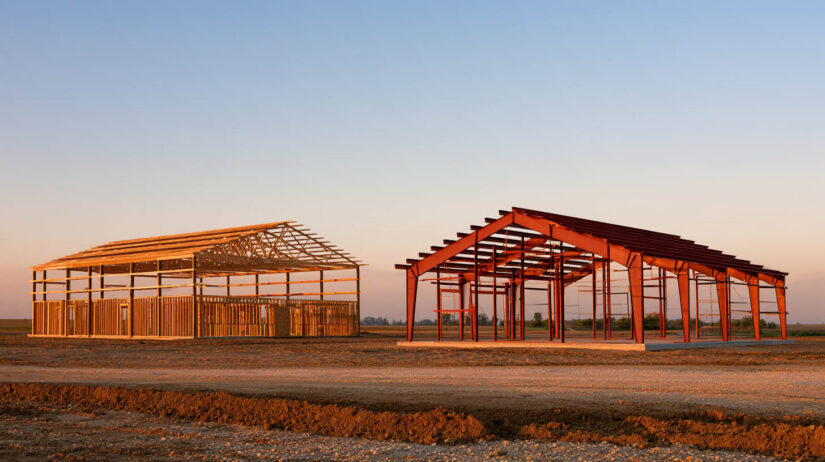
Post-Frame Construction vs Pre-Engineered Steel Buildings: What Actually Differs
Quick Answer What Post-Frame Construction Is Post-frame construction (sometimes written post and frame construction) is a building system in which large wood posts, embedded in the soil or fastened to concrete piers or a slab, carry the roof and the wall cladding without a continuous stud wall. The National Frame Building Association (NFBA) describes it […]
Read Article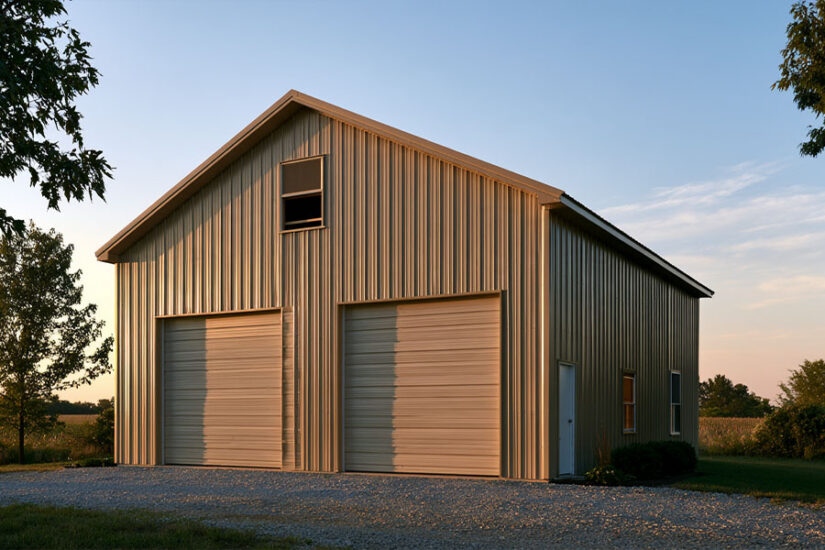
Garage With Loft: Steel Garage Loft Sizes, Heights and Uses
Quick Answer What Counts as a Garage Loft in a Steel Building A garage loft is a second floor level built inside the garage, usually over part of the floor and open to the space below. A wood-framed garage often has an attic inside its roof trusses; a steel garage with an open frame has […]
Read Article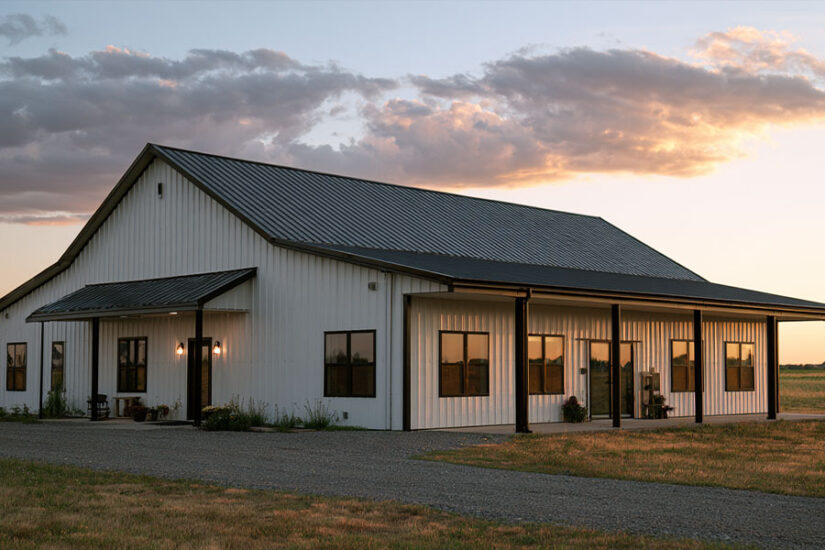
White Barndominium and Farmhouse Exterior Ideas for a Steel Home
Quick Answer A white barndominium is a steel-frame home clad in white wall panels, usually set off by a dark roof and black window and corner trim. Add a covered front porch and a steeper gable, and the same shell reads as a farmhouse barndominium, especially over a stone or wood base. Why White Works […]
Read Article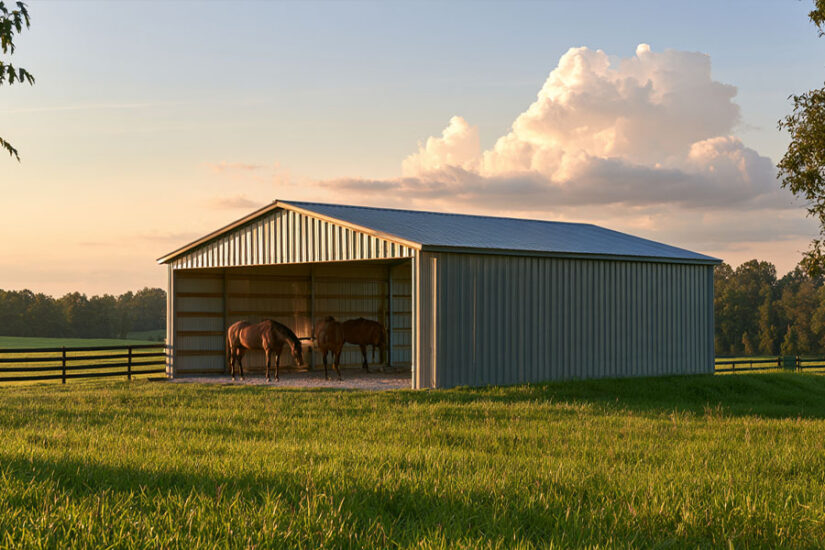
Loafing Shed vs Run-In Shed: Sizes, Layouts, Steel Option
Quick Answer What is a Loafing Shed, and How is it Different From a Run-In Shed? A loafing shed is a roofed shelter, usually closed on three sides and open on the fourth, where livestock rest out of the weather and leave whenever they like. In a barn with stalls each horse is led in […]
Read Article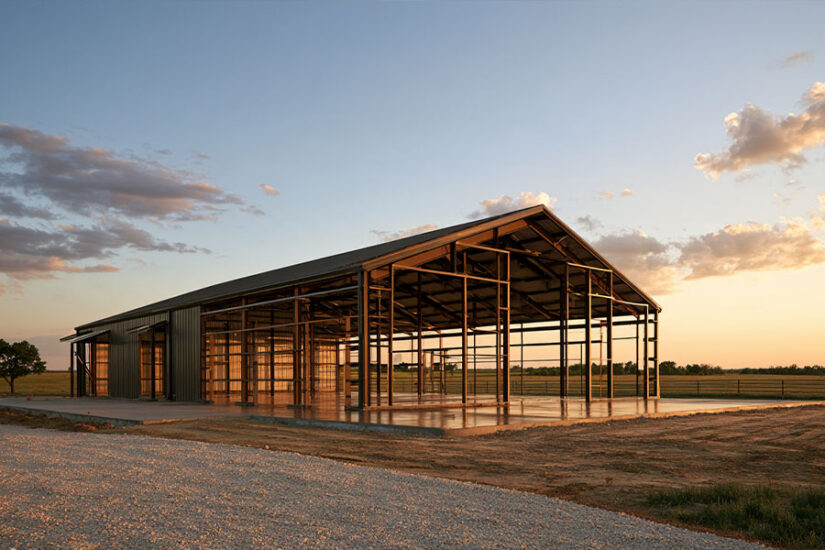
How to Build a Barndominium: Steps From Land to Move-In
Quick Answer Building a barndominium runs in a set order: check the land and local rules, choose the size and plan, get engineered drawings and a permit, order the steel kit, prepare the site and pour the slab, erect the shell, then finish rough-ins, insulation and the interior before the final inspection. A barndominium is […]
Read Article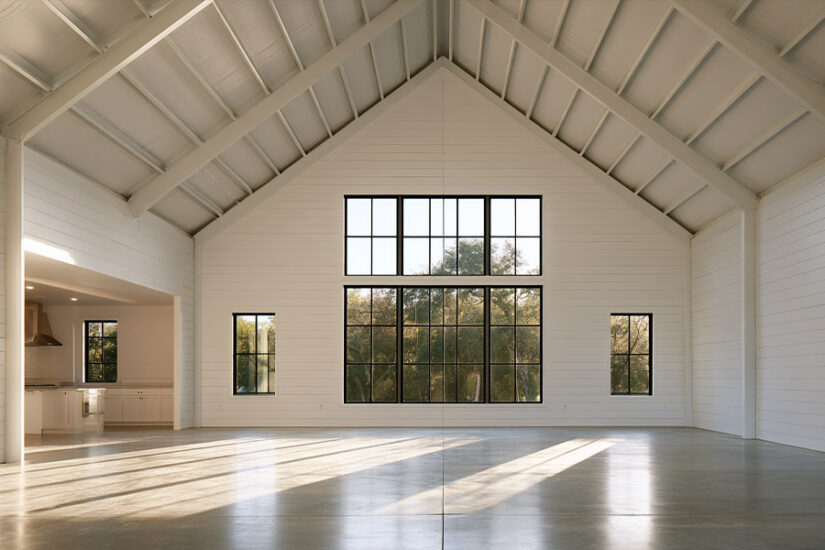
Barndominium Interior Ideas for a Steel-Frame Home
Quick Answer Barndominium interior ideas that hold up start with what the steel frame allows: an open floor with no load-bearing interior walls, and enough height for a loft or a vaulted great room. Behind the finishes, insulation and moisture control keep the rooms dry, and a separation wall divides living space from any shop. […]
Read Article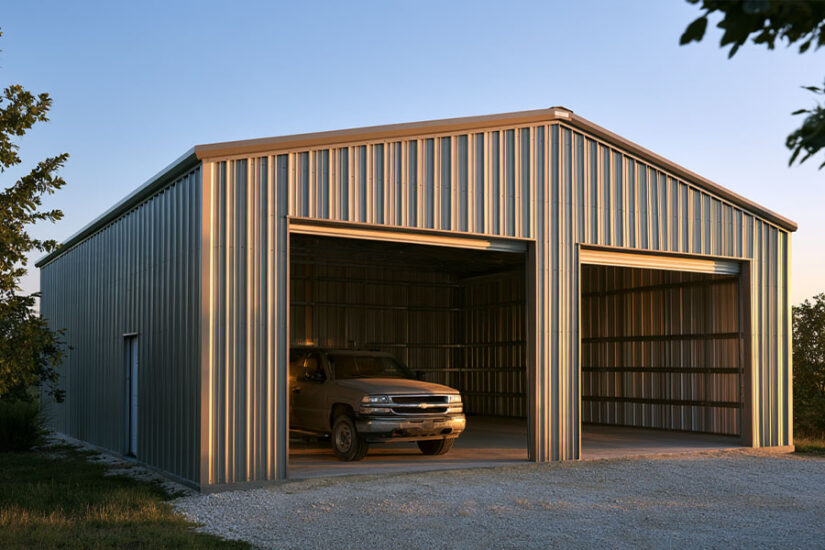
Standard Garage Sizes: 1-, 2- and 3-Car Garage Dimensions
Quick Answer Standard Garage Sizes at a Glance When people say “standard garage size,” they usually mean a two-car garage, and that is what most new houses get. In 2025, 64% of newly completed single-family homes had a two-car garage, according to the Census Bureau’s Characteristics of New Housing data. Garages for three or more […]
Read Article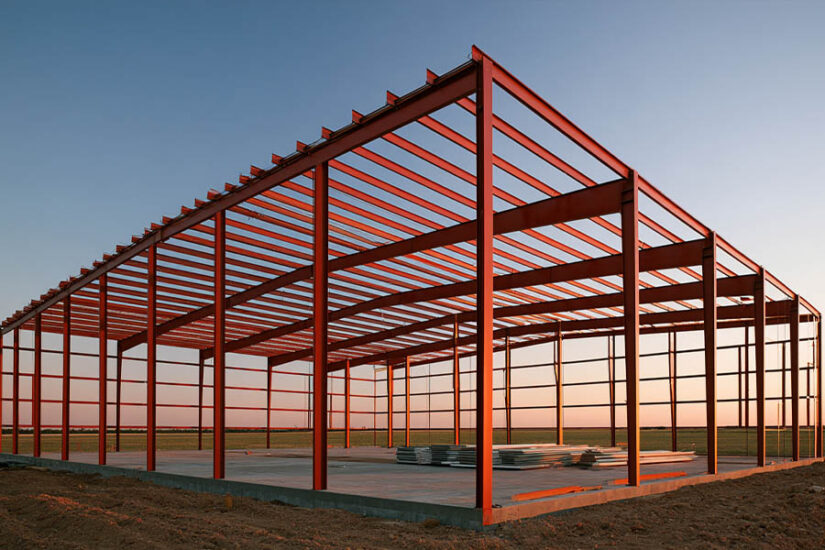
What is a PEMB (Pre-Engineered Metal Building)?
Quick Answer What PEMB Stands for, and What the Industry Actually Calls it PEMB stands for pre-engineered metal building. Contractors and building officials use the acronym for a low-rise steel building that one manufacturer designs and supplies as a complete structural package. The same product appears in quotes under other names too: pre-engineered steel building, […]
Read Article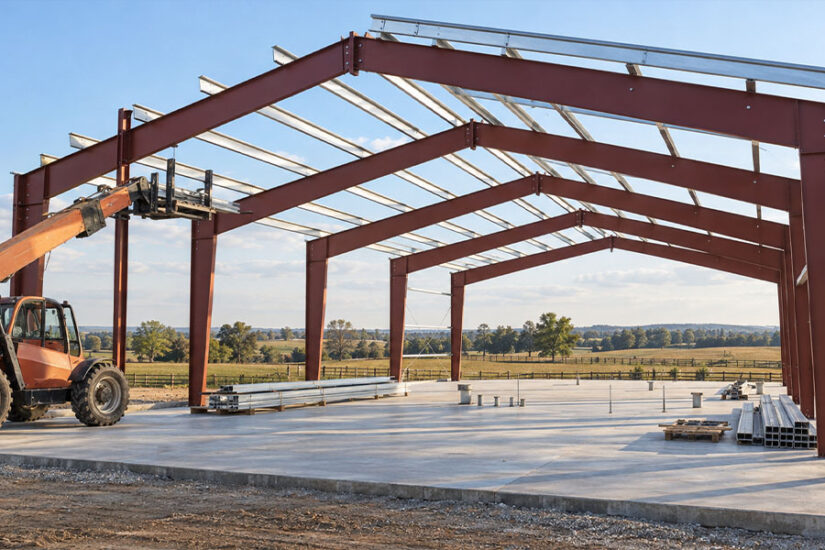
Red Iron Steel Buildings Explained
Quick Answer What Red Iron is and Where the Name Comes From Dealers and classified ads use “red iron” as if it were a material you could order by name. It isn’t. It’s trade shorthand for the heavy structural steel in the primary frame of a metal building, and the phrase stuck because the parts […]
Read Article