
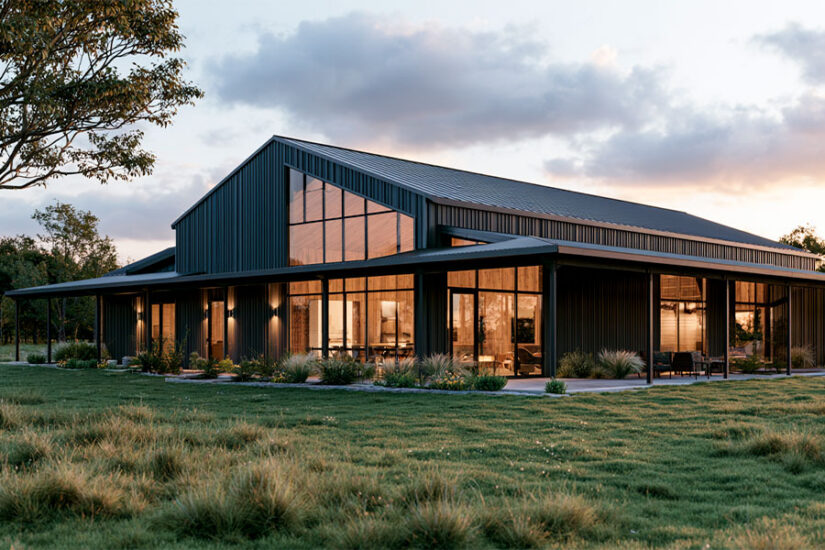
Barndominiums can be a good investment, but the honest answer depends on three things: where you build, how well you build, and whether you can get the place appraised and financed when it’s time to sell. Build on acreage in a market where barndos are familiar, put real money into the finish, and you’ll likely hold value or better. Build in a suburban subdivision where appraisers have no comps and buyers have no frame of reference, and you’re taking on real resale risk. This article works through both sides of that picture.
Do Barndominiums Appreciate or Hold Their Value?
Short answer: Most well-built barndominiums hold their value, and many appreciate in markets where the property type is established. They are not guaranteed appreciators, and the resale story depends heavily on location.
The data that exists points in a generally positive direction. A 2020 survey of Texas barndominium listings found that 87% had sold at or above original list price (Source: KW Appraisal Group). One documented case showed a barndominium that sold for $270,100 in May 2023, up from its purchase price two years earlier, a gain of more than 30% (Source: KW Appraisal Group). In Texas, Oklahoma, and parts of the Midwest, where barndominiums are common enough that appraisers have regional comps to work with, appreciation tracks reasonably close to the surrounding land market.
The harder question is what happens in markets where barndominiums are still unusual. There, the comp problem kicks in: an appraiser who can’t find three similar properties within a reasonable radius has to make judgment calls, and those calls sometimes come in below what the owner expected. That’s not a flaw in the building. It’s a market familiarity problem that is slowly resolving as the property type spreads.
What Drives Barndominium Resale Value
Four factors account for most of the variance in barndominium resale prices.
Location and land. This is the biggest one. A barndominium on five or ten acres of rural land in an established equestrian or agricultural county sells into a buyer pool that already understands the property type. A barndo on a half-acre lot in a conventional subdivision does not. Land itself carries and appreciates; a well-chosen rural parcel can make up for a lot of other variables.
Market familiarity. In Texas, the Hill Country, Oklahoma, Missouri, and parts of the Southeast, appraisers have seen enough barndominiums to find comps and value them correctly. In markets where the property type is still rare, the valuation process is more subjective. This gap is narrowing, but it’s real today. If you’re building primarily as an investment, choose a market where barndos are already bought and sold regularly.
Quality of construction and finish. A barndominium finished with low-cost materials, poor insulation, and a rough interior doesn’t hold value any better than a traditionally built house finished the same way. Quality is quality. A well-insulated steel frame with quality fixtures, proper HVAC, and a thought-out floor plan competes against conventional homes on finish terms.
Steel frame vs. wood construction. For metal barndominiums specifically, the structural durability of the steel frame is a genuine long-term value factor. Steel doesn’t rot, warp, or attract termites. A steel frame barndominium built to spec is designed to last 50 to 100 years or more (Source: buildmax.com). That longevity matters when a buyer is evaluating the remaining useful life of the structure.
Barndominium vs. traditional home: cost and ROI
The cost-to-build advantage is real, and it’s the main reason barndominiums pencil out as investments in many situations.
| Barndominium | Traditional stick-built home | |
| Construction cost per sq ft | $60–$160 | $150–$400 |
| Average finished range | $80–$130/sq ft | $120–$200+/sq ft |
| Steel shell kit (starting point) | $25,000–$48,000 for a 40×60 | N/A |
| Typical construction timeline | 4–9 months | 6–12 months |
| Long-term maintenance | Lower (steel frame, metal roof) | Higher (wood rot, termites, re-roofing) |
| Resale liquidity | Moderate to strong in rural/ag markets | Strong in most markets |
| Financing availability | Improving; specialized lenders often needed | Conventional lenders, straightforward |
Sources: houseplans.com (2025); bhcconstruct.com (2025); KW Appraisal Group.
The 30–50% lower construction cost per square foot is a genuine head start on ROI. The caveat: lower construction cost only translates to investment return if the finished property appraises at or near market value. In markets with strong comp availability, that happens reliably. In markets without comps, the appraisal gap can eat the cost advantage.
For a detailed breakdown of what a barndominium actually costs to build, see the metal building cost guide.
Where Barndominiums are a Strong Investment vs. Where They Carry More Risk
Strong markets:
Rural acreage in Texas, Oklahoma, Arkansas, Missouri, Kentucky, and the broader Southeast is where barndominiums perform most predictably as investments. These markets have an established buyer pool, appraisers who have seen the property type before, and land values that support the overall transaction. On 10 or more acres in one of these states, a well-built barndominium typically sells into real demand.
Markets with more risk:
Suburban subdivisions where all neighboring properties are conventional stick-built homes. The buyer pool is narrower, the appraiser has no direct comps, and the average buyer walking a subdivision may not know how to evaluate a steel-frame home. This doesn’t mean a barndominium can’t sell in these locations, but the resale process is less predictable.
Also worth flagging: areas where barndominiums are simply new. The Mid-Atlantic, New England, and parts of the Pacific Northwest have few established comps. An appraiser in Vermont or New Hampshire working a barndominium appraisal may need to pull comps from out of state. Appraisals in these markets can come in conservative, which affects both resale value and the ability of the next buyer to get financing.
Financing and Appraisal Challenges
This is the friction point that catches buyers off guard.
Conventional mortgage lenders often struggle with barndominiums. The core issue is comps: if an underwriter can’t find three comparable sales within a reasonable radius, the loan is harder to close. Big national banks frequently decline barndominium applications not because of the borrower but because they can’t get the collateral valued with confidence.
The options that work better:
Farm credit and agricultural lenders. Institutions like Farm Credit Services or AgAmerica understand rural property types and have more flexibility on comps.
Local and community banks. A local bank in a county where barndominiums are common often has institutional familiarity that a national bank doesn’t.
USDA and VA loans. Both are available for barndominiums through select lenders, though underwriting requirements have tightened. Most lenders require a 640+ credit score for USDA; successful borrowers averaged 700 in 2024 (Source: HMDA via Rocket Mortgage). VA has no agency-set minimum, but individual lenders set their own floors.
Construction-to-permanent loans. For new builds, a construction loan that converts to a permanent mortgage at completion is the most common financing path.
Freddie Mac’s guidelines explicitly list barndominiums as eligible property types for conforming mortgages, which has improved conventional financing options compared to five years ago. But “eligible” doesn’t mean “easy”: the comp requirement remains the practical barrier. Your best move before building in a new market is to talk to a local lender who has already closed barndominium loans in that county.
The same comp problem affects insurance. Some carriers have less experience pricing barndominium policies, particularly in markets where the property type is new. Shop multiple carriers and ask specifically for experience with metal-frame residential structures.
Longevity: Why the Steel frame Matters to Long-Term Value
A steel-framed barndominium built to current engineering specs is designed to last. The frame itself, properly galvanized and coated, can exceed 50–100 years (Source: buildmax.com). Metal roofing, a standard feature on barndominiums, lasts 40–70 years with proper maintenance. A poured concrete slab foundation can endure 80–100 years. Compare that to a wood-frame home where the framing, sheathing, and roof deck are all susceptible to rot, termite damage, and moisture over the same time horizon.
For buyers evaluating remaining useful life, a well-built steel barndominium in good condition has a structural durability story that a comparable wood-frame house often can’t match.
That structural durability also connects to weather performance. For buyers in storm-prone regions, the steel frame’s ability to handle high winds is a concrete selling point. See can a barndominium withstand a hurricane for the engineering detail on what a properly engineered steel frame handles vs. what conventional construction handles.
Honest Downsides: What to Go in With Your Eyes Open About
The comp problem is real and won’t disappear overnight. As barndominiums spread across more markets, appraisers will build their comp databases and this friction will ease. But in 2026, in the majority of US counties, you are still building a property type that the next appraiser may not have seen. Plan for that.
Your buyer pool is smaller than for a conventional home. Not every buyer wants a barndominium. In a slow market, a smaller buyer pool means longer time on market. In rural areas this is partly offset by the fact that rural markets often have longer average days on market regardless of property type.
Permits and financing add friction that conventional homes don’t have. Both are manageable but neither is frictionless. See what is a barndominium for more on how barndominium permitting works in practice.
Resale value in suburban locations is genuinely uncertain. There’s no strong data set showing barndominiums outperforming conventional homes in suburban subdivisions. If your exit plan requires maximum market liquidity, a suburban barndominium carries risk that a rural-acreage barndominium does not.
Interior finish quality matters more than the shell. The steel frame is durable, but a buyer evaluating a resale barndominium looks at the kitchen, bathrooms, floors, and HVAC the same way they’d evaluate any home. Skimping on interior finish to save money at build time almost always costs more at resale.
Is a Barndominium the Right Investment for You?
It comes down to what you’re optimizing for.
If you want a home that costs less per square foot to build than a conventional house, has lower long-term maintenance costs, and sits on land that is itself likely to appreciate in a rural or agricultural market, a barndominium is a reasonable investment decision. The people building barndominiums in markets where the property type is established are generally not making a bad financial call.
If you want maximum liquidity and the ability to sell quickly to any buyer with straightforward conventional financing, a traditional stick-built home in a suburban subdivision will deliver that more reliably than a barndominium will today.
For most buyers the honest answer is somewhere in between: build on acreage in a market with established barndominium activity, invest in the finish, work with a lender who knows the property type, and you’re likely to hold value. Treat it as a hybrid between a home and a rural land investment.
For floor plan options and what to expect from the build process, see barndo floor plans explained.
Talk to Someone Who Knows the Product
If you’re weighing whether a barndominium makes financial sense for your land and your situation, the specifics matter a lot more than any general answer.
Call (888) 415-1576 or use the quote form to talk through location, footprint, and what the build would actually cost. US Patriot Steel ships to 40+ states and works with buyers who are weighing the investment case, not just the floor plan.
Frequently Asked Questions
Barndominiums can be a good investment when built in the right location. In rural and agricultural markets, particularly in Texas, Oklahoma, and the Midwest, well-built barndominiums hold their value and often appreciate alongside land values. The key risks are the appraisal comp problem in markets where the property type is still uncommon, and a narrower buyer pool than conventional homes. Build quality and location are the two factors that matter most.
Many do, particularly in established barndominium markets. A 2020 survey of Texas barndominium listings found 87% sold at or above original list price, and documented cases show 30%+ appreciation over two-year periods in active markets (Source: KW Appraisal Group). In markets where appraisers lack comparable sales data, appreciation is harder to realize because the appraisal process itself becomes a friction point.
In rural and agricultural markets with established comps, barndominiums compare favorably to traditional homes on resale value, often with lower per-square-foot construction costs that create equity on day one. In suburban markets and areas where barndominiums are rare, traditional homes are more liquid and easier to finance at full appraised value. The comparison favors the barndominium where the market knows the product.
Yes, generally, provided the location and finish quality support it. Steel frame construction contributes to structural longevity (50–100+ years designed lifespan), which gives buyers confidence in remaining useful life. The main value risk is not the building itself but the availability of comparable sales for appraisal purposes. In markets with established comps, barndominiums hold value comparably to well-maintained conventional homes.
A steel-framed barndominium is built to last 50–100 years or more (Source: buildmax.com). The steel frame doesn’t rot, warp, or suffer termite damage. Metal roofing typically lasts 40–70 years. The poured concrete foundation can last 80–100 years. Interior finishes (flooring, cabinetry, HVAC) have the same maintenance and replacement cycles as any home. Structural longevity is one of the genuine advantages of steel-frame construction over wood.
It’s harder than for a conventional home but improving. Conventional banks often struggle because they can’t find comparable sales to support the appraisal. Farm credit lenders, local community banks, USDA, and VA loans through select lenders are the most reliable paths. Freddie Mac now explicitly lists barndominiums as eligible for conforming mortgages. Working with a lender who has already closed barndominium loans in your county is the fastest way to avoid financing delays.
- What is a barndominium?: how barndominium construction works and what makes it different from a conventional home
- Metal barndominiums: US Patriot Steel barndominium kits, floor plans, and customization options
- Barndo floor plans explained: popular layouts, square footage options, and design considerations
- Barndominium energy efficiency: how insulation and steel construction affect utility costs and long-term operating expenses
- Can a barndominium withstand a hurricane?: engineering detail on steel frame performance in high-wind events
- Modular home vs. barndominium: comparison of the two property types on cost, build time, and resale
References
- KW Appraisal Group. Do Barndominiums Hold Their Value? The Results on Appreciation. Survey data on Texas barndominium sale-to-list ratios and documented appreciation case. kwappraisalgroup.com/do-barndominiums-hold-their-value/
- buildmax.com. What Is the Honest Life Expectancy of a Steel Frame Barndominium Kit? Structural longevity data for steel-frame construction. buildmax.com/what-is-the-honest-life-expectancy-of-a-steel-frame-barndominium-kit/
- bhcconstruct.com. Barndominium Cost per Square Foot vs Traditional Homes 2025. Cost comparison data, construction cost per square foot ranges. bhcconstruct.com/barndominium-cost-per-square-foot-vs-traditional-homes/
- mortgageresearch.com. How to Finance a Barndominium With a Conventional Loan. Financing eligibility, Freddie Mac guidelines, lender requirements. mortgageresearch.com/articles/conventional-loan-for-barndominium/
- Rocket Mortgage / HMDA. USDA Loan for a Barndominium. USDA credit score benchmarks; average approved score 700 in 2024. rocketmortgage.com/learn/usda-loans-barndominiums