
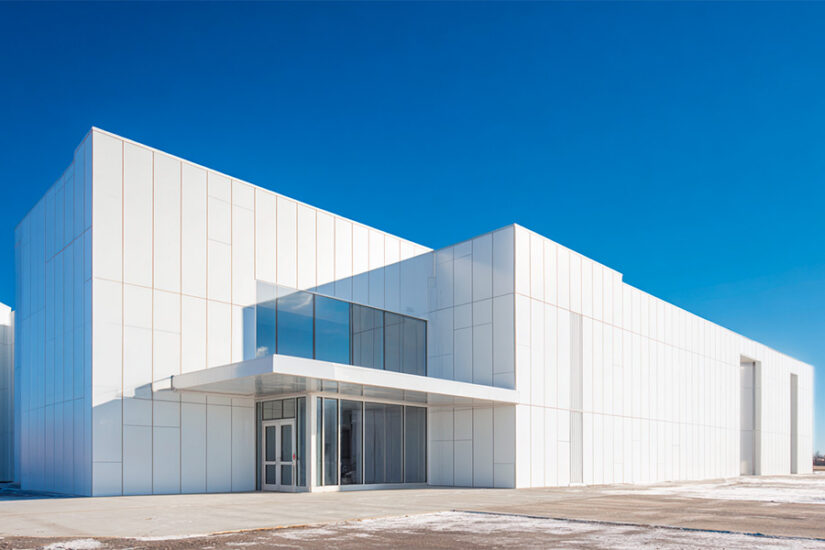
An insulated metal panel (IMP) is a single building panel made of two pre-finished steel sheets bonded to a rigid foam core, typically polyurethane (PUR) or polyisocyanurate (PIR). The two skins and the foam are pressed and cured into one unit at the factory. The finished panel handles three jobs at once: structural skin, insulation, and weather barrier. A standard IMP is 2 to 6 inches thick, runs roughly $7 to $18 per square foot installed in 2026, and delivers an R-value between R-14 and R-42 depending on thickness and foam type, Kingspan’s KingRib Wall IMP, for example, reaches R-7.2 per inch (see References).
For most US Patriot Steel customers building a barndominium, workshop, equestrian arena, or commercial metal building, the choice between a standard metal panel skin (with separate insulation added inside) and an insulated metal panel comes down to four questions: how cold or hot the building has to stay, whether the interior will see condensation, how fast the build has to finish, and whether the interior will ever be finished as a clean conditioned space. This guide walks through how the panels work, what they cost in 2026, where they win against standard metal and standard insulation, and where they lose.
Quick Answers (TL;DR)
What it is: a factory-made sandwich panel, two pre-finished steel skins bonded to a rigid foam core. Handles structural skin, insulation, and weather barrier in one unit.
Common thickness: 2 in (R-14–R-16), 3 in (R-21–R-24), 4 in (R-28–R-32), 6 in (R-42–R-48).
Installed cost (2026): $7–$18 per sq ft of envelope, depending on thickness, foam type, finish, and project size.
Main brands: Kingspan, Metl-Span (Cornerstone Building Brands), MBCI, Centria, ATAS.
Best for: cold storage, food processing, climate-controlled commercial, indoor riding arenas, fast-build commercial.
Where it loses: budget barndominium and shop builds, unconditioned agricultural buildings, projects that will be drywalled anyway, owner-builder small projects.
Useful life: 30–50 years for established US brands; PVDF (Kynar 500) paint warranty 20–40 years.
What an Lnsulated Metal Panel actually is
An insulated metal panel is a factory-made sandwich. The outer skin is 22 to 26 gauge pre-finished steel with a baked-on paint system rated for a 20 to 40 year warranty against fade and chalk. The inner skin is 24 to 26 gauge pre-finished steel in a smoother profile, often white, designed to face the building interior. Between the two skins sits a continuous foam core: polyurethane (PUR), polyisocyanurate (PIR), or in some products mineral wool.
Panel widths run 36 to 42 inches typical. Panel lengths run up to 50 feet or longer (limited mostly by trucking, not by the panel itself). Panel thicknesses run 2 inches (R-14 to R-16), 3 inches (R-21 to R-24), 4 inches (R-28 to R-32), and 6 inches (R-42 to R-48). The edges interlock with a tongue-and-groove or shiplap profile that hides fasteners and creates a continuous insulation plane across the whole wall or roof.
Established US brands include Kingspan, Metl-Span (a Cornerstone Building Brands product, on the market since 1968), MBCI, Centria, and ATAS. The panels go up faster than a conventional metal-wall-plus-batt-insulation system because the building closes in completely in one step.
How IMP Differs From Standard Metal Plus Insulation
The conventional way to insulate a metal building uses 26 gauge metal wall and roof sheeting on the outside and adds insulation inside the building: fiberglass batts compressed between the steel structure (faced or unfaced), faced rolls draped across the inside before sheeting, or closed-cell spray foam applied directly to the back of the metal sheeting after the shell is up. For the full playbook on how to install each of these systems, see how to insulate your metal building.
IMP replaces all of that with one factory-assembled panel.
| Property | Standard metal + insulation | Insulated metal panel |
| Trades on site | 2–3 (sheeting, insulation, sometimes interior) | 1 (panel install) |
| Erection speed for 60×120 building | 7–12 days | 4–7 days |
| Realized R-value (3 in IMP vs 6 in batts) | R-19 (batts compressed) | R-21–R-24 (continuous) |
| Thermal bridging through metal structure | High (batts cut by steel) | Minimal (foam continuous) |
| Interior finish on day one | No (steel structure visible) | Yes (smooth white inner skin) |
| Condensation risk | High (separate vapor control needed) | Low (panel is sealed) |
| Cost per sq ft installed (2026) | $4–$9 | $7–$18 |
| Useful life | 30–50 years | 30–50 years |
| Repair after damage | Easier (replace one sheet) | Harder (replace one full panel) |
Standard build is cheaper per square foot. IMP build is faster, cleaner, and produces a better-performing envelope. For most barndominium and shop builds the standard build is still the default. For commercial cold storage, food processing, equestrian arenas, and any climate-controlled commercial use, IMP is usually the right call.
Insulated Metal Panel Cost in 2026
Installed IMP costs $7 to $18 per square foot of wall or roof surface in 2026. The spread reflects thickness, foam type, panel finish, project size, and US region.
For a 60 by 120 foot metal building with 16 foot sidewalls (about 11,520 sq ft of wall and 7,200 sq ft of roof, 18,720 sq ft of envelope total), the 2026 cost picture looks like this.
| Envelope choice | $/sq ft installed | Total envelope cost | Notes |
| Standard 26-gauge metal + R-19 batts inside | $4 – $6 | $75,000 – $112,000 | Cheapest, most common for barndo and shop |
| Standard 26-gauge metal + closed-cell spray foam | $5 – $9 | $94,000 – $169,000 | Better envelope, no condensation |
| 3-inch IMP (R-21) | $7 – $12 | $131,000 – $225,000 | One trade, fast, clean interior |
| 4-inch IMP (R-28) | $9 – $14 | $169,000 – $262,000 | Climate-controlled commercial |
| 6-inch IMP (R-42) | $13 – $18 | $244,000 – $337,000 | Cold storage, food processing |
Sources: 2026 commercial IMP price ranges informed by Kingspan and Metl-Span product literature plus general MCA market guidance (see References). Project size and region shift the numbers; small jobs (under truckload) add 5–12%.
When to Use Insulated Metal Panels
Five situations where IMP usually wins.
- Cold storage and freezer buildings. Walk-in coolers, ice rinks, food storage, pharmaceutical warehouses. The continuous insulation and air-sealed envelope is exactly what these buildings need.
- Food processing and clean-room industrial. The smooth interior steel skin wipes down easily, holds no moisture, and meets USDA and FDA cleanability requirements that fiberglass batts cannot.
- Indoor riding arenas where dust and condensation are problems. White steel inner skin eliminates the dust that drifts down from batt-insulated arenas. The sealed envelope reduces condensation drip onto the footing in winter.
- Build-fast commercial. Time-pressed projects (data centers, retail, distribution centers under deadline) where finishing the shell in 4–7 days instead of 12–18 saves real money on general conditions and equipment rental.
- Climate-controlled barndominiums in extreme climates. Properly insulated barndos in north Minnesota, Idaho, eastern Montana, or northern New England benefit from a 6-inch IMP envelope because it eliminates the air-leak paths that batts always have. For the bigger-picture energy view, see barndominium energy efficiency.
When Standard Metal Plus Insulation Wins
- Budget-driven barndo or shop builds. The cost gap of $30,000–$80,000 on a 60×120 building is hard to justify if the build is otherwise budget-driven.
- Agricultural buildings without conditioning. Hay barns, equipment sheds, pole-frame barns that never need a finished interior. Spend the money where it earns a return.
- Projects with drywall interior anyway. The smooth interior steel skin of IMP loses its main advantage if the wall will be drywalled and painted. Standard metal plus stud framing plus drywall plus insulation often costs less and gives more wall depth for routing electric and plumbing.
- DIY or owner-builder builds. IMP panels are heavy, long, and require lifting equipment and trained installers. The labor savings vanish for a small crew.
Common Insulated Metal Panel Mistakes
- Choosing thickness on install cost, not operating cost. A 2-inch IMP saves $30,000–$50,000 against a 4-inch IMP on a 60×120 building. The 4-inch panel pays it back in 5–10 years of heating and cooling savings in any climate-controlled use. Run the energy math, not just the install math.
- Skipping the panel-end and panel-base flashing. IMP joints are excellent. IMP edges (panel meets foundation, roof, doors, windows) leak air and water if flashing details are rushed. Specify the manufacturer’s full flashing kit.
- Buying off-brand panels. Generic foam-core panels from low-cost importers look identical on day one. The fastener pattern is different, the foam often delaminates within 5 years, and the manufacturer is sometimes gone before a warranty claim. Stick with Kingspan, Metl-Span, MBCI, ATAS, or Centria.
How IMP Compares to Spray Foam
Spray foam (closed-cell polyurethane sprayed directly to the inside of standard metal sheeting) and IMP achieve similar envelope performance through different paths. Both eliminate condensation, both eliminate most thermal bridging, both seal air leaks at the metal joints.
Spray foam costs $1.50 to $3.50 per board-foot installed (a board-foot is one square foot at 1 inch thick). To match a 3 inch IMP (R-21) you need roughly 3 inches of closed-cell foam (R-21), which runs $4.50 to $10.50 per square foot of wall on top of the cost of the standard metal sheeting underneath.
Total cost of metal-plus-foam often comes within 10 to 25 percent of the cost of IMP, with IMP usually winning when the project is large enough that panel install speed offsets the panel premium. For smaller buildings (under 5,000 sq ft envelope) metal-plus-foam usually wins on cost. For larger commercial buildings IMP usually wins. Spray foam also adds a labor-and-cure delay; IMP delivers a finished interior surface on day one of the shell going up. For a direct ranking of insulation systems by use case and climate, see what is the best insulation for metal buildings.
Durability and Severe-Weather Performance
Quality IMP from established US manufacturers lasts 30 to 50 years. The paint warranty (typically 20 to 40 years on PVDF/Kynar 500 systems) is usually the limiting factor on appearance. The foam core and steel skins themselves outlast the paint warranty in most installations. On the structural side, properly engineered steel framing handles hurricane-force winds and tornado-prone regions far better than wood, see can a barndominium withstand a hurricane for the full structural picture.
How to Specify IMP for a New Build
For owners working with US Patriot Steel or another steel building supplier on an IMP envelope, the spec should include eight items.
- Thickness and R-value target (typically 3 in / R-21 for general commercial, 4 in / R-28 for climate-controlled, 6 in / R-42 for cold storage).
- Foam core type. PIR (polyiso) gives slightly higher R-value per inch and better fire performance than PUR (polyurethane).
- Exterior panel profile (flat, fluted, embossed) and color.
- Interior panel profile and color (almost always smooth white for commercial).
- Manufacturer warranty period on the paint system (20–40 years).
- Flashing package: base, eave, ridge, end-wall, door and window jamb.
- Fastener type and pattern. IMP uses concealed clip fasteners, not exposed fasteners.
- Installer certification. Most IMP manufacturers require certified installers for the warranty to apply.
Why Build With US Patriot Steel
US Patriot Steel supplies pre-engineered steel building kits across the US, with envelope options that range from standard 26-gauge sheeting with batt or spray-foam insulation to factory-supplied insulated metal panels for climate-controlled commercial use.
- Made in the USA steel components.
- Engineered to local codes for snow, wind, and seismic loads.
- Prefabricated kits with all primary components.
- Nationwide delivery with in-house project support from quote to completion.
Frequently Asked Questions
Insulated metal panels (IMP) are factory-made building panels with two pre-finished steel skins bonded to a rigid foam core, typically polyurethane (PUR) or polyisocyanurate (PIR). Each panel handles structural skin, insulation, and weather barrier in one unit. Panels are usually 2 to 6 inches thick, deliver R-14 to R-42, and install as a single trade on the building shell.
Installed IMP costs $7 to $18 per square foot of envelope in 2026, depending on thickness, foam type, finish quality, and project size. For a 60 by 120 foot building with 16 foot sidewalls (about 18,720 sq ft of envelope), a 3-inch IMP envelope runs $131,000 to $225,000 installed. A 6-inch cold-storage envelope runs $244,000 to $337,000.
IMP R-values run R-14 to R-16 for 2-inch panels, R-21 to R-24 for 3-inch, R-28 to R-32 for 4-inch, and R-42 to R-48 for 6-inch. Polyisocyanurate (PIR) foam delivers slightly higher R-value per inch than polyurethane (PUR). Kingspan’s KingRib Wall IMP reaches R-7.2 per inch. The continuous foam means the rated R-value is the realized R-value, unlike batt insulation which loses performance to thermal bridging through the steel structure.
For cold storage, food processing, climate-controlled commercial, and large fast-build projects, yes. The continuous insulation, sealed envelope, and one-trade install pay back the cost premium. For budget barndominium and shop builds without climate-controlled use, standard metal sheeting with spray foam or batt insulation inside usually costs less for the same comfort level.
Quality IMP from established US manufacturers (Kingspan, Metl-Span, MBCI, Centria, ATAS) lasts 30 to 50 years. The PVDF (Kynar 500) paint warranty (20 to 40 years) is usually the limiting factor on appearance. The foam core and steel skins outlast the paint warranty in most installations. Off-brand panels sometimes delaminate at the foam-skin bond within 5 to 10 years.
Yes, especially in climate-extreme regions (north Minnesota, Idaho, eastern Montana, northern New England, Colorado mountain country). The trade-off is cost: IMP adds $30,000 to $80,000 on a typical 40 by 60 or 40 by 80 barndominium against standard metal plus batt insulation. For most barndominium builds, standard metal with closed-cell spray foam interior is the cost-effective middle path.
References
- Kingspan US. What Is the R-Value of Insulated Metal Panels?. www.kingspan.com/us/en/knowledge-articles/what-is-the-r-value-of-insulated-metal-panels/
- Metl-Span (Cornerstone Building Brands). Insulated Metal Panel (IMP) Manufacturer, product overview. metlspan.com/imp
- MBCI. Insulated Metal Roof & Wall Panel Systems. www.mbci.com/products/insulated-metal-panels/
- Metal Construction Association (MCA). IMP technical resources. www.metalconstruction.org/resource-center/
- U.S. Department of Energy. Building Envelope Research, continuous insulation. www.energy.gov/eere/buildings/building-envelope-research