
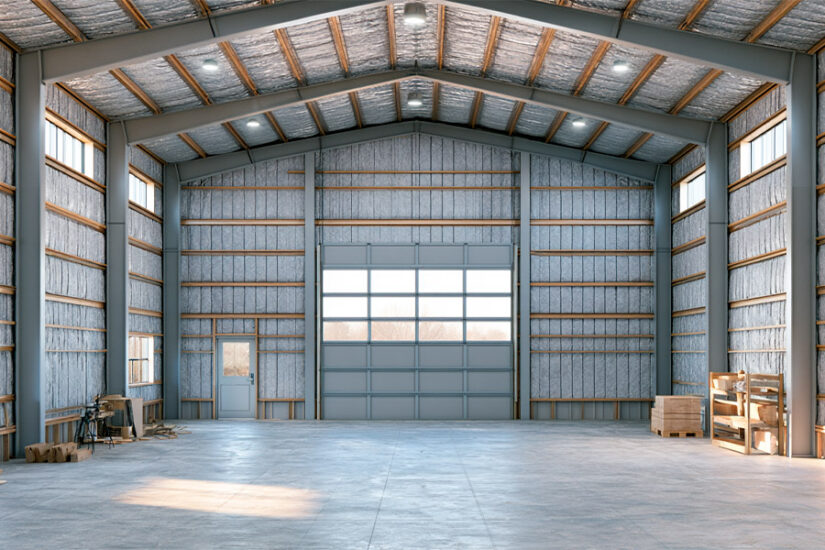
A steel shell keeps weather out, but bare metal does almost nothing to hold temperature. Insulation is what turns a metal building into a space you can heat, cool, work in, or live in year round. The hard part is not whether to insulate, it is choosing the right type for your climate, your building, and whether the structure is already standing.
This guide covers the four insulation types that matter, the R-values the DOE recommends by climate zone, how to handle condensation, what changes when you retrofit an existing building, and what the job actually costs.
Quick Answer
For most metal buildings in a mixed or cold climate, the practical choice is closed-cell spray foam, or vinyl-faced fiberglass batt paired with a vapor barrier. Spray foam costs more but insulates and seals moisture in one step. Fiberglass costs less and is realistic for a DIY install on new construction. Recommended R-values track your DOE climate zone, not a single national number.
- Closed-cell spray foam: R-6 to R-7 per inch, best moisture control, pro install only
- Fiberglass batt (vinyl-faced): R-11 to R-38 by thickness, cheapest, DIY friendly
- Rigid foam board: R-4 to R-6.5 per inch, good for floors, doors, and retrofit walls
- Reflective/radiant barrier: useful only as a supplement in hot climates
The Four Main Insulation Types for Metal Buildings
Most insulation decisions for a steel building come down to four products. They are not interchangeable. Each one fits a specific job, climate, and budget, and picking the wrong one is where people lose money.
| Type | R-value per inch | Best for | Vapor barrier needed? | DIY? | Approx cost (materials) |
| Closed-cell spray foam | R-6 to R-7 | All climates, retrofit, condensation control | No (acts as barrier) | No, pro required | $1.50–$3.50/sq ft installed |
| Open-cell spray foam | R-3.5 to R-4 | Warm climates, sound control | Yes | No, pro required | $0.75–$1.50/sq ft |
| Fiberglass batt (vinyl-faced) | R-11 to R-38 | New construction, walls and roof | Yes | Yes | $0.30–$0.80/sq ft material |
| Rigid foam board (polyiso/XPS) | R-4 to R-6.5 | Floors, doors, retrofit walls | Depends on climate | Yes | $0.50–$1.25/sq ft material |
| Reflective/radiant barrier | R-1 to R-2 alone | Hot climates only, as a supplement | No | Yes | $0.15–$0.50/sq ft |
Cost ranges above reflect 2026 national pricing from HomeGuide, Angi, and steel building insulation suppliers (see References). Regional labor swings these numbers by 30 to 50 percent.
Spray Foam, and When it Earns its Price
Closed-cell spray foam is the only product that insulates, air-seals, and acts as its own vapor barrier at the same time. That is why it shows up on almost every retrofit. It expands into the gaps and ribs of a metal panel that a flat batt can never fill, and once cured it does not sag or absorb water. The cost is the catch. Installed pricing runs $1.50 to $3.50 per square foot, sometimes up to $5.00 on smaller jobs, and it is not a DIY product. The spray rig costs over $10,000 and the chemicals are hazardous without proper protection.
Open-cell foam is cheaper and softer, with a lower R-value around R-3.5 to R-4 per inch. It works in warm climates and dampens sound well, but it absorbs moisture, so it needs a separate vapor barrier in any climate where condensation is a risk.

Fiberglass Batt, Cheaper With One Condition
Vinyl-faced fiberglass batt is the most common insulation on new metal buildings, and for good reason: material runs $0.30 to $0.80 per square foot and a confident owner can install it. On a steel building the batt is held against the framing and laid over the purlins and girts, with the vinyl facing turned to the interior.
The condition is the vapor barrier. In DOE climate zones 3 and colder, fiberglass without a vapor barrier on the warm side will take on condensation, lose its R-value, and eventually rot. Skipping that barrier is the single most expensive shortcut in this whole guide. If you want a rigid-panel alternative for some surfaces, insulated metal panels bundle the facing and core into one product.

Rigid Board and Radiant Barrier, Where They Belong
Rigid foam board earns its place on floors and around door framing, anywhere a soft batt will not stay put. It also fastens cleanly to interior walls during a retrofit. Radiant barrier is the most misunderstood product on the list. The foil only reflects heat across an air gap, and only in hot climates does that translate to real comfort. Installing reflective insulation in Minnesota and expecting the result you would get in south Texas is a common and costly mistake.
R-value by Climate Zone, What the DOE Actually Recommends
There is no single right R-value for a metal building. The number depends on your DOE climate zone, and the roof always needs more than the walls because it loses more heat.
| DOE climate zone | Example states | Recommended R, walls | Recommended R, roof/ceiling |
| 1–2 (very hot) | FL, HI, south TX, south AZ | R-13 | R-25 to R-30 |
| 3 (hot-mixed) | GA, AL, MS, NM, central CA | R-13 to R-15 | R-30 to R-38 |
| 4 (mixed) | TN, VA, KY, OR/WA coast | R-13 to R-19 | R-38 |
| 5 (cold) | IL, OH, PA, NY, lower CO | R-19 to R-21 | R-38 to R-49 |
| 6–7 (very cold) | MN, ND, MT, southern AK | R-21 to R-25 | R-49 to R-60 |
| 8 (subarctic) | interior AK | R-25+ | R-60+ |
These follow IECC minimums for commercial and agricultural buildings. A residential barndominium in the same zone often has to meet a higher number under the local code, so check your county requirements before you buy materials. If you are insulating a home-use steel building, the comfort math overlaps heavily with barndominium energy efficiency.
Condensation and Vapor Barriers in Metal Buildings
This is the failure point that ruins more metal building insulation than any other. Steel conducts heat and cold fast. When warm, humid interior air meets a cold steel surface, it condenses, the same way a cold glass sweats on a summer day. That water soaks fiberglass, drips onto stored goods, feeds mold, and starts rust under the panel.

The fix is a vapor barrier on the correct side of the insulation, and the correct side changes with climate:
- New construction: vinyl-faced fiberglass batt with the facing toward the interior, or closed-cell spray foam, which needs no separate barrier.
- Cold climates (zones 5 to 7): vapor barrier on the inside, warm face of the insulation. This is not optional.
- Hot, humid climates: a vapor retarder or a breathable barrier toward the exterior. Put it on the wrong side here and you trap moisture instead of blocking it.
Ventilation is the other half of the equation. Even a well-sealed building needs airflow. A ridge vent paired with soffit or eave vents lets moisture escape instead of collecting against the steel. Buildings that house animals, a paint booth, or any process that throws off humidity should add powered exhaust on top of passive venting.
Example scenario: on a steel shop where condensation dripping from the roof was the main complaint, the practical fix is a thin closed-cell spray foam pass on the underside of the roof panels to kill the cold surface, then standard batt on the walls. The dripping stops once the foam cures.
Insulating an Existing Metal Building, the Retrofit Problem
Insulating a building that is already standing is a different job from insulating one under construction, and most guides gloss over it in a sentence. The constraint is access. You cannot hang batt in framing you can no longer reach from behind the panel.
The realistic retrofit options:
- Closed-cell spray foam on the interior steel surfaces. No demolition, fills every rib and gap, and doubles as the vapor barrier. It is the most reliable retrofit and the most expensive, at $1.50 to $3.50 per square foot plus labor.
- Rigid foam board fastened mechanically to interior walls and ceiling, then covered with drywall or OSB. Cheaper than spray foam, and a capable owner can do it. Polyiso board gives the best R-value per inch (R-6 to R-6.5) for the thickness, which matters when interior headroom is tight.
- A combined approach for zones 4 to 6: a thin one-inch pass of closed-cell foam to create the vapor barrier, then fiberglass batt over it. Good balance of cost and performance.
The roof is the hardest part of any retrofit. Without pulling the roofing, spray foam or blown-in insulation are usually the only ways to reach the cavity, and the roof is exactly where you cannot afford to skip insulation. Blown-in cellulose or fiberglass works in an enclosed ceiling cavity if you can drill access holes; spray foam is the answer on an open roof underside.
Thermal bridging through the steel purlins and girts is the other retrofit headache. Heat moves straight through the metal framing every few feet, bypassing whatever insulation sits between them. The ASHRAE Handbook of Fundamentals puts the effective R-value of a metal-framed wall at 20 to 35 percent less than the nominal R-value of the insulation alone, because of this framing effect. Spray foam reduces it by covering the framing surface; a continuous layer of rigid board over the framing handles it better because it breaks the thermal path entirely.
If you are also pouring or upgrading a slab during the work, the concrete slab and foundation detail matters for floor insulation. One more practical note: a retrofit on a residential barndominium almost always needs a permit. A plain storage garage may not, depending on your jurisdiction, but check before you start work rather than after.
Example scenario: a typical existing 30×40 garage in a mixed climate, insulated with rigid board on the walls and a foam-and-batt combo on the ceiling, usually goes from unusable in winter to comfortable with a single space heater.
By Structure, How the Approach Changes
The principles above hold for any steel building, but the right execution shifts with what the building is. Here is the part specific to each structure type, without repeating the basics.
Metal Garage
A metal garage is often unheated and sits on a concrete slab. Add rigid board under the finish floor if comfort underfoot matters: two inches of XPS under a plywood subfloor gets the slab surface out of direct contact with cold ground and adds roughly R-10 to the floor assembly. The weak point is the door. Insulating the walls to R-38 does little if the overhead door has no insulation, so pair the walls with an insulated door rated around R-12 or higher. An uninsulated steel overhead door is effectively a hole in your thermal envelope, regardless of how well the walls are done. These are the same trade-offs that come up when people convert a garage to living space.
Metal Shop or Workshop
Tools, compressors, and welders add heat and humidity, which raises the ventilation requirement above what a storage building needs. A welding setup produces both heat and fumes; a spray paint booth requires explosion-proof exhaust rated for solvent vapors. If either operation runs in the space, the vapor barrier should be a chemically resistant product rather than a basic poly sheet, which can off-gas or degrade near solvents.
Roof and Ceiling
The roof loses more heat than the walls in most climates, so it gets the higher R-value from the zone table above. Vinyl-faced fiberglass batt between the purlins is the new-construction standard; spray foam or blown-in covers a retrofit. Condensation collects on the roof first, before the walls ever see moisture problems, so the vapor barrier here is not optional regardless of climate zone. In zones 5 through 7, a roof assembly without a vapor barrier will show corrosion under the purlin flanges within a few winters.
Walls
Wall girts create a thermal bridge through the steel every five to eight feet. Batt between the girts handles the open area but does nothing for the girts themselves. For zones 5 to 7, add one to two inches of continuous rigid board across the full wall surface over the batt to break that bridge. The rigid layer also gives you a flat interior surface to finish if you eventually want to drywall the space.
In zones 3 and 4, batt alone often meets code for a non-residential building, but if the shop will be heated daily, the energy math usually favors adding the rigid layer: the payback on a continuous inch of polyiso at R-6.5 runs about three to five heating seasons in most of the Midwest.
Metal Carport
An open carport is not worth insulating. If it is enclosed with walls and a door, treat it like a garage. If it is open but used as a workshop, close in the walls first, then insulate, because insulating an open structure wastes material and accomplishes nothing.
Cost of Insulating a Metal Building, What the Numbers Actually Mean
“It depends” is true but useless, so here are concrete scenarios. These reflect 2026 pricing; regional labor moves them up or down by 30 to 50 percent.
| Scenario | Building size | Insulation | Approx total |
| Cheapest: DIY fiberglass batt, walls only | 30×40 garage | R-19 vinyl-faced batt | $800–$1,500 materials |
| Mid-range: DIY rigid board + batt combo | 30×40 garage | R-21 combined | $1,500–$2,500 materials |
| Pro spray foam, full building | 40×60 shop | closed-cell, walls + roof | $12,000–$20,000 installed |
| Full retrofit, existing building | 40×60 shop | rigid board + pro spray foam | $15,000–$28,000 |
A 40×60 building takes roughly 3,600 to 4,400 square feet of insulation depending on roof pitch. For materials alone that is about $1,200 to $3,600; professional labor adds another $1,200 to $3,000 for batt, and more for spray foam, where labor often equals or exceeds the material cost. DIY mainly saves the labor line, 40 to 60 percent of a batt job, in exchange for your weekend and the right safety gear. If you are still pricing the building itself, see how much a metal building costs for the shell side of the budget.
DIY vs Hiring a Pro, Where the Line Actually is
The split is cleaner than most people expect.
DIY is realistic for:
- Fiberglass batt in the walls of new construction. The tools are a utility knife, shears, and a staple gun.
- Rigid foam board for floors and door framing.
- Reflective barrier, if your climate actually supports it.
Hire a pro for:
- Closed-cell spray foam. The equipment runs over $10,000 and the chemicals are hazardous without proper protection.
- Open-cell spray foam, for the same reasons.
- Any roof retrofit that does not involve pulling the roofing.
For a DIY fiberglass batt job in a 30×40 garage you need R-19 vinyl-faced batt at roughly $0.50 per square foot, a vapor barrier if you are in a cold climate, a staple gun, and P100 respirator with eye and hand protection. Plan on one to two days with two people. If you are buying a new building and want the insulation handled from the start, ask about it when you spec your metal garage kit.
What to do First, a Simple Decision Guide
Run these five questions before you buy anything:
- Is the building new or already standing? That decides which methods are even available.
- What is your DOE climate zone? That sets the R-value.
- Will the building be heated? If not, a vapor barrier plus minimal insulation may be enough.
- Is there condensation already? If yes, lean toward spray foam, not fiberglass.
- What is the budget: under $2,000 (DIY batt), $2,000 to $10,000 (DIY combo), or $10,000-plus (pro spray foam)?
- Once you can answer those, the right product is usually obvious. If you want a second opinion on a specific building, call US Patriot Steel at (888) 415-1576 and talk it through before you commit.
Frequently Asked Questions
Closed-cell spray foam gives the best all-around performance. It insulates, stops air leaks, and acts as its own vapor barrier in one step. For new construction on a tighter budget, vinyl-faced fiberglass batt with a separate vapor barrier is the most common choice and covers R-13 to R-38 depending on thickness. The right answer depends on your climate zone and whether the building is already built.
DIY fiberglass batt on the walls of a 30×40 metal garage runs $800 to $1,500 in materials plus a weekend of labor. That is the floor. You need a vapor barrier on the warm side in climate zones 3 and above, which adds $100 to $300. Skipping the vapor barrier saves money upfront and costs much more later in water damage and mold.
Yes, and it is done regularly. The practical options for an existing building are closed-cell spray foam on interior surfaces with no demolition, rigid foam board fastened mechanically to interior walls, or blown-in insulation in enclosed ceiling cavities. Fiberglass batt is hard to retrofit unless you can reach the wall framing from inside. A contractor assessment is worth the cost before you pick a method.
In most US climates, yes. Metal conducts temperature efficiently, so warm interior air hits a cold surface and condenses. That moisture ruins fiberglass insulation, accelerates rust, and grows mold. In climate zones 3 through 7, a vapor barrier on the warm side of the insulation is standard practice. Closed-cell spray foam is the exception, since it acts as its own barrier.
It depends on your DOE climate zone. For walls: R-13 in hot climates (zones 1 to 2), R-13 to R-19 in mixed climates (zones 3 to 4), and R-19 to R-21 in cold climates (zones 5 to 6). Roofs typically need 50 to 75 percent more than the walls. Check your local building code, because residential-use barndominiums often require higher R-values than storage or agricultural buildings in the same zone.
Four come up repeatedly: skipping the vapor barrier, which lets condensation destroy fiberglass within a few seasons; using reflective barrier alone in cold climates, where it adds little R-value; undersizing the roof insulation relative to the walls; and insulating a building that already has a moisture problem instead of fixing the moisture first. That last one is the costly one, because wet insulation is worse than none.
- How much does a metal building cost?
- Insulated metal panels explained
- Barndominium energy efficiency
- Concrete slab thickness guide for steel buildings
- Metal garage kits
- Convert a garage to living space
References
- U.S. Department of Energy, Building America Solution Center, climate zone map and R-value recommendations: https://basc.pnnl.gov/
- International Energy Conservation Code (IECC), insulation requirements by climate zone
- North American Insulation Manufacturers Association (NAIMA), metal building insulation guidance: https://www.insulationinstitute.org/
- ASHRAE Handbook of Fundamentals, effective R-value of metal-framed assemblies (thermal bridging section)
- HomeGuide, pole barn and metal building spray foam insulation cost (2026): https://homeguide.com/costs/spray-foam-insulation-cost-pole-barn
- Angi, spray foam insulation cost (2026): https://www.angi.com/articles/spray-foam-insulation-cost.htm
- Nationwide Steel Structures, insulated steel building cost (2026): https://www.nationwidesteelstructures.com/post/insulated-steel-building-cost-2026
- Steel Building Insulation, cost guide: https://steelbuildinginsulation.com/steel-building-insulation-cost/
- Insulation Marketplace, metal building insulation cost guide: https://www.insulationmarketplace.com/blogs/blogs/metal-building-insulation-cost