
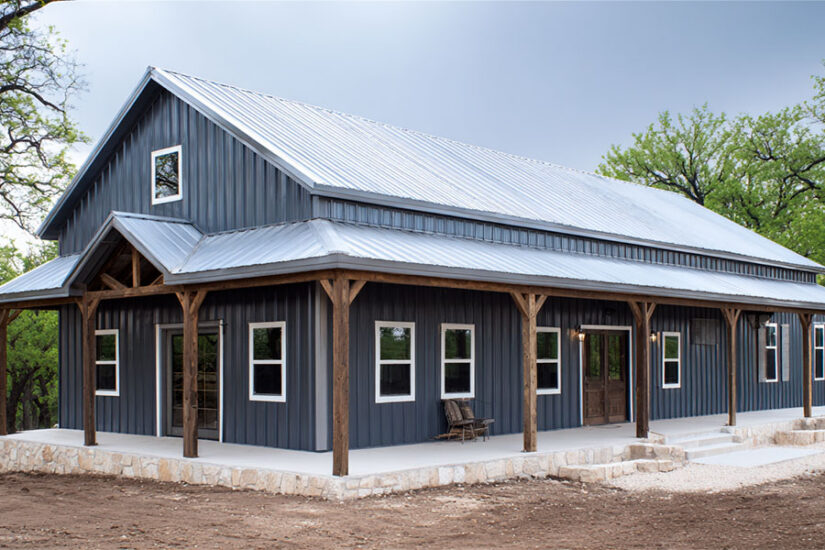
A barndominium floor plan is the layout drawing that shows how living space, garage, and (optionally) shop space sit inside a steel-framed building shell. The most common US barndominium plan is a 40 by 60 foot single-story open-concept layout with three bedrooms, two bathrooms, an attached two-car garage, and roughly 1,800 to 2,400 finished square feet. That layout fits the way most American families actually live, costs $180,000 to $320,000 finished in 2026 depending on region and finish level, and resells well because the proportions match standard mortgage appraisal benchmarks.
The longer answer is more interesting, because the right floor plan depends on lot, climate, family size, and whether you actually need shop space attached to the home. A barndominium can be 1,000 square feet with a sleeping loft, or 4,800 square feet across two floors with a workshop wing. Picking the wrong size or the wrong layout style is the single most expensive mistake new barndominium owners make. For the full background on the building type itself, see our pillar guide: what is a barndominium.
Quick Answers (TL;DR)
What it is: a top-down layout drawing of the interior space inside a steel-framed barndominium, defined by footprint (length by width), finished living area, and bedroom and bathroom count.
Most popular footprint: 40 by 60 (2,400 sq ft, about 1,800–1,900 finished), 3 bed / 2 bath, open-concept, attached 2-car garage.
Other common sizes: 30 by 40 (starter), 40 by 80 (shop-attached), 50 by 80 and 60 by 80 (large or multi-generational).
Cost to build (2026): roughly $65–$160 per finished square foot, or $130,000–$320,000 for a 2,000 sq ft home, per HomeGuide and Angi 2026 cost data (see References).
Layout style: open-concept is the default; split-bedroom is used in about 70% of stock plans; traditional and L-shape are situational.
Stories: about 80% of US barndominium builds are single-story. Two-story and 1.5-story (sleeping loft) plans add square footage on the same footprint.
What a Barndominium Floor Plan Actually is
A barndominium floor plan is a top-down architectural drawing of the interior space inside a steel or post-frame building. Three numbers define every plan: the building footprint (length by width, in feet), the finished living area in square feet, and the bedroom and bathroom count.
A floor plan is not the same as a full set of blueprints. The blueprint adds structural framing, mechanical, electrical, and plumbing detail, plus engineering stamps required for permits. The floor plan is the document homeowners actually use to decide what they want, walk through with a builder, and compare against other layouts. Stock floor plans from online catalogs can be adapted into full blueprints by a residential designer or licensed architect for roughly $1,500 to $6,000.
Most barndominium plans in the US fall into three building footprints: 30 by 40 (1,200 sq ft), 40 by 60 (2,400 sq ft, the most common size), and 50 by 80 or 60 by 80 (4,000 to 4,800 sq ft for larger families or shop-attached layouts). The structural system underneath is almost always steel framing rather than wood post-frame, which determines column spacing and how open the interior can be – for the full comparison see steel vs. wood frame barndominium.
Barndominium Floor Plans by Size
30 by 40 (1,200 square feet)
The starter barndominium. Best for retired couples, second homes on rural land, single-person households, or anyone who wants a debt-light build. Typical layout: two bedrooms, one bathroom, open kitchen and living combined, a small utility or laundry corner, and either a covered patio or a single-car attached garage. Most owners go single-story and skip the shop space.
Finished cost in 2026: $90,000 to $160,000 depending on region, finish level, and whether the owner does any sweat-equity work. Land and site prep are separate.
40 by 60 (2,400 square feet)
The most common barndominium size in the US, and the size most stock plans target. The footprint fits a comfortable family-sized home with attached parking on a 1 to 3 acre lot. Typical layout: three bedrooms, two bathrooms, an open kitchen-dining-living room across one long side, a primary suite at one end, two secondary bedrooms at the other end, a laundry room near the back, and a 24 by 24 attached two-car garage taking up roughly one-third of the building. About 1,700 to 1,900 finished square feet of living space after subtracting the garage area.
Finished cost in 2026: $180,000 to $320,000 depending on region and finish level. The wide spread reflects the difference between a builder-grade finish in Oklahoma or East Texas (low end) and a custom finish in Colorado, Idaho, or New England (high end). The 40 by 60 wins on resale because the proportions match what mortgage appraisers compare against, and the footprint can absorb a future loft addition or rear extension without major engineering changes.
40 by 80 (3,200 square feet)
The shop-attached barndominium. Most 40 by 80 layouts split the footprint: 40 by 40 of living space (about 1,500 to 1,600 finished square feet) on one side, a 40 by 40 shop with 14 to 16 foot ceilings and one or two 12 by 14 overhead doors on the other. Best for owners who actually work from home in trades: woodworkers, hot rod and tractor restorers, gunsmiths, farm equipment mechanics, and similar. The shop side stays unfinished concrete with overhead lighting and the living side gets full residential finishes.
Finished cost in 2026: $220,000 to $400,000. The shop side adds roughly $40,000 to $70,000 over the living-only equivalent because it needs the same envelope, slab, doors, electric, and basic mechanical work.
50 by 80 to 60 by 80 (4,000 to 4,800 square feet)
The large-family or multi-generational barndominium. Common layouts include four to five bedrooms, three to four bathrooms, a primary suite with private bath and walk-in closet, an open kitchen with island, a separate dining room, a covered porch, an attached three-car garage or attached shop, and sometimes a guest suite or in-law setup at one end. Finished cost in 2026: $320,000 to $620,000 depending on finish level and whether a second story is included.
Two-story versions of 50 by 80 are increasingly common because the upstairs floor doubles the usable square footage without expanding the foundation or the steel kit footprint. The trade-off is engineering complexity: the steel frame must carry the upper-floor load, the upstairs needs egress windows in every bedroom, and roughly $40 to $80 per upstairs square foot is added to the build cost.
Open-Concept vs. Traditional vs. Split-Bedroom
The interior layout style matters at least as much as the building footprint.
The open-concept layout, the default for most US barndominium plans, runs the kitchen, dining, and living spaces together across one long side of the building with no interior walls between them. The bedrooms stack along the other long side, separated by a hallway. This layout maximizes the feeling of space inside a single rectangular shell, takes advantage of the high ceilings most barndominiums have, and supports the rural lifestyle most owners are after.
The traditional layout adds full walls between kitchen, dining, and living, more like a conventional suburban home. It uses more interior wall framing, which adds cost, but it gives quieter, more separated spaces. This works better in cold climates where heating zones matter, and for owners who want a formal dining room.
The split-bedroom layout puts the primary suite at one end of the building and the secondary bedrooms at the opposite end, with the common living areas in the middle. This is the dominant layout in 40 by 60 and larger plans because it gives the primary suite privacy from kids’ rooms or guest rooms. About 70 percent of stock barndominium plans use this layout.
The L-shape adds a perpendicular wing to a rectangular base, usually to fit a shop or a covered porch. The L-shape costs more (extra corners, more roof intersections) but solves lot-layout problems on irregular parcels.
One Story vs. Two Story

Single-story barndominium plans dominate in Texas, Oklahoma, Arkansas, the Plains states, the Southeast, and most of the South. The pitched-roof shell looks proportionally correct as a single story, the design is simpler and cheaper, and accessibility for aging-in-place is built in. About 80 percent of all US barndominium builds are single-story.
Two-story plans show up more often in the Midwest, Mountain West, and New England, where smaller lots, steeper slopes, or stricter setbacks make a taller footprint more efficient. A two-story 40 by 60 gives 4,800 finished square feet on the same footprint as a single-story 2,400 sq ft plan. The trade-off is structural cost: the steel frame has to carry the floor load, the stairs eat usable space (figure 100 to 120 square feet for a code-compliant stair), and the building shell needs taller sidewalls (typically 18 to 22 feet versus 12 to 14).
A 1.5-story layout (sometimes called a sleeping-loft barndominium) is a popular middle path. The main floor handles primary bedroom and all daily living. An upstairs loft adds secondary bedrooms or guest space without a full second floor. The sidewall stays at 14 to 16 feet and the loft uses the existing roof volume.
Garage and Shop Integration
About 60 percent of US barndominium plans include some form of attached garage or shop. The integration ranges from a one-car residential garage stuck onto one end (smallest add, simplest finish) to a full 40 by 40 shop wing with industrial doors and a separate slab pour.
Three common configurations dominate. The first is an attached two-car residential garage (24 by 24 on one end of a 40 by 60). The second is an attached workshop with overhead doors (30 by 40 shop on one end of a 40 by 80). The third is a drive-through shop, with overhead doors on both ends so trucks and trailers can drive in one side and out the other. These configurations also map onto broader categories of the building itself — residential, agricultural, and commercial — covered in detail in types of barndominiums.
A note on the shop slab. Living-side slab is usually 4 inches thick over 2 to 4 inches of foam insulation, with in-floor heat tubing. Shop slab is usually 6 inches thick, fiber-reinforced or steel-mesh-reinforced, without insulation, designed for the weight of vehicles and equipment.
Cost by Plan Type (2026)
Finished cost for a 40 by 60 barndominium on a clean rural lot in a typical US region (Texas, Oklahoma, Tennessee, Missouri, Kansas) breaks down as follows in 2026.
| Stage | Cost range | Notes |
| Land and site prep | $20,000 – $60,000 | Varies wildly by region |
| Foundation (slab on grade) | $18,000 – $35,000 | 4 in slab under living, 6 in slab for shop |
| Steel building kit (40 by 60) | $35,000 – $65,000 | Delivered with doors and windows |
| Erection labor | $12,000 – $25,000 | Crew of 3–4, about a week |
| Interior framing | $10,000 – $22,000 | Studs, sheathing, interior walls |
| Plumbing, electric, HVAC | $30,000 – $60,000 | Rough-in and finish |
| Insulation | $8,000 – $18,000 | Spray foam typical |
| Drywall, paint, trim | $18,000 – $35,000 | |
| Cabinets and countertops | $15,000 – $40,000 | Stock to custom |
| Flooring | $8,000 – $25,000 | LVP to hardwood/tile mix |
| Bathroom finishes | $8,000 – $25,000 | Two bathrooms |
| Appliances | $5,000 – $15,000 | |
| Doors, windows, exterior trim | $8,000 – $20,000 | |
| Total finished | $195,000 – $445,000 | Most builds land $220k–$320k |
Sources: HomeGuide and Angi 2026 barndominium cost data (see References). Figures are national U.S. ranges; your final cost depends on size, finishes, site work, and local labor.
For comparison, a 50 by 80 with attached shop runs $320,000 to $620,000 finished, and a starter 30 by 40 runs $90,000 to $160,000.
What Goes Wrong With Floor Plans
- Building too small. Owners planning a 30 by 40 (1,200 sq ft) often regret it inside three years and want to add square footage. Adding to a steel-framed building is expensive because the roof and sidewalls have to be extended. Going to 40 by 60 in the first place costs roughly $30,000 more on the build and saves $80,000 to $150,000 in future addition cost.
- Undersized ceilings. Standard residential ceiling height is 8 feet. Most barndominium plans should specify 10 to 12 foot ceilings because the building shell easily allows it and high ceilings are part of the look people are buying. Going from 8 foot to 10 foot ceilings adds about $4,000 to $7,000 on a 2,400 square foot plan.
- Undersized utility space. A 6 by 8 laundry closet cannot fit a washer, dryer, water heater, water softener, and HVAC return. Plan 10 by 12 minimum for the utility area on any barndominium 1,800 sq ft or larger.
- No mudroom. Barndominiums are rural. Owners come in muddy, wet, in work boots. A 6 by 8 mudroom between the garage and the main living space pays for itself in mopping time inside two years.
- Open-concept regret. Some owners build a fully open kitchen-dining-living plan and discover that cooking smells, dishwasher noise, and visible kitchen mess dominate the living space. The fix is a partial wall or a peninsula counter that separates the kitchen visually without closing it off.
Foundation Choices on the Plan
Most barndominium floor plans assume a slab-on-grade foundation, which is the cheapest, the simplest, and the only option that gives in-floor heat the obvious way to run. Crawl space and pier-and-beam options exist for sloped sites, regions where the frost line forces a deeper foundation, or owners who want HVAC, plumbing, and electric runs under the floor for future access. For the trade-offs, see can a barndominium have a crawl space.
Choosing the Right Plan for Your Style
Color and exterior style sit on top of the floor plan, not under it. Once the footprint and layout are locked, the exterior choices, paint color, trim, roof type, porch placement, drive almost all of the curb appeal. For one popular exterior direction, see black barndominium design ideas.
Barndominium vs. Modular and Stick-Built
Floor plans look almost the same on paper for a barndominium, a modular home, and a stick-built rural home of the same square footage. The structural system underneath is what differs, along with how it finances. For the full side-by-side on financing, layout flexibility, and timeline, see modular home vs. barndominium.
How to Choose a Floor Plan
Five questions narrow the choice fast, in this order.
- How many bedrooms and bathrooms do you need today, and what is realistic over the next ten years? Future kids, future aging-in-place, future guest space.
- Do you need shop or workshop space attached? If yes, plan a 40 by 80 or larger. If no, save the money and stay at 40 by 60.
- What is the lot orientation? Rectangular footprints work on most lots. L-shape and split-wing layouts work better on irregular or sloped parcels.
- What is the total budget ceiling? Land plus build, not just the steel kit. The kit is roughly 15 to 25 percent of all-in cost.
- What style of life do you want inside the space? Wide-open and casual, or zoned and quiet. The layout style drives this more than the building footprint.
Owners who answer these five questions before shopping plans save weeks of revision cycles with their designer.
Why Build Your Barndominium With US Patriot Steel
US Patriot Steel supplies pre-engineered steel building kits and barndominiums, delivered nationwide and engineered to local codes.
- Made in the USA steel components.
- Engineered to code, with structural drawings and stamps for your jurisdiction.
- Prefabricated kits with all primary components for efficient on-site assembly.
- Nationwide delivery with in-house project support from quote to completion.
See current configurations and sizing on our metal barndominiums page.
Frequently Asked Questions
The most popular plan in the US is a 40 by 60 foot single-story open-concept layout with three bedrooms, two bathrooms, an attached two-car garage, and roughly 1,800 to 1,900 finished square feet of living space. It fits the way most American families live, costs $180,000 to $320,000 finished in 2026, and resells well because the proportions match standard appraisal benchmarks.
Stock barndominium floor plans cost $200 to $1,500 from online catalogs. Custom plans drawn by a residential designer cost $1,500 to $4,000. Plans by a licensed architect run $3,000 to $8,000 or more, plus an engineering stamp if the county requires it (another $500 to $2,000). For most rural counties a stock plan with minor modifications is enough.
The most common US barndominium footprint is 40 by 60 feet (2,400 square feet of building, about 1,800 to 1,900 of finished living space after the garage). Smaller starter barndominiums run 30 by 40 (1,200 sq ft). Larger family barndominiums run 50 by 80 to 60 by 80 (4,000 to 4,800 sq ft). About 80 percent of US builds are single-story.
Yes. Two-story barndominium plans give roughly double the finished square footage on the same footprint. Trade-offs: higher engineering cost (the steel frame must carry the upper-floor load), taller sidewalls (18 to 22 feet versus 12 to 14), and code-required egress windows in every upstairs bedroom. A 1.5-story sleeping-loft layout is a common middle path.
Most rural counties accept stock floor plans modified by a residential designer for permit purposes. A licensed architect is required in counties that demand a stamped architectural drawing (common in California, parts of New England, and some HOA-controlled subdivisions), in two-story builds with non-standard structural loads, and for any commercial use. Check with the county building department before paying for a full architect package.
A 40 by 80 footprint split into 40 by 40 of living space (about 1,500 to 1,600 finished sq ft) and 40 by 40 of shop with 14 to 16 foot ceilings and a 12 by 14 overhead door. The living side gets full residential finishes; the shop side stays insulated but unfinished. A fire-rated interior wall separates the two. Total finished cost in 2026 runs $220,000 to $400,000.
References
- HomeGuide. How Much Does a Barndominium Cost to Build? (2026). homeguide.com/costs/barndominium-cost
- Angi. How Much Does a Barndominium Cost? [2026 Data]. www.angi.com/articles/barndominium-cost.htm
- BuildingsGuide. Barndominium: Costs, How to Plan, Build & Buy [2026 Buying Guide]. www.buildingsguide.com/barndominium/
- International Code Council (ICC). International Residential Code, Section R310, Emergency Escape and Rescue Openings. codes.iccsafe.org/content/IRC2024P1/chapter-3-building-planning
- U.S. Department of Energy. Home Design, energy.gov. www.energy.gov/energysaver/home-design