


Quick Answer
Common and standard shed sizes run from 4×6 and 8×10 feet for garden tools, through 10×12 to 12×16 feet for a riding mower and workbench, and 10×20 feet or larger for a compact tractor or a trailer. Size the shed from the widest and longest thing you store, then check your local permit threshold.
- Small sheds (4×6 to 8×10): hand tools and a push mower or bikes; usually bought as ready-made wood or resin sheds
- Mid-size sheds (10×12 to 12×16): a riding mower with room to walk around it, plus shelving or a bench
- Large sheds (10×20 to 16×24): an ATV or a compact tractor, often with a trailer, where the door opening matters more than floor area
- Garage-scale sheds (18×20 and up): a car or a boat on its trailer, sized like a garage rather than a shed
Common Shed Sizes at a Glance
There is no single standard for shed sizes. What people call standard or common shed sizes are the footprints builders and sellers make most often, and nearly all of them are even numbers of feet. For wood sheds the arithmetic is convenient: 8, 12 and 16 feet are whole multiples of the 4-foot width of a sheathing panel, the standard 4×8-foot size that APA, The Engineered Wood Association, gives for OSB. The table groups storage shed sizes by what each class typically holds.
| Class | Typical sizes | Floor area, sq ft | What usually goes inside |
| Small | 4×6, 6×8, 8×8, 8×10 | 24–80 | Hand tools, a push mower, bikes |
| Mid-size | 10×10, 10×12, 10×14, 12×12, 10×16, 12×16 | 100–192 | A riding mower, a workbench, seasonal storage |
| Large | 10×20, 12×20, 12×24, 16×20, 16×24 | 200–384 | A compact tractor with implements, an ATV, a trailer, a workshop corner |
| Garage-scale | 18×20 and larger | 360+ | A car, a boat on a trailer, a full workshop |
Don’t pick from an average shed size, though. Two sheds of 120 square feet, one 10×12 and one 8×15, store very different things. The door opening and the length of the longest item you own decide more than the square footage.
Small Sheds: 4×6 to 8×10
A 4×6 shed holds rakes, shovels, a string trimmer and the hose reel; at 8×10 there is room for a push mower and two or three bikes on wall hooks. Most garden shed sizes fall in this range: the sheds that sit against a fence and get opened a few times a week.
This class belongs to ready-made wood and resin sheds, and that’s a reasonable choice. A small wood shed is easy to paint to match the house, and shelves screw into the studs wherever you like. A resin shed needs almost no upkeep. The smallest steel shed on the US Patriot Steel sheds page is a 10×12, so for garden gear alone a wood or resin shed will do the job.
Check the door anyway: the riding mower in the next section needs a clear opening close to 5 feet.
Mid-Size Sheds: 10×12 to 12×16
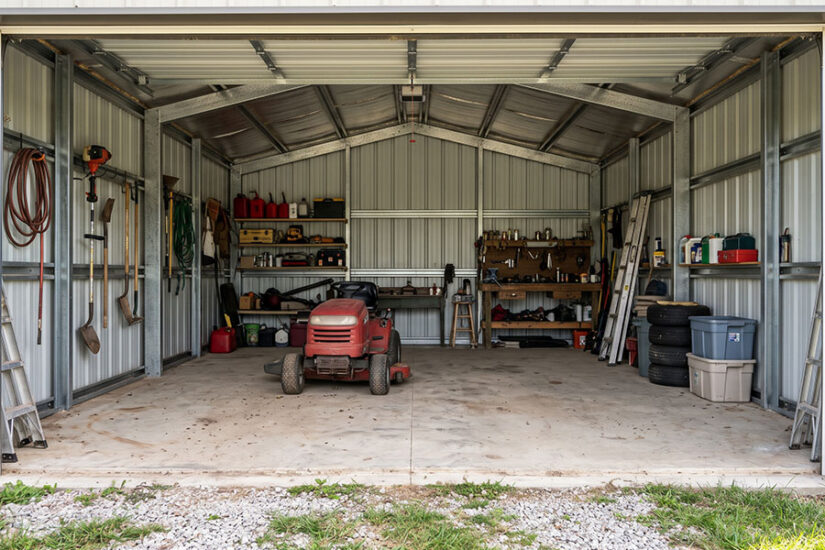
A 10×12 to 12×16 shed is the size class for a riding mower, and the mower sets the numbers. Take the John Deere S100 lawn tractor with a 42-inch deck. Deere lists it at 69.7 inches long, just under 6 feet, and 55.2 inches wide with the deck. With the discharge deflector folded up for storage, the width drops to 46.5 inches.
Will a Riding Mower Fit in a 10×12 Shed?
On the floor, easily. Parked along the 12-foot side, the S100 leaves about 6 feet of length for a bench or shelves, and across the 10-foot width it takes under 4 feet with the deflector up.
The door is where it gets tight. The clear opening has to be wider than 46.5 inches, plus a few inches on each side for steering. Add 6 inches per side and you need about 59 inches, close to 5 feet. Measure the opening between the jambs, not the door leaf.
For depth, add a walkway of about 2 to 3 feet to the mower’s length, plus the depth of your shelves. A 12×16 shed gives that walkway at both ends of the mower and still leaves a long wall for a workbench.
A 10×12 shed is 120 square feet, the exact limit in one of the model building codes; the permit section explains what that means.
This is where steel sheds start. The kit table below has three mid-size footprints, 12×12, 10×16 and 12×16, listed by width and length, with door options settled in the quote. A 12-foot width lets the mower park down the middle with deeper storage on both sides than a 10-foot shed allows.
Large Sheds: 10×20 to 16×24
At 10×20 and up, the shed holds machines: an ATV or UTV, a compact tractor with its loader and mower deck, a small utility trailer, or a workshop corner beside the equipment. Large shed sizes are where the door decides more than the floor.
Honda lists the 2026 FourTrax Rancher 4×4 ATV at 82.8 inches long and 47.4 inches wide, roughly 7 by 4 feet. In a 10×20 shed it parks along the long wall with about 13 feet left for a trailer or a mower. In a 10×16 the leftover falls to about 9 feet, still enough for the riding mower above, which makes 10×16 a sensible step down.
For a compact tractor, take the overall length with the loader and mid-mount deck attached from the spec sheet, not the length of the tractor alone. A trailer adds its tongue, and you need room to back it in straight. A 12×24 shed fits a tractor with its implements parked alongside; a 16×24 adds a full side for a bench.
Shelters for horses and livestock are sized by the number of animals rather than by what you store; see loafing shed vs run-in shed.
A 10×20 shed is exactly 200 square feet, the limit in the other model code.
When a Shed Turns into a Garage
From about 18×20 feet, a shed is sized like a garage. It holds a car or a boat on its trailer, sometimes a full workshop, and the dimensions follow the vehicle rather than the stored gear.
US Patriot Steel lists buildings of this size as sheds, including an 18x20x10 one-car shed and a 24x30x10 two-car steel shed. Whatever the name, plan it like a garage, from the length of the vehicle and the width and height of the door it drives through. The guide to standard garage sizes runs those numbers with real vehicles, so they are not repeated here.
If the building may ever hold a pickup, size it as a garage from the start. A shed that’s a few feet short can’t be stretched later without a new end wall.
What Actually Sets a Shed’s Size
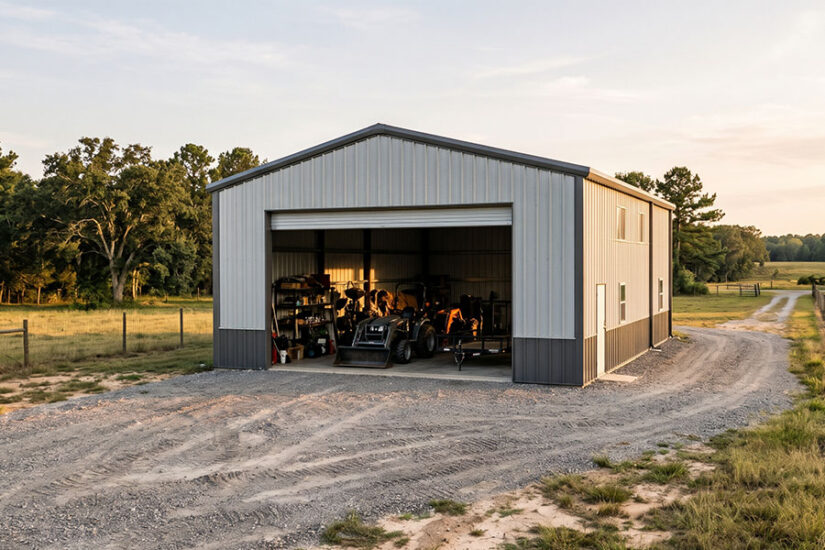
Floor area hides the shed dimensions that matter most: the door opening and the wall height, then the room you need to move around inside.
Door Width and the Widest Thing You Store
The right shed door size is the widest thing you store plus room to steer it through. A push mower goes through any walk-in door. The S100 and the Rancher above both need close to 5 feet of clear opening. A tractor with a loader needs more, and a trailer more again, because you back it in.
A single swing door is the narrowest option, and double doors open wider but need clear ground to swing over. A roll-up door leaves the ground clear and coils above the opening, so it needs room under the roof. On a steel shed, ask for the clear opening of each door option in your quote.
Wall Height and Roof Shape
Shed height has two figures, the side wall and the peak. On a steel building the side wall height is the eave height: the height of the wall where the roof meets it, lower than the peak. It decides whether tall shelving fits against the wall and whether a tractor with its rollover bar up clears a side-wall door. On a gable roof, an end-wall door can sit higher, because the end wall rises toward the peak.
Roof shape changes how much of that height you can use. A gable gives the most height along the center line, and a gambrel, the barn-style roof, adds headroom for a storage loft. A lean-to is tall on one side only, so the tall shelving and the door belong on that side.
Walkways, Shelving and the Door Swing
Park the machine on paper, then add what you need to move around it. In a 12×16 shed with 2-foot-deep shelves along one long wall, 10 feet of width remains; the S100 takes about 4 feet of it with the deflector up, leaving a 6-foot aisle. A door that swings inward needs its own width of clear floor behind it, so on a small shed an outswing door saves space.
Shed Size and Permits
Whether a shed needs a building permit depends mostly on its floor area, and your local jurisdiction sets the threshold, not one national rule. The model building codes give the starting point.
What the Building Codes Say
The International Code Council (ICC) publishes two model codes that states and counties adopt, often with their own amendments:
- International Residential Code (IRC), for one- and two-family homes and townhouses. Section R105.2 of the 2021 IRC exempts from permits, other than storm shelters, “one-story detached accessory structures, provided that the floor area does not exceed 200 square feet.” An accessory structure is a building that serves the house on the same lot, such as a shed.
- International Building Code (IBC), for other buildings. Section 105.2 of the 2021 IBC exempts “one-story detached accessory structures used as tool and storage sheds, playhouses and similar uses, provided that the floor area is not greater than 120 square feet.”
Both sections add that an exemption does not authorize work that violates the code or other local laws.
The arithmetic: a 10×12 shed is 120 square feet, a 12×16 is 192, and a 10×20 is exactly 200, right at the IRC line. Don’t assume a 10×20 goes up without a permit: that depends on how your jurisdiction adopted the code, so ask.
Jurisdictions move these numbers both ways. Laramie County, Wyoming, requires a permit for an accessory building only when it is larger than 400 square feet, twice the IRC figure. New Mexico’s state rules go the other way and cut the IRC exemption for home lots to 120 square feet. For how permit rules tend to vary by state, see the state-by-state overview of carport and building permits.
Setbacks, Height Limits and HOA Rules
A permit exemption does not exempt the shed from zoning. The setback, the minimum distance between a building and the property line, still applies, as do height limits, lot coverage, caps on the number of accessory buildings and any HOA rules on size or color. Setback distances are local, so no general figure holds.
On farm property, whether a shed or barn is exempt depends on the use. Before you order, call your building department with the shed’s size and where it will sit on the lot.
Wood, Resin or Steel: What the Material Changes
Wood and resin sheds are the easy route at small sizes. They come ready-made, and shelves go anywhere in a wood frame. Wood does need protection from moisture. The USDA Forest Products Laboratory explains that decay fungi need wet wood and that soil is a steady source of moisture; subterranean termites also keep a connection to the soil. A wood shed lasts longer on a base that keeps the floor framing off the ground and drains water away.
Steel makes sense when machines drive in and need wide doors and tall side walls. A steel frame also leaves the floor open, with no posts in the way, and it is designed for the wind and snow loads at its site; the guide to wind and snow loads explains how those are set. Ask for the design wind and snow loads in your quote. Steel doesn’t rot, and termites don’t eat it.
Steel brings its own homework. The frame has to be tied down, which anchors for metal buildings covers. Warm, humid air can condense under a steel roof and drip onto stored gear; see condensation in a metal building. Shelving fastens to the framing members, so plan shelves around them. For site prep and assembly, see setting up a prefab metal building in your backyard.
How Shed Sizes Map to Steel Shed Kits
Steel shed kits are named by width and length. A 12×16 shed is 12 feet wide and 16 feet long. Garage-scale sheds add a third figure for height: the 18x20x10 one-car shed is 18 feet wide, 20 feet long and 10 feet high. Ask whether a listed size is measured to the frame, the floor or the roof edge, since the usable interior is a little smaller than the outside of the frame. The steel and metal sheds page lists the footprints from 10×12 to 12×24; the larger kits in the table below have their own product pages.
| If you need | Kit to look at | Why it fits |
| A riding mower plus shelving | 12×12 steel storage shed | The mower parks down the middle with storage on both sides |
| A mower, a bench and seasonal storage | 10×16 mid-size steel utility shed | About 10 feet of length left past a riding mower |
| Room to walk around a mower or a small tractor | 12×16 metal storage shed | A walkway at both ends and a 16-foot wall for a bench |
| A long space for an ATV or a trailer | 10×20 extended steel utility shed | An ATV along the long wall with about 13 feet behind it |
| A tractor with implements | 12×24 metal utility shed | Length for the loader, width to park implements alongside |
| A workshop corner plus equipment | 16×24 metal utility shed | Machines on one side, a bench along the other |
| A car or a boat | 18x20x10 one-car metal shed | A garage-scale footprint; size it with the garage guide |
The 12×16 and 16×24 listings offer door and window options, and the 16×24 lets you choose where the door goes, so the main door can face your driveway.
Choosing a Size Before You Order
Size the shed for what you will store in ten years. A mower owner who may buy a compact tractor should order tractor length now; adding length later means a new end wall and a bigger base.
Before you settle on a footprint:
- Write down the length, width and height of the largest machine from the manufacturer’s spec page, with trailer and implements
- Add walkways and shelf depth, then round up to the next common size
- Decide which wall gets the main door and how wide its clear opening must be
- Check your permit threshold, setbacks and any HOA rules
- Plan a base slightly larger than the shed; the guide to foundation options for a steel building compares gravel pads and slabs
No shed size calculator beats this list and a tape measure.
What to do Next
Start from the biggest thing you will store and the wall where its door should go. US Patriot Steel will match a shed width, length and wall height to them.
Call (888) 415-1576 or use the get a quote form. Tell us the largest thing you’ll store, and ask for the clear opening of each door option along with the quote.
Frequently Asked Questions
The most common shed sizes, judging by search demand, are 10×12 and 8×10. In US search data, “10×12 shed” draws about 8,100 searches a month and “8×10 shed” about 6,600, more than 12×16 or 10×20 (Semrush, November 2026). No standard ranks shed sizes, so demand is the best guide. An 8×10 suits garden tools; a 10×12 also takes a riding mower.
The shed you need is set by the largest item you store and the door it must pass through. Measure that item on the manufacturer’s spec page, add 2 to 3 feet of walkway plus your shelf depth, and round up to a common size. Then check that the door’s clear opening is wider than the item.
A compact riding mower fits on the floor of an 8×10 shed, but check the door first. The John Deere S100, for example, is 69.7 inches long and 46.5 inches wide with the deflector up, so it needs a clear opening of about 5 feet. With the mower inside, little room is left for anything else.
Under the model codes, a one-story detached shed needs no building permit up to 200 square feet on a home lot under the IRC, or up to 120 square feet under the IBC. Your jurisdiction may change these limits; Laramie County, Wyoming, for example, exempts accessory buildings up to 400 square feet. Zoning setbacks and HOA rules apply either way.
Yes, every shed needs a level base that drains. A small wood or resin shed can sit on a gravel pad or treated skids. A larger steel shed also has to be anchored against wind uplift, so its base must take the anchors the frame is designed for. Make the base slightly larger than the shed.
A steel shed makes more sense once machines drive in: a riding mower, an ATV, a tractor or a trailer. They need wide door openings and tall side walls, and a steel frame is designed for local wind and snow loads. For garden tools and a push mower, a wood or resin shed is a good choice.
More in this Guide
- Metal sheds
- Standard garage sizes: 1-, 2- and 3-car garage dimensions
- Prefab metal buildings for backyards
- Carport permits: state-by-state overview
- Cheapest foundation for a steel building: options and real costs
- Metal garage kits
References
- International Code Council. 2021 International Residential Code, Chapter 1, Section R105.2 Work exempt from permit (one-story detached accessory structures up to 200 square feet; an exemption does not authorize violations). codes.iccsafe.org
- International Code Council. 2021 International Building Code, Chapter 1, Section 105.2 Work exempt from permit (tool and storage sheds up to 120 square feet). codes.iccsafe.org
- International Code Council. 2021 International Building Code, Chapter 1, Section 101.2 Scope (detached one- and two-family dwellings and townhouses may follow the International Residential Code). codes.iccsafe.org
- Laramie County Planning & Development Office, Wyoming. FAQ – Frequently Asked Questions (December 16, 2025): a permit is required for an accessory building larger than 400 square feet. laramiecountywy.gov
- State of New Mexico. 14.5.2.9 NMAC, Exceptions to requirement for permits, B. Residential (IRC Section R105.2 item 1 amended: one-story detached accessory structures up to 120 square feet). law.cornell.edu
- John Deere. S100 Lawn Tractor specifications: overall length, width with mower, width with mower with deflector raised for storage. deere.com
- American Honda. 2026 FourTrax Rancher 4×4 specifications: overall length and width. powersports.honda.com
- Nucor Buildings Group. Specification Guide, Section 1.2.3: eave height measured from the finished floor to the top of the eave strut or purlin. nucorbuildingsgroup.com
- APA, The Engineered Wood Association. OSB (Oriented Strand Board): standard 4×8-foot panel size. apawood.org
- USDA Forest Service, Forest Products Laboratory. S. T. Lebow, R. H. White, Durability of Wood in Construction (2007): moisture needs of decay fungi, ground contact, subterranean termites. research.fs.usda.gov