
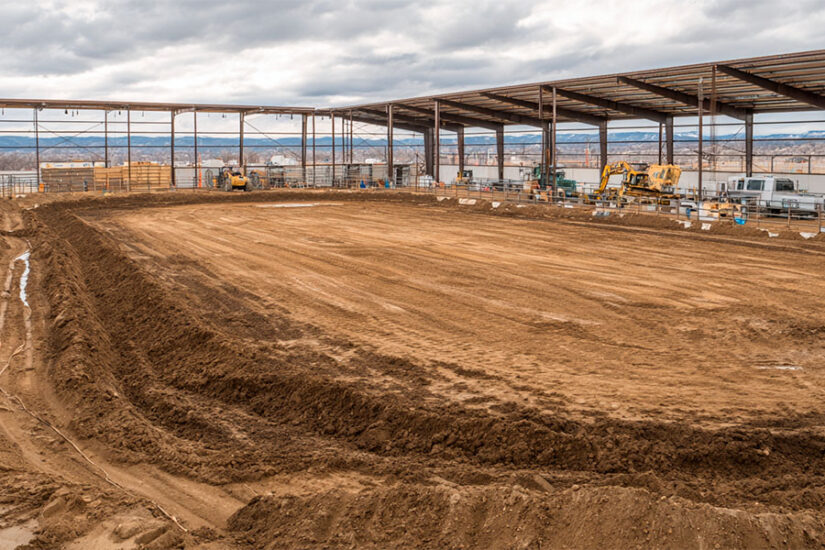

Horse arena construction is, structurally, a layered earthworks and steel-framing project with very specific tolerances. The riding surface gets the attention, but the long-term performance of the arena is decided about three feet below it – in subgrade preparation, base gradation, drainage engineering, and foundation specification. Get those right and the arena rides well for fifteen years. Get them approximately right and the arena starts failing somewhere between year two and year four.
This article is the technical companion to the owner-focused build guide. It focuses on the specs that matter to whoever is actually doing or evaluating the construction work: what good practice looks like at each engineering stage, what code references apply, and where contractor proposals frequently diverge from what a long-life arena actually needs.
Cost figures and project sequencing are summarized briefly because the technical depth is the point. For a complete cost breakdown by region, see the indoor riding arena cost guide.
Quick Engineering Reference
Subgrade compaction target: 95% Standard Proctor density (ASTM D698), or 95% Modified Proctor (D1557) for heavier traffic zones
Surface crown: 1–1.5% center-to-sidewall indoor; 1.5–2% outdoor
Base depth: 4–6 in compacted ¾” minus crushed stone, two-lift placement
Sub-base depth: 2–4 in stone dust or screenings
Geotextile spec: non-woven, 4–6 oz/sq yd, separation grade
Foundation type, standard indoor: perimeter strip footing, depth below frost line
Concrete mix, foundation: 3,000–4,000 psi at 28 days, air-entrained in freeze regions
Steel kit code: designed to IBC 2024 with site-specific snow/wind loads
Footing depth: 2–3 in over prepared base
Build time, indoor 60×120: 8–16 weeks
Build time, outdoor 60×120: 3–6 weeks
Subgrade Engineering
Subgrade is the native soil that everything else sits on. It is also where most arena failures originate, because subgrade quality varies wildly across even a single property.
Soil testing. A geotechnical bore at the planned arena center, $250–$1,500 depending on depth and region, returns soil classification (USCS), in-place density, plasticity index, and water table elevation if present. On a borderline site this single document decides whether the planned base depth is adequate or whether subgrade improvement is needed. Most arenas get built without one. The arenas that fail in unexpected ways are disproportionately the ones built without soil tests on questionable ground.
Compaction target. The full footprint plus a 10–20 foot perimeter apron compacts to 95% of maximum dry density per ASTM D698 (Standard Proctor) for typical horse-traffic arenas. Commercial training facilities with daily equipment traffic should specify 95% Modified Proctor (ASTM D1557), which targets a denser final state. A field density test (nuclear gauge or sand-cone, $100–$300 per test) verifies compliance. Specifying 95% without testing is meaningless.
Subgrade improvement. Clay subgrades with plasticity index above 20 either get a chemical stabilization treatment (lime or Portland cement at 4–6% by weight, mixed into the top 8–12 inches and compacted) or a geogrid layer below the base. Skipping this in expansive clay regions (most of Texas, Oklahoma, eastern Carolinas, Mississippi delta) is the most common cause of base failure within five years.
Frost considerations. In freeze regions, the subgrade below the perimeter foundation extends to or below the local frost depth. The IRC 2024 frost depth tables run from 0 inches in the Gulf states to 60 inches in northern Minnesota. Foundations that stop above frost depth heave and crack within a few winter cycles. The base under the riding surface itself is less critical for frost because the load is light and distributed.
Drainage Engineering
Drainage is hydraulics, not just trenching. The system has to move a design storm volume off the arena footprint without ponding or undermining the base.
Design storm. A reasonable design target for arena drainage in most US regions is the 25-year, 24-hour storm – typically 4 to 8 inches of rainfall depending on location (NOAA Atlas 14 gives site-specific numbers). Arenas in flash-flood zones design to a 50-year event. Outdoor arenas in heavy rain regions (Pacific Northwest, the Gulf, Southeast) design to the higher number even when the building code doesn’t require it.
Perimeter drain spec. A 4-inch perforated SDR-35 PVC pipe or smooth-wall HDPE, wrapped in a 4–6 oz/sq yd non-woven geotextile sock, bedded in washed #57 stone, run continuously around the arena footprint at the base subgrade elevation. Slope to the outflow at 0.5% minimum (1% preferred), daylighting to a low point at least 25 feet from any structure or 50 feet from any well.
Surface crown. A 1 to 1.5% crown from arena centerline to sidewall is standard for indoor arenas, with the building’s roof and gutter system handling sheet flow off the roof separately. Outdoor arenas need a steeper 1.5 to 2% crown to shed rain directly off the surface. A 60×120 arena at 1.5% crown drops 5.4 inches from center to sidewall. Riders rarely notice the slope, horses never do.
Geotextile separation layer. A non-woven fabric (separation grade, 4–6 oz/sq yd) sits between subgrade and base. The fabric stops upward capillary migration of fines from native soil into the base voids, which is the primary failure mode in clay-heavy regions. Cost $0.30–$0.50/sq ft for material, $0.20–$0.40/sq ft for installation labor. On a 60×120 arena that’s $4,500–$6,500 total, and skipping it is the most common $5,000 saving that becomes a $30,000 repair four years later.
Base Material Specifications
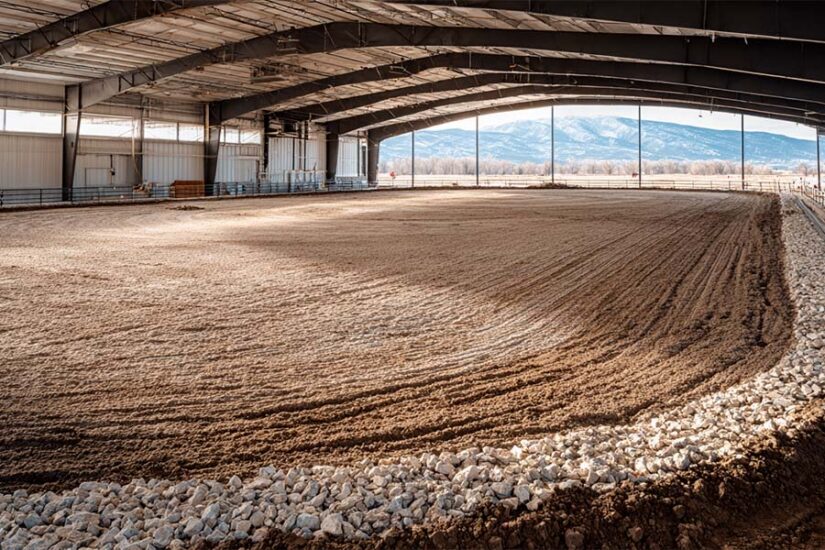
The base is the structural layer that carries the footing and the horses. Specs vary by region and use intensity, but the principles are consistent.
Bottom course (structural base). 4 to 6 inches of ¾-inch minus crushed stone or limestone (AASHTO #57 stone is the common spec). Placed in two lifts of 2–3 inches each, with mechanical compaction between lifts. A vibratory roller (1–3 ton class) for the open footprint, plate compactor at the edges and against the foundation. Final density target: 95% Standard Proctor as verified by nuclear gauge.
Top course (sub-base). 2 to 4 inches of stone dust or quarry screenings, lightly compacted (a single pass with the roller or a heavy drag, not full compaction). Laser-leveled to the planned crown profile. The light compaction matters – fully compacting the sub-base creates a hard pan that footing can’t bond to and water can’t drain through.
Edge transition. The base extends 2 to 4 feet past the riding surface in every direction. In indoor arenas this transitions into the perimeter foundation excavation. In outdoor arenas it supports the rail posts and gives the drag equipment stable ground to turn on at the corners.
Climate adaptations. Northern climates (Minnesota, the Dakotas, northern New England, northern Mountain West) increase the base depth to 8–10 inches because frost penetration into a thin base causes heaving. Wet climates increase the geotextile weight to 6–8 oz/sq yd. Dry climates (Arizona, Nevada, New Mexico) can sometimes reduce the structural base to 4 inches without consequence.
Foundation Engineering (Indoor Arenas)
Indoor riding arenas need a foundation that the steel building columns bolt into. Three approaches dominate, with very different cost and performance implications.
Perimeter strip footing (standard for most US private indoor arenas). A continuous reinforced concrete strip running under each sidewall, with enlarged pad footings at each column line. Strip dimensions: typically 12–18 inches wide, 12–24 inches deep depending on column loads. Column pads: 24–36 inches square, 12–18 inches deep, reinforced with #4 rebar in a 12-inch grid. Concrete mix: 3,000 psi at 28 days, 4,000 psi in freeze regions, air-entrained to 5–7% in zones with freeze-thaw cycles.
The strip extends below local frost depth. Anchor bolts (typically ¾-inch or 1-inch diameter, embedded 8–10 inches) are set into wet concrete using a template provided by the steel kit manufacturer. Bolt placement tolerance is ±¼ inch. Misaligned bolts force field modification of the steel kit during erection, which adds days to the schedule and voids portions of the manufacturer warranty.
Full slab on grade. A complete concrete slab covers the footprint, typically 4–6 inches thick with #3 or #4 rebar on 18-inch centers or with structural fiber mesh, then dust-locked and sealed. Footing material goes directly on the slab. More expensive ($25,000–$50,000 more on a 60×120 than a perimeter strip), and used mainly in commercial facilities where the arena doubles as event space or where the arena will host heavy equipment regularly.
Individual column piers. One concrete pier at each frame line, typically 24-inch diameter, 4–6 feet deep depending on frost and column load. No perimeter strip. This is the cheapest foundation option (roughly 30–40% less than a perimeter strip), used mostly in dry climates and on smaller spans where the building manufacturer’s engineering allows it. The arena perimeter relies on edge restraint from the base and footing rather than a poured wall.
Cure time. Concrete reaches design strength at 28 days but is sufficient for steel erection at roughly 7 to 10 days after pour in moderate weather. Cold-weather pours (ambient below 40°F) require either heated enclosures, accelerator admixtures, or extended cure times to reach the same strength.
Steel Building Engineering (Indoor Arenas)
Pre-engineered steel buildings used for riding arenas are designed to the International Building Code (IBC) with site-specific load inputs. The engineering happens at the manufacturer before the kit ships.
Code framework. IBC 2024 is the current model code, with state and county adoptions varying by jurisdiction. The relevant chapters for arena engineering: structural design loads (Chapter 16), steel design (Chapter 22), and accessory structures (Section 312). Wind loads come from ASCE 7-22 using site-specific basic wind speed maps. Snow loads come from ASCE 7-22 using ground snow load tables, with importance factor 0.8 for agricultural buildings or 1.0 for higher-occupancy structures.
Frame design. Clear-span steel frames for 60-foot to 100-foot wide arenas are tapered web column-and-rafter, also called rigid frames. The tapered profile concentrates material where bending moment is highest (the haunch at the column-rafter connection) and saves steel where it isn’t needed. Standard spans up to 100 feet without interior columns are routine. Spans beyond 100 feet move into custom engineering and heavier steel.
Column spacing. Standard bay spacing is 25 feet on center. Wider bays (30–35 feet) reduce column count and visual obstruction but require heavier framing. Narrower bays (20 feet) are unusual outside high snow-load regions where reducing tributary load per frame matters more than column count.
Roof and wall sheeting. Standard spec is 26-gauge painted steel for both roof and walls, with a 40-year manufacturer paint warranty for premium coatings (PVDF/Kynar). 24-gauge is heavier and a small upgrade. The roof gauge matters more than wall gauge because the roof carries the snow load and the wind uplift.
Code-required openings. Building code does not require any specific door count for a private agricultural arena, but ventilation code (IMC) does require minimum air changes if the building is enclosed. A ridge vent or gable-end powered ventilation usually satisfies this. Egress code applies if the arena is used for public events or lessons – at least two exits required for occupancies over 50 persons.
Footing Installation as Construction Step
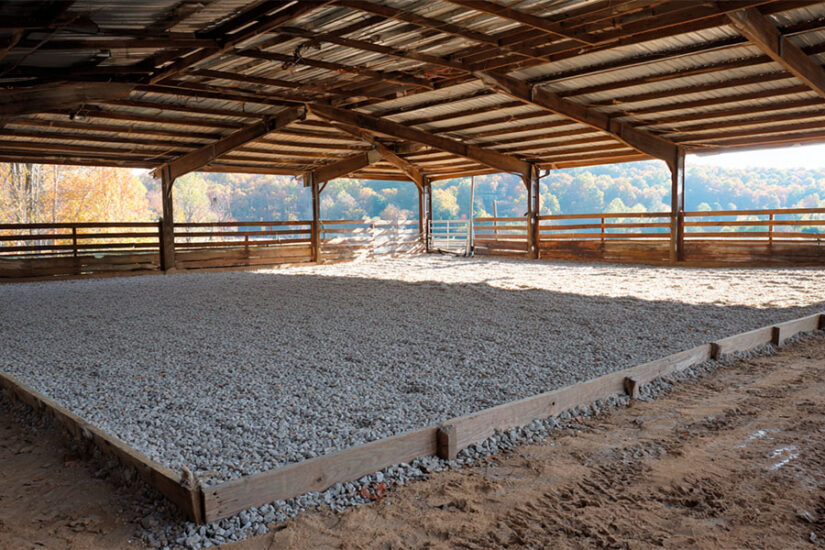
The footing layer is the construction step most often outsourced separately from the rest of the build. Whoever installs the footing arrives after the building is closed in.
Material delivery. A 60×120 arena needs roughly 60–80 cubic yards of footing material for a 2.5-inch depth. That’s 6–10 dump truck loads. Material is staged at one end of the arena, usually inside the building if a door is wide enough.
Spreading and compaction. A small skid steer with a laser-controlled spreader places the material to the planned depth across the arena. Water is added during spreading at roughly 8–10% by weight to bind fiber (if present) to sand. The surface is dragged with a power groomer to a flat profile after spreading is complete.
Riding-in. New footing settles for about a week of low-intensity riding before the depth profile stabilizes. During this period the surface dries and compacts unevenly, and the first horse to use it usually leaves visible hoofprints that disappear after subsequent dragging.
Material specs. For a comprehensive treatment of footing materials, layer depths, discipline-specific picks, and maintenance, the horse arena footing guide covers it in depth.
Quality Control Checkpoints
A well-managed arena build has formal inspection points at five stages.
After subgrade compaction: field density test (nuclear gauge or sand-cone), typically one test per 5,000 sq ft. Acceptance: 95% of laboratory maximum dry density. Failed tests trigger re-compaction or additional moisture conditioning.
After geotextile placement: visual inspection for tears, seam overlaps (minimum 12 inches), and pinning. Photo documentation before base placement.
After base compaction: second round of density testing on the base course. Visual check of base elevation against the planned profile using a laser level. Documentation of as-built crown.
Before steel erection: verification of anchor bolt placement against the kit template. Tolerance check ±¼ inch on placement, ±⅛ inch on elevation. Concrete strength verification (cylinder break test) if the schedule has compressed cure time.
After footing install: depth verification at the corners, midpoints, and centerline using a probe rod. Documentation of as-installed material gradation against the spec.
A contractor proposal that does not name these checkpoints is a proposal that doesn’t plan to do them. That’s a question to ask before signing.
Common Engineering Mistakes Contractors Make
A handful of mistakes show up repeatedly across US arena projects, often on lower-cost builds.
Compaction proof by feel. A crew that doesn’t run density tests and tells the owner “it’s compacted, we walked on it” is committing the most common single error in arena construction. Compaction below 90% Standard Proctor is invisible at the time of pour and disastrous by year three.
Skipping the geotextile. Already covered above. It saves $1,500 and costs $25,000 to remediate four years later. Some contractors leave it off the bid specifically because the next-cheapest competitor did, and the owner is shopping on price.
Under-spec’d anchor bolts. A kit designed for ¾-inch bolts at 36-inch on-center spacing won’t tolerate ½-inch bolts at 48-inch spacing, even though the cheaper hardware “looks similar.” Always cross-reference the kit’s anchor bolt schedule against what the foundation crew is installing.
Misalignment of crown and roof drainage. Indoor arenas with the roof gutter outflow dumping into the same low corner as the perimeter drain saturate that corner during heavy rain. The two systems should outflow to opposite corners or use independent dry wells.
Concrete pour in cold weather without protection. Below 40°F ambient, concrete cures more slowly. Below 32°F, water in the mix freezes and the matrix cracks. Heated enclosures, accelerators, or pour delays are the only acceptable responses. “It’ll be fine, the sun will hit it tomorrow” is not engineering.
Frequently Asked Questions
Site selection and permits, then site prep and grading, then drainage installation, then base placement, then foundation pour (indoor only), then steel building erection (indoor only), then footing install, then fit-out. Each stage has compaction or curing requirements that prevent compressing the schedule below 8 weeks for an indoor 60×120 or 3 weeks for an outdoor.
95% of Standard Proctor density (ASTM D698) for the subgrade and base, verified by field density testing. Commercial training facilities with daily equipment traffic should specify 95% Modified Proctor (D1557). Specifying a percentage without requiring testing has no engineering meaning.
Not for private indoor arenas. The standard foundation is a perimeter strip with column pad footings, and the riding surface sits on prepared base. A full slab is required only when the arena doubles as event space, hosts heavy equipment, or operates in winter without footing in cold climates.
IBC 2024 with state and county adoptions for the steel building itself, with structural loads per ASCE 7-22. IRC 2024 frost depth and snow load tables for the foundation. Local zoning and agricultural-exempt provisions for permitting in many counties. Wind speed and snow load maps are site-specific – the manufacturer’s engineering uses the bonded values for the construction location.
This article covers the engineering and technical specifications. The how-to-build owner’s guide covers the owner-side decisions, what an owner can DIY versus hire, and what each stage feels like from the owner’s perspective. Use this article when evaluating contractor proposals or specifying a build. Use the owner’s guide for understanding the project flow as the person paying for it.
A steel building shell rated to IBC 2024 lasts 40–60 years with minimal structural maintenance, with roof and wall panel coatings needing recoating around year 25. The footing layer needs refresh every 7–15 years depending on material. The base, if built to 95% compaction with proper drainage and geotextile, outlasts everything else in the arena — 25+ years before any base intervention is needed.
Evaluating a Contractor’s Spec Sheet
The fastest way to assess a horse arena construction proposal is to compare it against a short list of named specs. A good bid mentions: compaction target with testing method, base depth and gradation, geotextile weight and class, perimeter drain pipe diameter and material, surface crown percentage, foundation depth relative to local frost line, concrete mix strength, anchor bolt size and spacing per the steel kit’s template, and steel kit code reference (IBC 2024 with site-specific loads).
A proposal that says “we’ll compact the base properly” without a density target, or “we’ll install drainage” without a pipe spec, is a proposal that may build a functional arena and may build one that fails in year four. The same crew might do both depending on which inspection they expect.
The longest-lasting arenas are not the most expensive ones. They are the ones built to spec, by crews that know what the spec is for.
More in This Guide
- How to build a horse arena – owner’s view of the project: decisions, DIY honest assessment, month-by-month feel
- Indoor riding arena cost – full pricing by size, type, and US state
- Horse arena footing – material, depth, and layer engineering
- How big should a horse riding arena be? – dimensions by discipline
- Concrete slab thickness for steel buildings – slab spec by use
References
Sources worth cross-checking against on subgrade engineering, drainage hydraulics, base specs, foundation design, and steel kit code requirements. All URLs verified live as of May 2026.
- International Code Council. International Building Code (IBC), 2024 edition. Structural design loads, steel design, accessory structures. codes.iccsafe.org
- International Code Council. International Residential Code (IRC), 2024 edition. Frost depth tables, snow load maps, foundation requirements. codes.iccsafe.org
- American Society of Civil Engineers. ASCE 7-22, Minimum Design Loads and Associated Criteria for Buildings and Other Structures. Wind speed maps, snow load tables, seismic categories. asce.org
- Metal Building Manufacturers Association (MBMA). Metal Building Systems Manual. The trade-body engineering reference for steel kit design and erection practice. mbma.com
- US Federal Highway Administration. Pavement and base compaction standards, Standard Proctor density (ASTM D698) and Modified Proctor (D1557) references. fhwa.dot.gov/pavement
- Penn State Extension (Eileen E. Fabian Wheeler, Ph.D., with Jennifer Zajaczkowski). Riding Arena Footing Material Selection and Management. Footing material engineering specifics. extension.psu.edu
- Eileen Fabian Wheeler, Ph.D. Horse Stable and Riding Arena Design. Wiley-Blackwell, 2006. ISBN 9780813828596. Academic reference textbook on equestrian facility engineering.
- NOAA Atlas 14. Precipitation-frequency atlas – site-specific design storm depths for drainage engineering. hdsc.nws.noaa.gov