
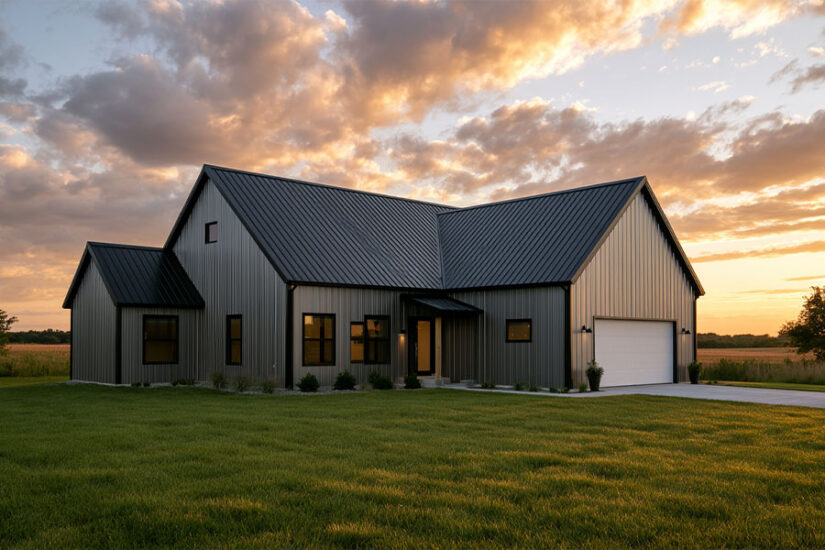

Whether you’re building a residential garage, a horse barn, or a large commercial facility, color plays a functional and aesthetic role in how your metal building looks and performs. Picking a wall color, a roof color, and trim that work together isn’t just a style choice: it also affects how much heat the building absorbs and how long the finish holds up before it needs attention.
This guide covers the most popular color schemes and combinations, how to choose colors by building type, and the practical side of color that most palette pages skip: heat, fading, and durability.
Quick Answer
The most requested paint colors are colony green, charcoal gray, tan, and white, and the most popular combinations pair a neutral wall color with a contrasting roof and trim:
- White walls, colony green or charcoal roof, white trim: the classic agricultural look, still the most common pairing on barns
- Tan walls, brown roof, brown trim: blends into wooded or rural settings
- Gray walls, black or charcoal roof, black trim: a modern, clean profile common on barndominiums and shops
- Two-tone walls with a darker wainscot band at the base: popular on residential-style builds
Coating quality and steel gauge determine how long any of these colors hold up in the sun, which is covered further down this page.
How to Choose Colors for a Metal Building
Start with the building’s surroundings, not a color chart. A metal garage sitting fifty feet from a brick colonial reads differently in gray and black than it does in barn red, and the wrong contrast can make a well-built structure look like an afterthought.
Architectural context comes first. Match or complement the roofline color of the house or the buildings already on the property. A residential garage or barndominium usually looks best pulling from the same palette as the main house. A standalone barn or shop has more room to go traditional agricultural, since it isn’t competing visually with a home nearby.
Local rules come next, and they’re easy to overlook until they cause a problem. Some homeowners associations and municipalities restrict exterior colors on accessory structures, particularly in planned communities. Check the HOA covenant or local zoning office before finalizing a color. That’s not something a builder can override once panels ship.
Climate is the factor most buyers underweight. Dark colors absorb more solar heat than light colors, which matters more on a building without active climate control or in a hot, sun-heavy region. The “Does color affect performance” section below breaks down how much that actually matters and where it doesn’t.
Resale and long-term use round it out. Neutral colors such as white, tan, and gray tend to have broader appeal if the property might sell later. A bolder choice like black or barn red makes a stronger personal statement but narrows the buyer pool if resale is on the horizon. Neither is the wrong answer; it’s worth deciding on purpose rather than by default.
Personal preference still counts, and there’s nothing wrong with leading with it. These four factors just narrow the field before taste takes over.
Popular Metal Building Color Schemes and Combinations
The color combinations that keep showing up across barns, garages, and commercial buildings share a pattern: a neutral wall color, a contrasting roof, and trim that ties the two together. That contrast is what makes a metal building read as designed rather than assembled from a parts catalog.
| Wall color | Roof color | Trim | Look |
| White | Colony green | White | Classic farm and agricultural |
| Tan | Brown | Brown | Warm, blends into rural settings |
| Gray | Charcoal or black | Black | Modern, clean |
| White | Charcoal | Charcoal | High-contrast, commercial-friendly |
| Two-tone (light wall, dark wainscot) | Matches the darker tone | Matches | Residential and barndominium-style |
The best-performing combination for most buyers pairs a light or neutral wall with a darker roof and matching trim. The contrast reads as intentional in person, photographs well for listings, and works across nearly every building type on this list.
Two pairings do most of the work in the field. White walls with a colony green roof are the closest thing the industry has to a default, especially on barns and agricultural buildings, because the combination has decades of use behind it and reads as established rather than trendy. Gray walls with a charcoal or black roof are the newer standard, especially on barndominiums and shops built to look more like a house than a farm structure.
Two-tone schemes, a lighter wall color on top with a darker wainscot band along the base, have become common on residential-style builds. The darker band hides ground-level dirt and mower scuffs better than a single light color would, while the lighter upper wall keeps the building from reading as heavy or industrial.
High-contrast pairings such as white walls with a charcoal roof work well on commercial buildings that need to stand out along a highway or in a business park, where a muted agricultural palette can get lost among nearby structures.
One note on trim: matching trim to the roof color rather than the wall color usually reads cleaner. Trim that splits the difference between two colors tends to look indecisive rather than intentional.
Metal Building Colors by Type of Building
Color expectations shift by building type. What reads as classic on a horse barn can look out of place on a barndominium, and a scheme built for a house next door rarely works on a warehouse.
Colors for Residential Garages and Barndominiums
Residential-style buildings support a wider color range than agricultural ones, since the goal is often to match or complement a house rather than blend into a field. Two-tone schemes with a black, charcoal, or dark bronze wainscot under a lighter wall color are the current default for barndominiums, especially paired with black windows and trim. Solid dark exteriors, including full black or deep charcoal, have grown more common on builds that lean industrial rather than traditional farmhouse. Buyers weighing a darker exterior against a hotter regional climate should read the “Does color affect performance” section below before committing to it.
Colors for Horse Barns and Agricultural Buildings
Traditional agricultural colors are traditional for a reason: they hide the dust, mud, and hay debris that come with daily barn use better than lighter, glossier finishes do. Colony green with white trim remains the most requested combination for barns and stables, closely followed by barn red with white trim on properties going for a classic look. Charcoal and dark bronze roofs have gained ground on newer builds that want a more contemporary equestrian look without giving up the wall-and-roof contrast. Buildings built with daily use in mind often favor darker roof colors, since they show less staining from roof-mounted ventilation and dust runoff over time than a light roof does.
Colors for Commercial and Industrial Buildings
Commercial buildings tend toward a more restrained, often brand-driven palette: white, gray, or a single accent color tied to a company’s signage and logo rather than a decorative scheme. Legibility matters here in a way it doesn’t on a house or barn. A wall color that clashes with a building’s signage can make even well-designed signage harder to read from the road. Neutral tones such as white or light gray also make it easier to update branding later without repainting the entire structure. For a full look at layout and build options for offices, warehouses, and industrial facilities, see commercial metal building options.
Does Color Affect Performance? Heat, Fading, and Durability
Color isn’t only a look decision. It changes how a building manages heat and how long the finish holds up, and both are measurable rather than a matter of opinion.
Heat absorption. Dark surfaces absorb more of the sun’s energy and stay hotter than light ones. Testing compiled by the Cool Roof Rating Council and referenced in U.S. Department of Energy cool-roof guidance shows that most dark roofing materials reflect only 5 to 20 percent of incoming sunlight, while light-colored materials typically reflect 55 to 90 percent. On a clear summer afternoon, a white roof reflecting around 80 percent of sunlight can run roughly 55 degrees Fahrenheit cooler at the surface than a gray roof reflecting only 20 percent, based on Lawrence Berkeley National Laboratory Heat Island Group research cited in that DOE guidance. That research is built around roofing, where sunlight hits closest to straight-on. Vertical wall panels see less direct overhead exposure, so the temperature swing tends to be smaller on walls than on a roof, but the underlying principle still holds: a dark wall runs hotter than a light one in the same location. On a building without insulation or active cooling, that heat load transfers into the interior. Pairing a dark color with insulating a metal building offsets a meaningful share of that gain; pairing a dark color with an uninsulated shell compounds it.
UV fading. Every exterior paint color fades over time, but coating quality decides how fast. Panels finished with a PVDF-class coating (commonly sold under the Kynar name) hold their original color and gloss noticeably longer than panels finished with a lower-cost SMP paint, particularly on south- and west-facing walls that see the most direct sun over the life of the building. See metal building siding options for the coating and gauge specifics that determine how long a given color actually lasts on the panel.
None of this is a warranty claim from US Patriot Steel. It’s the physics and coating chemistry behind why some colors and coatings hold up better than others in the same climate.
Popular Individual Metal Building Colors
A handful of specific colors show up across most manufacturers’ standard lines and most of the buildings US Patriot Steel ships nationwide, each for a practical reason beyond just looking good.
Colony green carries more history than any other color in the metal building industry. Decades of use on barns and agricultural buildings gave it that reputation, and it hides grass stains and general weathering better than most greens. It’s still the top individual color request from barn and equestrian buyers specifically.
Charcoal gray, sometimes labeled slate or graphite depending on the manufacturer, has become the default modern choice, especially paired with black trim and windows on barndominiums and shops. It photographs well, works with almost any roofline color, and doesn’t show dirt streaking as visibly as a true black would.
Tan and beige tones are the safest neutral for buildings near residential neighborhoods, since they blend into a wider range of landscaping and architectural styles than either a bright color or a very dark one.
White remains a classic choice for a real reason: it reflects more heat than any other standard color, and it pairs with nearly every roof color on this page. The tradeoff is maintenance. White panels show dirt, algae streaking, and chalk residue faster than darker colors, so they need a rinse more often to keep their original look.
At US Patriot Steel, we’ve built thousands of structures nationwide, and these are consistently the colors buyers come back to once they see how they hold up over years of weather, not just how they look on day one.
What to do Next
Three questions narrow a color decision fast:
- What type of building is this: garage, barn, or commercial?
- What’s the local climate, and will the building run active cooling?
- What already exists on the property, in terms of house color, other structures, or HOA rules?
Matching a color against a physical sample is easier than matching it on a screen, since panel finishes read differently under real sunlight than they do on a monitor. Call (888) 415-1576 or use the quote form to talk through building type, panel options, and color availability for your project.
Frequently Asked Questions
Colony green, charcoal gray, tan, and white are the most requested individual colors nationwide. Popularity varies by building type: agricultural buyers lean toward colony green and barn red, while residential and commercial buyers lean toward charcoal, gray, and white for a cleaner, more modern look.
White walls with a colony green or charcoal roof and matching trim is the most requested combination across manufacturers, prized for the contrast between wall and roofline. Gray walls with a black or charcoal roof is the modern equivalent, common on barndominiums and shops going for a less agricultural look.
Yes. Dark colors absorb more solar heat than light colors, which raises surface temperature and, to a lesser extent, interior temperature on a building without insulation or active cooling. The effect is smaller on wall panels than on a roof, since walls see less direct overhead sun, but it’s still worth factoring into the decision in hot climates.
All exterior paint fades eventually, but coating quality determines how fast. PVDF-class (Kynar) coatings hold color and gloss significantly longer than lower-cost SMP paints, particularly on walls facing south or west. Lighter colors also tend to show fading and chalking less visibly than dark, saturated colors as the finish ages.
Horse barns and agricultural buildings do best with traditional colors like colony green, barn red, or white, since they hide dust and staining well and hold up to decades of daily use. Residential garages and barndominiums support a wider range, including two-tone schemes and darker charcoal or black exteriors that match a house’s design.
It depends on the property. Some homeowners associations and municipalities restrict exterior colors on accessory structures, particularly in planned communities. Check the HOA covenant or local zoning office before finalizing a color, since this isn’t something that can be changed after panels are ordered and shipped.
More in this Guide
- Metal building siding options: panel types, gauge, and coating that determine how a color performs over time
- How to insulate a metal building: insulation systems that offset heat gain from darker colors
- Metal garage kits: US Patriot Steel’s residential garage product line
- Horse barns and stables: equestrian building options and layouts
- Commercial metal buildings: layout and build options for offices, warehouses, and industrial facilities
- Black barndominium guide: a closer look at the all-black and two-tone dark exterior trend
References
- Cool Roof Rating Council (CRRC). Independent, nonprofit rating program for the radiative properties of roofing and exterior surface materials, referenced for solar reflectance ranges between light and dark colors above. coolroofs.org
- U.S. Department of Energy / ENERGY STAR. Cool roof guidance, including Lawrence Berkeley National Laboratory Heat Island Group research on surface temperature differences by color, cited for the heat absorption comparison above. energystar.gov/products/cool-roofs
- Metal Construction Association (MCA). Research on coil-coated steel coating and paint system performance, referenced for the PVDF versus SMP fade-resistance comparison discussed in the linked siding guide above. metalconstruction.org