
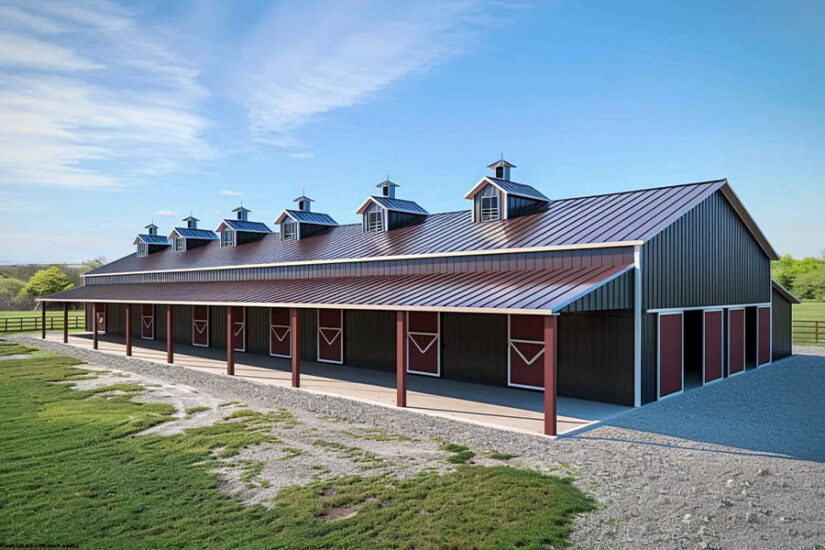
Building a horse barn is one of the most significant investments a farm owner can make. The structure shapes how your horses live every day – their health, safety, and comfort depend on the quality of the building around them. Steel horse barns have become the preferred choice for serious equestrian operations across the United States, and the reasons go well beyond simple cost comparison.
Over the past decade, US Patriot Steel has designed and delivered horse barns ranging from small 2-stall private facilities to large 30-stall equestrian centers, across climates from the Texas Hill Country to the Pacific Northwest. This guide covers everything: material advantages, stall dimensions and layout, ventilation, insulation, flooring, fire safety, common design mistakes, and realistic cost expectations.
Why Steel Is the Right Material for Horse Barns
Horse barns demand more from a building material than almost any other agricultural structure. They face daily kicking and impact loads, constant moisture from urine and humidity, heavy roof loads, and – in much of the country – real wildfire and high-wind exposure. Steel meets all of these requirements more effectively than wood, and does so over a significantly longer service life.
A properly maintained steel structure lasts 50 to 100 years. Wood barns typically require significant structural repairs within 20–30 years. Steel is non-combustible, immune to rot, and unaffected by the pests that steadily destroy wood framing. It does not warp, shrink, or swell with moisture cycles – a critical advantage in barn environments where humidity is constant.
Maintenance costs reflect this directly. Wood barns require regular painting, staining, sealing, and pest treatment; steel needs periodic inspection and minor touch-ups. Industry estimates put annual maintenance for wood barns at $2,000–$4,000 versus $400–$800 for a comparable steel structure. Over 20 years, that gap exceeds $65,000.
Steel vs. Wood Horse Barn: Head-to-Head Comparison
| Category | Steel Barn | Wood Barn |
| Service Life | 50–100 years | 20–30 years |
| Fire Resistance | Class A (non-combustible) | Class C (combustible) |
| Pest & Rot Resistance | Immune | Vulnerable |
| Annual Maintenance | $400–$800 | $2,000–$4,000 |
| Insurance Premiums | 20–30% lower | Standard rate |
| Construction Time | Faster (pre-engineered) | Slower (on-site frame) |
| Span Flexibility | Clear span, any width | Limited by lumber spans |
| Long-Term Value | Holds structural integrity | Declines with maintenance |
Horse Barn Dimensions and Stall Size Guide
Correct sizing is the single most important planning decision. Build at least 20% more stalls than your current herd size — operations grow faster than most owners anticipate. Expanding a finished barn costs far more than adding space during initial construction.
Stall size: The industry standard for a 1,000-pound horse is 12’ × 12’. Larger breeds require 14’ × 14’ or more. Foaling stalls need a minimum of 16’ × 20’ to allow safe movement around the mare.
Ceiling height: Standard range is 10–12 feet (8 feet absolute minimum). Any area used for riding or training needs 12–14 feet.
Aisle width: Minimum 10 feet for horse and handler movement; 12–14 feet if equipment moves through the aisle.
Recommended Dimensions for Steel Horse Barns
| Element | Minimum | Standard | Large Breeds / Pro |
| Standard Stall | 10’ × 10’ | 12’ × 12’ | 14’ × 14’ |
| Foaling Stall | 16’ × 16’ | 16’ × 20’ | 20’ × 20’ |
| Ceiling / Eave Height | 8’ | 10–12’ | 12–14’ |
| Stall Partition Height | 7.5’ | 8’ | 8’ |
| Center Aisle Width | 10’ | 12’ | 14’ |
| Stall Door Width | 42–45 inches | 4’ | 4’+ |
Barn Layout: Center Aisle vs. Shed Row
Center aisle barn: Stalls line both sides of a central walkway – the most common layout for serious operations. Compact, weather-protected, efficient for daily chores. A typical 6-stall center aisle barn runs 36–48 feet long depending on tack and feed room placement.
Shed row barn: All stalls in a single row with a covered overhang. Simpler and less expensive; ventilates easily in hot climates. Best suited to smaller herds or southern regions.
Whichever layout you choose, plan dedicated spaces for tack room, feed room, wash stall, and manure storage. A horse produces approximately 45 pounds of manure per day. Manure storage must be at the downwind end of the barn – essential for air quality and pest control.
Ventilation: The Most Critical Design Element
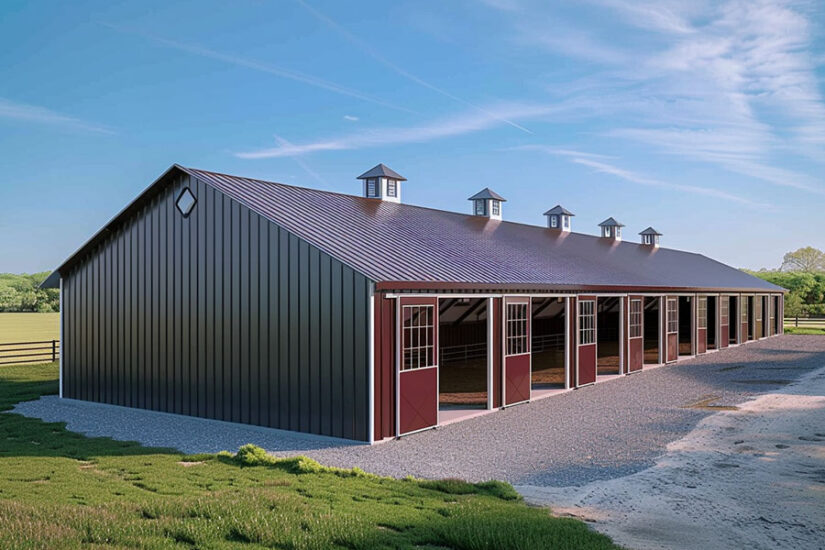
Inadequate ventilation is the most common design mistake in modern horse facilities. Horses produce significant heat and moisture continuously – poor air exchange leads directly to respiratory disease, ammonia buildup, and condensation damage to both building and animals.
A properly designed steel barn addresses ventilation at three levels:
- Passive ventilation: ridge vents and cupolas allow hot air to escape; adjustable eave openings provide cross-flow. The University of Minnesota Extension recommends at least 1 inch of continuous eave opening per 10 feet of building width with a matching ridge vent – a specification pre-engineered steel buildings accommodate cleanly.
- Natural openings: Dutch doors on each stall deliver direct air to individual horses. Open or mesh panels on the upper stall partitions prevent stagnant air pockets inside stalls even when aisles are well-ventilated.
- Mechanical ventilation: required when natural airflow cannot maintain 125 CFM per 1,000 pounds of horse body weight. Staged exhaust fans maintain consistent year-round exchange without overcooling in winter.
Critical rule: hay and bedding stored above stalls create both a fire hazard and a major source of respiratory allergens. Hay should always be stored in a separate structure or a dedicated fire-rated room at ground level.
Insulation and Climate Control
Insulated metal panels achieve R-values up to R-30, reducing heating and cooling costs by an estimated 40–50% compared to uninsulated steel. Roof insulation is recommended in all climates – it reduces summer heat gain and prevents warm humid barn air from condensing on cold roof panels and dripping into stalls, one of the leading causes of chronic moisture damage in metal agricultural buildings.
Horse Barn Flooring Options
Flooring is one of the most consequential design decisions in any horse barn. The right choice depends on climate, budget, and how long horses are stalled. Penn State Extension’s horse stable flooring guide identifies four primary options:
- Rubber mats over compacted base – best all-around choice. Mats over compacted road mix or crushed limestone provide joint cushioning, easy cleaning, and good moisture management. Basic mats run $2–$4 per sq. ft.; premium interlocking versions cost $5–$8 per sq. ft. The base must be level and well-compacted or mats will shift.
- Compacted clay – economical and traditional, but high-maintenance. Forgiving on legs, but urine softens clay over time, creating uneven surfaces. Best used as a subfloor under rubber mats rather than as a finished surface.
- Concrete – right for aisles and service areas, not bare stalls. Ideal for aisles, wash stalls, feed rooms, and tack rooms. Too hard on horse joints when used as the sole stall surface – always pair with rubber mats and heavy bedding.
- Road base mix / decomposed granite – good drainage subfloor. Compacts well and drains effectively. Works best as a base layer under rubber mats; shifts with use when used alone as a finished surface.
For aisles: textured concrete or compacted road base provide durability and easy cleaning. Smooth concrete must be avoided in any area where horses walk – it becomes dangerously slippery when wet.
Fire Safety in Steel Horse Barns
Fire is the most dangerous threat to horse facilities because evacuating animals is difficult and time-critical. Steel is non-combustible, earns a Class A fire rating under NFPA standards, and provides a critically longer evacuation window. It does not ignite, spread flames, or contribute fuel load to a fire that starts from hay, electrical faults, or equipment.
The fire safety advantage has a direct financial parallel: steel horse barns typically qualify for 20–30% lower insurance premiums versus wood-frame structures. All electrical wiring should run in metal conduit – rodent damage to exposed wiring is one of the leading causes of barn fires regardless of construction type.
Common Horse Barn Design Mistakes to Avoid
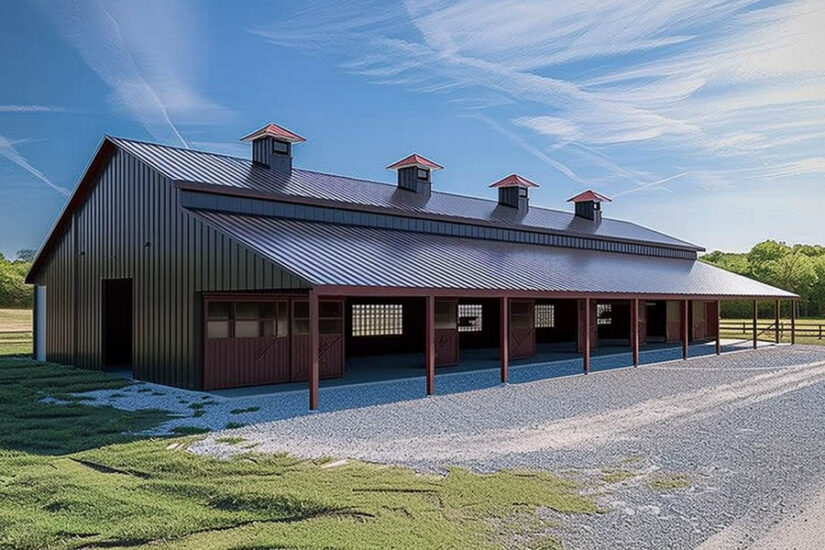
Most costly barn problems are preventable at the design stage. These are the mistakes we see most often:
- Stalls built too small. 10’ × 10’ stalls are the most common regret. Undersized stalls increase injury risk and cannot be easily enlarged later. Build to the 12’ × 12’ minimum from the start.
- Ventilation added as an afterthought. Retrofitting fans and ridge vents after construction is expensive. Ridge vents, cupolas, and Dutch stall doors must be designed into the building from day one.
- Hay stored above stalls. A fire hazard and a chronic source of respiratory allergens. Hay belongs in a separate building or a dedicated fire-rated room at floor level.
- Manure storage too close to the barn. Position manure storage at the downwind end, as far from stalls as practical. Ammonia levels rise quickly when it sits near stall openings.
- Aisles too narrow. Eight-foot aisles create daily safety risks and restrict veterinarians, farriers, and equipment. Ten feet is the non-negotiable minimum.
- No expansion plan. Pre-engineered steel buildings expand modularly – but only if the original foundation was planned for it. Discuss expansion potential with your builder before construction begins.
How Much Does a Steel Horse Barn Cost?
Steel horse barn construction in 2025 ranges from $30 to $50 per square foot for metal buildings, based on industry data from HomeGuide and HomeAdvisor. Total project cost depends on size, stall count, insulation level, foundation type, and regional labor rates:
| Barn Type | Approx. Size | Estimated Cost |
| Basic 4-stall center aisle | 36’ × 48’ | $35,000–$55,000 |
| 6-stall with tack & feed room | 48’ × 60’ | $50,000–$75,000 |
| 8-stall with wash stall & office | 60’ × 80’ | $70,000–$100,000 |
| 12-stall boarding facility | 80’ × 120’ | $100,000–$150,000 |
| 20+ stall equestrian center | Custom | $150,000+ |
Key cost factors include foundation type (concrete slab adds $5–$12 per sq. ft.), insulation level, doors and windows, electrical and plumbing, and regional labor. Agricultural metal buildings also qualify for IRS Section 179 deductions, allowing farm operators to deduct the full building cost in the year of installation – a significant tax advantage over multi-year depreciation schedules.
Build Your Steel Horse Barn with US Patriot Steel
US Patriot Steel designs and manufactures custom steel horse barns engineered to your specific herd size, climate, and site requirements. Every building includes certified steel framing, full engineering packages for local permitting, custom stall configurations, and nationwide delivery. Whether you are building a 4-stall private barn or a 20-stall boarding facility, our team handles design through delivery. Request a free quote today.
Conclusion
A steel horse barn is not simply a shelter. It is a long-term infrastructure investment that affects the health of your horses, the efficiency of your daily operations, and the value of your property. Steel outperforms wood in durability, fire safety, maintenance cost, and structural lifespan. Properly planned and built, a steel horse barn will serve your operation for 50 years or more. If you are ready to start planning, US Patriot Steel will help you design a barn correctly sized for your herd, engineered for your climate, and built to last.
FAQ: Metal Barn Fire Safety
The industry standard for a 1,000-pound horse is 12’ × 12’. Larger breeds including Warmbloods and draft horses require 14’ × 14’. Foaling stalls should be a minimum of 16’ × 20’.
A minimum of 10 feet for horse and handler movement. Plan for 12–14 feet if you operate equipment in the aisle – standard practice on working farms and boarding facilities.
Rubber mats over a compacted road mix or crushed limestone base is the best all-around choice: comfortable for horses, easy to clean, and effective for drainage. Concrete should only be used as a stall subfloor under rubber mats, never as the finished surface on its own.
A properly designed steel barn ventilates as well or better than wood. Ridge vents, cupolas, Dutch stall doors, and open-panel partitions provide effective passive airflow. Inadequate ventilation is a design problem, not a material problem.
A properly maintained steel barn lasts 50 to 100 years, compared to 20–30 years for wood before major structural work is required. US Patriot Steel provides a structural warranty on all agricultural buildings.
Initial costs are comparable or slightly higher for steel. Over 10–20 years, steel delivers better total value through lower maintenance costs, reduced insurance premiums, and longer structural life. Most owners who calculate total cost of ownership find steel is the less expensive option.
Yes. Pre-engineered steel buildings are designed for modular expansion – adding stalls, a wash rack, or storage is straightforward, provided the original foundation was planned for it.
References
- Penn State Extension — Horse Stable Flooring Materials and Drainage
- Penn State Extension — Horse Stall Design
- University of Minnesota Extension — Ventilation Systems for Horse Barns
- HomeGuide — Cost to Build a Horse Barn (2025 data)
- U.S. Fire Administration (USFA / FEMA) — Agricultural Storage Fires
- NFPA — Barn Fire Safety Tip Sheet