
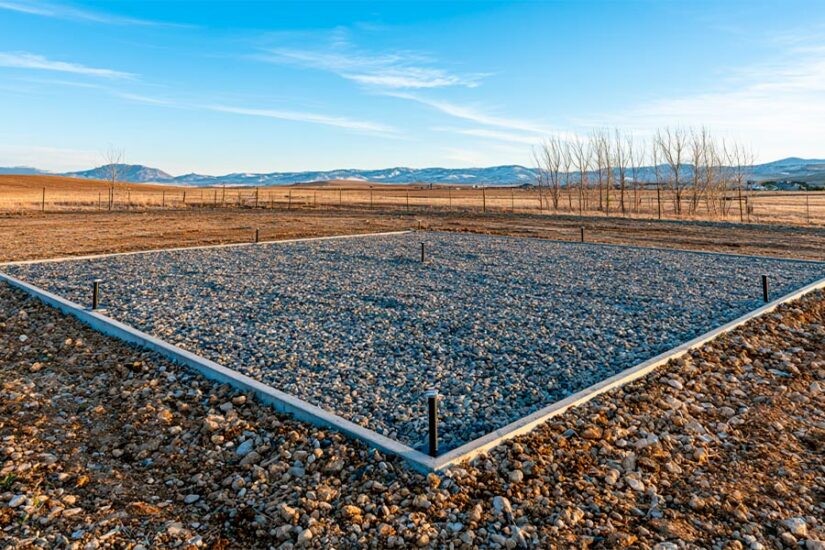
A gravel pad with a concrete anchor perimeter is the cheapest foundation for a steel building, typically running $1–$3 per square foot in materials alone. A basic slab-on-grade comes next at $4–$8 per square foot installed. Pier and footing systems cost more than either.
Cheap does not automatically mean right for your situation. The cheapest option only makes sense for certain building types, soil conditions, and uses. Get that wrong and you spend more fixing it than you would have spent on the better foundation to begin with.
Quick answer
The cheapest foundation for a steel building is a compacted gravel pad, sometimes called a crushed stone pad. It is the lowest-cost option when you do not need a finished floor and the structure is for storage.
- Gravel/crushed stone pad: $1–$3 per sq ft in materials, roughly $2–$6 installed (depending on depth and compaction needed)
- Slab-on-grade (monolithic): $4–$8 per sq ft installed, typically $6–$8 in most US markets in 2026
- Perimeter footings with concrete piers: $7–$12+ per sq ft, often higher than a full slab once labor is included
- Full basement or crawlspace: highest cost, rarely used for steel buildings
The cheapest foundation is the right foundation only when the use case, soil, and local code all permit it. More on that below.
What “Cheapest” Actually Means for a Steel Building Foundation
Price per square foot is only one part of the equation. The real cost of a foundation is what you pay over the life of the building, not just on pour day.
A gravel pad for a 30×40 storage building might cost $2,500 in materials. That same building on a 4-inch slab might cost $9,000–$12,000 for the concrete work. On the surface, gravel saves you $6,500–$9,500. In practice, a gravel pad that was not compacted properly or that sits on soft clay will shift. Doors stick. Anchor points pull. You spend money releveling and re-anchoring, and your building permit may not have covered a gravel-base structure in the first place.
So when we talk about the cheapest option, we mean the lowest installed cost that still results in a foundation that does its job for your specific building and use.
Two things drive that calculation: what you are building (storage vs. shop vs. occupied space) and what is under your feet (soil type, drainage, frost depth). Local code is the third constraint that overrides both, because some jurisdictions require concrete for any permitted structure regardless of use.
The Cheapest Options Ranked
Gravel or Crushed Stone Pad
This is the lowest-cost foundation type for a steel building. A properly built gravel pad uses 4–6 inches of compacted crushed stone over firm, graded subsoil, with landscape fabric underneath to separate stone from dirt. Some builders go 6–8 inches for larger structures or softer ground.
Material cost runs $1–$3 per square foot, or $10–$50 per ton for the stone itself (Source: Angi, 2026). Installed cost with grading and compaction typically lands between $2 and $6 per square foot depending on site conditions and local labor. For a 20×30 building (600 sq ft), that is roughly $1,200–$3,600 all-in.
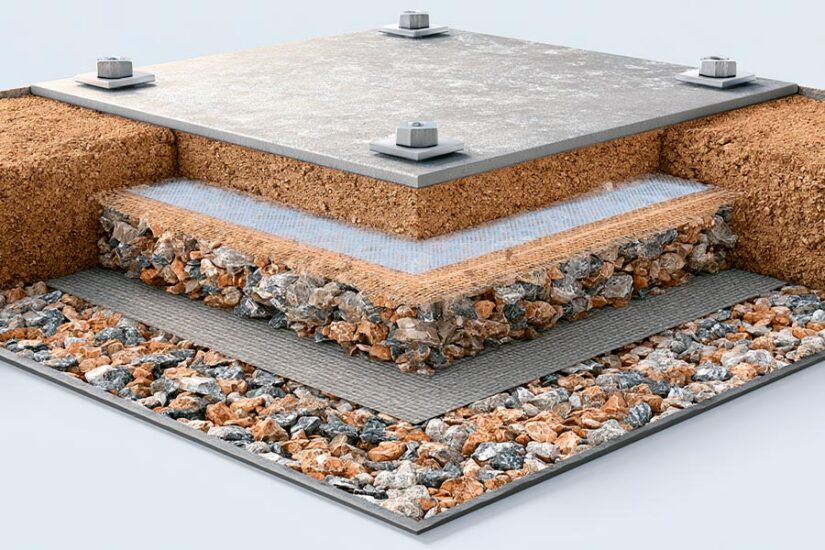
The gravel pad works because crushed stone drains. Water moves through rather than pooling under the structure. That drainage keeps the base stable in wet conditions where a poorly drained dirt floor would soften and shift.
A gravel pad is not a shop floor and is not suitable for occupied structures. It also requires the building’s anchor bolts to be set in concrete, either along the perimeter or at isolated footings at each column location. The steel frame does not anchor directly into gravel.
Slab-on-Grade (Monolithic)
A slab-on-grade is the next step up in cost and the most common foundation for metal buildings in the US. A monolithic slab pours the floor and footing in a single continuous pour, which simplifies construction and reduces labor.
Installed cost in most US markets in 2026: $4–$8 per square foot for a 4-inch reinforced slab, with thickened edges running $1–$3 per square foot more where load-bearing walls sit (Source: HomeGuide, 2026; Angi, 2026). For a 30×40 footprint (1,200 sq ft), a basic slab lands at $4,800–$9,600 before any site prep or drainage work.
A slab costs more than gravel, but it gives you a finished floor, easier anchor bolt placement, better pest control, and a foundation that does not shift with wet-dry cycles the way poorly compacted stone can. For a working shop, garage, or any building where people and equipment move around on the floor, a slab is the practical lower bound.
For detailed guidance on slab thickness options and reinforcement requirements, the concrete slab thickness guide for steel buildings covers what each spec is designed for.
Why Piers and Footings Cost More
Isolated pier foundations drive up costs for a simple reason: labor. Each pier requires drilling or digging a hole, setting rebar, and pouring concrete separately. In frost-heavy climates, piers must extend below the frost line, which means 3–5 feet of depth in colder states.
Cost per pier runs $500–$1,000 for concrete piers, with steel piers averaging $700–$1,600 each (Source: HomeGuide, 2026). A steel building with 12 column locations needs 12 piers. At $600 average, that is $7,200 in pier cost alone before any grade beam or perimeter concrete.
Pier systems are appropriate for uneven terrain, steep slopes, and areas with unstable surface soil where a slab would need extensive sub-base work. On a flat, reasonably firm lot, a slab-on-grade almost always pencils out better.
Cost Ranges by Foundation Type
The table below covers realistic 2026 installed cost ranges for each foundation type on a typical steel building footprint. Figures include materials and labor but not site prep, grading, or permits.
| Foundation type | Cost per sq ft (installed) | 30×40 (1,200 sq ft) | 40×60 (2,400 sq ft) | Best for |
| Gravel/crushed stone pad | $2–$6 | $2,400–$7,200 | $4,800–$14,400 | Open-air storage, agricultural |
| Slab-on-grade, 4″ | $4–$8 | $4,800–$9,600 | $9,600–$19,200 | Garages, shops, most uses |
| Slab-on-grade, 6″ | $6–$10 | $7,200–$12,000 | $14,400–$24,000 | Heavy equipment, vehicles |
| Perimeter footings + piers | $7–$12+ | $8,400–$14,400+ | $16,800–$28,800+ | Sloped sites, deep frost zones |
Sources: HomeGuide (2026); Angi (2026); Steel and Stud (2026).
When the Cheapest Option is Fine and When it Backfires
Gravel Pad Works When:
- The building is for dry storage (hay, equipment, supplies) and does not need a finished floor
- Soil on site is firm, well-drained, and does not have heavy clay content
- The footprint is smaller, generally under 30×40
- Local code allows a non-concrete foundation for the structure type
- You do not plan to run vehicles or heavy forklifts across the floor
Gravel Pad Backfires When:
- Soil is soft, expansive clay, or poorly draining. Clay expands when wet and contracts when dry. A gravel pad over clay will shift with the seasons, taking your building with it.
- You are in a freeze-thaw climate. Ground frost heaving moves gravel foundations. Frost depth in northern states hits 42–60 inches. Gravel has no way to resist that movement.
- The building needs a permit. Most jurisdictions require an engineer-stamped foundation plan for permitted structures, and that almost always means concrete.
- The use is residential or mixed-use. Any occupied structure, including a barndominium, workshop with an office, or garage with living space above, requires a concrete foundation in virtually every jurisdiction.
- You are anchoring a large clear-span building (40×60 or bigger). Larger buildings put more lateral and uplift load on the anchor system. Gravel does not hold anchor bolts under wind load.
A Slab Can Backfire Too:
- On a site with significant slope, a monolithic slab requires fill or extensive grading. A pier system or floating slab with stem walls may come out cheaper once you price the grading work.
- Where soil drainage is very poor, a slab over saturated ground can crack from frost heaving below. Site drainage and a well-compacted gravel sub-base under the slab are not optional in those conditions.
Hidden Costs of Going Too Cheap
Re-anchoring is the biggest one.
Steel buildings transfer wind and snow loads down through the frame into the anchor bolts. If those bolts are not set in adequate concrete with proper embedment depth, they pull out under load. Re-anchoring after erection is expensive: the frame has to come partially apart, holes get drilled, epoxy anchors get installed, and the base plates get repositioned. Costs start around $2,000–$5,000 for a small building and scale up from there.
Floor replacement is the second problem. If you build on gravel and later decide you need a real floor, you cannot pour concrete inside an erected steel building the way you would on a raw pad. Access is limited, and the anchor perimeter complicates forming. Some owners end up doing a partial pour or a self-leveling overlay, which costs more per square foot than an original slab would have.
The third issue is permits and insurance. A building on a gravel foundation may not qualify for full structural permits, which affects resale value and whether your insurance covers the structure for wind, fire, or contents. Some carriers will not write a policy on an unpermitted structure.
How to Decide
What will the building be used for? Storage and agricultural uses tolerate gravel. Any shop, garage, occupied space, or building with vehicles inside needs a slab.
What does your soil look like? Sandy, well-drained soil with no clay is gravel-friendly. Clay, poor drainage, or soft fill means concrete at minimum, possibly a deeper footing.
What does your local code require? Check before you spend anything. Some rural counties have agricultural exemptions. Most suburban and urban jurisdictions do not.
If you are comparing all foundation types side by side, including perimeter footings, floating slabs, and what to use on sloped sites, the complete guide to steel building foundations covers each option in detail.
If you are uncertain whether your building even needs a floor at all, whether you need a floor for a metal building answers that specific question.
For a full picture of what your total building budget looks like beyond the foundation, the metal building cost guide covers kit, erection, and site costs across standard building sizes.
Next Step
Foundation type affects more than cost. It affects your permit application, your anchor bolt layout, and how long the building holds up.
Call (888) 415-1576 or use the quote request form to talk through your site conditions, building size, and intended use. US Patriot Steel supplies to 40+ states and can help you figure out what foundation your building actually needs before you order.
Frequently Asked Questions
A compacted gravel or crushed stone pad is the cheapest foundation for a steel building. Installed cost runs $2–$6 per square foot, compared to $4–$8 per square foot for a concrete slab-on-grade. Gravel works for storage structures on firm, well-drained soil. It is not suitable for shops, garages, occupied buildings, or most permitted structures.
For any building, a gravel or crushed stone pad is the lowest-cost foundation type. It has no concrete except where anchor bolts are set. For light residential construction, a monolithic slab is often the cheapest concrete option. Pier and beam, crawlspace, and basement foundations all cost more than a slab.
Gravel is adequate for small storage buildings on firm, well-drained soil. It is not adequate for shops or garages where you need a real floor, for buildings in freeze-thaw climates where frost heaving is a concern, for large clear-span structures where wind uplift demands solid anchor bolt embedment, or for any permitted structure in most US jurisdictions. Gravel that is not compacted in 4–6 inch lifts will shift, and doors and anchor points go with it.
A gravel pad for a steel building runs roughly $2–$6 per square foot installed, including site grading and compaction. A 20×30 building (600 sq ft) runs $1,200–$3,600. A 30×40 (1,200 sq ft) runs $2,400–$7,200. You still need concrete at anchor bolt locations along the perimeter, which adds $500–$2,000 depending on the building size. A slab-on-grade for the same 30×40 footprint runs $4,800–$9,600 installed.
A metal building cannot be anchored directly to bare dirt. The steel frame requires anchor bolts set in concrete. For the most basic option, you compact the soil and grade the site, add a gravel base, and then set anchor bolts in isolated concrete pads at each column location or in a continuous perimeter strip. Bare dirt with no preparation or anchoring is not a foundation.
On a flat site with reasonable soil, a slab-on-grade is almost always cheaper than a pier system once you add up all the pier costs. A pier system at 12 column locations using concrete piers at $500–$1,000 each runs $6,000–$12,000 for the piers alone, plus any perimeter grade beam. A 4-inch slab on the same footprint runs $4,800–$9,600 installed and includes the full floor. Piers make sense on sloped sites or where surface soil is too unstable for a slab without major rework.
- The complete guide to steel building foundations: all foundation types, side-by-side comparison, and how to choose by use case, soil, and climate
- Concrete slab thickness guide for steel buildings: 4-inch vs. 6-inch vs. thickened-edge slabs and what each spec costs
- Do you need a floor for a metal building?: when a floor is required vs. optional and what the alternatives look like
- How much do metal buildings cost?: full cost breakdown across building sizes, including site prep and foundation
References
- Angi. How Much Does a Gravel Pad for a Shed Cost? (2026 Data). Gravel pad material and installed cost ranges. angi.com
- HomeGuide. How Much Does a Concrete Slab Cost? (2026). National per-square-foot slab pricing, labor and materials. homeguide.com